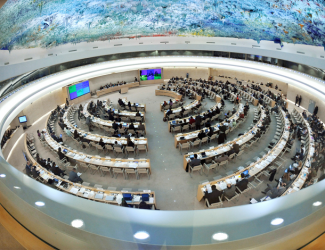
The Human Rights Council (HRC) is the key intergovernmental body within the United Nations system responsible for the promotion and protection of all human rights around the globe. It holds three regular sessions a year: in March, June and September. The Office of the UN High Commissioner for Human Rights (OHCHR) is the secretariat for the HRC.
The HRC works by:
Debating and passing resolutions on global human rights issues and human rights situations in particular countries
Examining complaints from victims of human rights violations or activist organizations on behalf of victims of human rights violations
Appointing independent experts (known as “Special Procedures”) to review human rights violations in specific countries and examine and further global human rights issues
Engaging in discussions with experts and governments on human rights issues
Assessing the human rights records of all UN Member States every four and a half years through the Universal Periodic Review
AWID works with feminist, progressive and human rights partners to share key knowledge, convene civil society dialogues and events, and influence negotiations and outcomes of the session.
With our partners, our work will:
◾️ Monitor, track and analyze anti-rights actors, discourses and strategies and their impact on resolutions
Match up your favourite messages below with these images for Facebook. These messages may also be used on Twitter via private Direct Messages, which don’t have character limits.
Facebook messages for your personal profile
The wait is over! We can all register for the 2016 AWID Forum. So excited to reconnect with fellow activists and re-imagine our feminist futures. See you there, in Brazil!http://forum.awid.org/forum16/
Loving the thought of re-imagining feminist futures with 2,000 people from lots of amazing women's rights and social justice movements at the AWID Forum. Register and meet me in Brazil!http://forum.awid.org/forum16/
Facebook messages for your organization’s page
Registration is now open for the 2016 AWID Forum in Costa do Sauípe, Brazil! This is not just any event - it’s a key space for women’s rights and social justice activists to come together and re-imagine our feminist futures. You won’t want to miss it!http://forum.awid.org/forum16/
Join us at the 2016 AWID Forum in Brazil! Activists and movements from all over the world will come together to celebrate, strategize, inspire and renew ourselves and our collective struggles. Register now!http://forum.awid.org/forum16/
The 2016 AWID Forum will be a historic global gathering of women’s rights and social justice activists and movements. Join us there to break the silos, strengthen solidarity and leverage our collective power. Register now!http://forum.awid.org/forum16/
The 2016 AWID Forum will be a historic global gathering of women’s rights and social justice activists and movements. Join us to celebrate, strategize, inspire and renew ourselves and leverage our collective power. Registration is now open!http://forum.awid.org/forum16/
Avec jusqu'à 2 500 participant·e·s sur place et 3 000 participant·e·s virtuel·e·s/hybrides, il s'agira du plus grand Forum de l'AWID jamais organisé. Nous envisageons de mettre en place de multiples espaces qui vous permettront d'établir des liens significatifs, d'apprendre, d'échanger, d'avoir des échanges stratégiques, de guérir et de fêter. C'est la première fois que nous nous réunissons dans cet espace depuis la pandémie, et nous brûlons d’impatience.
ours chapter 3
Capítulo 3
Discursos anti-derechos
Los discursos anti-derechos continúan evolucionando. Además de utilizar argumentos relacionados con la religión, la cultura y la tradición, los actores antiderechos cooptan el lenguaje de la justicia social y los derechos humanos para ocultar sus verdaderas agendas y ganar legitimidad.
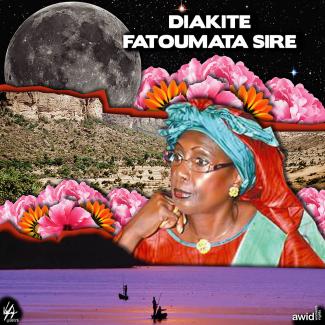
Diakite was actively involved in advocating for women in political and public life in Mali.
She worked to support training of women candidates in elections, and spoke out against the practice of Female Genital Mutilation (FGM). She was a strong proponent of reproductive health and rights.
WITM - Refreshed INFOGRAPHIC 3 FR
Comment les féministes s’autofinancent ?
Les organisations féministes et de défense des droits des femmes ne dépendent pas uniquement des financements institutionnels, elles s’autofinancent. Nos mouvements sont animés par la passion, la solidarité, l’engagement politique et le soin collectif.
Ces ressources autonomes et autogénérées sont souvent invisibles dans les budgets, mais elles sont le pilier de notre action collective.
Pourquoi et comment renouveler votre adhésion de l'AWID
Rencontrez d'autres membres
Nos membres individuel-le-s et institutionnels viennent de 163 pays situés dans TOUTES les régions du monde. Les dernier-ère-s membres à avoir rejoint notre association viennent de l’Inde, du Royaume-Uni, du Sri Lanka et du Kirghizistan. Nos membres contribuent un éventail riche et diversifié de perspectives, d’expériences, de connaissances, d’énergie et d’inspiration !
Connaissez-vous nos profils hebdomadaires de membres ?
En tant que membre de l’AWID, vous pourrez, entre autres avantages, voir votre propre histoire figurer dans la newsletter que nous envoyons à 35,000 abonné-e-s et que nous diffusons par le biais des médias sociaux auprès de 60,000 personnes.
Récemment en vedette :
Rencontrez Angila Ashitua, une jeune femme du comté de Vihiga, situé dans l’ouest du Kenya.
en entrant en contact avec d’autres membres par le biais de notre forum des membres et de notre annuaire en ligne.
en en apprenant davantage sur le travail de l’AWID et sur les questions relatives aux droits des femmes et à la justice sociale grâce à nos publications et ressources, et notamment grâce à notre dernière vidéo en date “Changing Systems, Changing Lives“.(uniquement disponible en anglais).
en prenant part à nos sessions de formation en ligne. Vous pouvez consulter ici les points principaux de notre webinaire sur la Puissance des entreprises et la justice de genre. (uniquement disponible en anglais)
Et bien plus encore !
Vous pouvez renouveler votre adhésion pour une période d’1, 2 ou 3 ans. Nous offrons la possibilité d’une adhésion individuelle ou institutionnelle gratuite à ceux et celles dont les revenus ou budgets sont restreints.
Si vous rencontrez des difficultés lors de votre identification en ligne et avez besoin d’aide, n’hésitez pas à me contacter à l’adresse suivante : membership@awid.org
Les témoignages de nos membre
«Nous trouvons que l’AWID est un réseau particulièrement stimulant et nous nous impliquons dans beaucoup de ses plateformes. » – Engabu Za Tooro (membre institutionnel de l’AWID)
« Je me réjouis d’entamer une collaboration fructueuse avec l’équipe. J’en suis très heureuse. Merci de m’avoir acceptée parmi vos membres. » – R. Chakraborty (membre individuelle de l’AWID)
« Je tiens à remercier infiniment l’AWID ! Vous accomplissez un travail gigantesque. Vos efforts sont grandement appréciés. » – E. Khan (membre individuelle de l’AWID)
Does AWID provide scholarships to attend the Forum?
Our Access Fund will offer a limited number of scholarships to fund the participation of activists who cannot otherwise make it, and don’t have relationships with funders who could cover their participation. So if you have other possibilities, please explore them. We will do our best to offer as many scholarships as we can, and will share more information about this process and how to apply in early 2024.
Résumé : Identifiez les principaux groupes et réfutez leurs arguments
Résumé :
Identifiez les principaux groupes et réfutez leurs arguments
Décideur·se politique à l’ONU, vous souhaitez apprendre à repérer les principaux groupes et discours antidroits au sein de l’institution ? Vous êtes un·e féministe, à la recherche de contre-arguments éclairs ? Ce résumé vous propose les informations essentielles en 8 pages seulement.
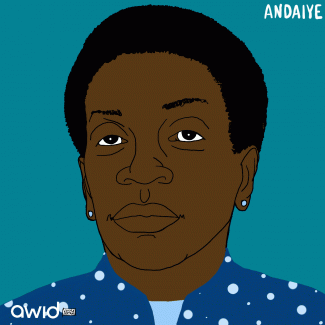
Andaiye in Swahili means ‘a daughter comes home’. Born Sandra Williams on 11 September 1942 in Georgetown, Guyana, she changed her name to ‘Andaiye’ in 1970 as the Black Power movements swept her country and the wider Caribbean region.
Andaiye was seen as a transformative figure on the frontlines of the struggles for liberation and freedom. She was an early member and active in the leadership of the Working People’s Alliance (WPA), a socialist party in Guyana which fought against authoritarian rule and continued throughout her life to focus on justice for the working-class and rural women’s rights and on bridging ethnic barriers between Indo and Afro-Guyanese women.
Andaiye was a founding member of Red Thread Women, an organization that advocated for women’s care work to be fairly remunerated, worked at the University of the West Indies and with CARICOM. Never afraid to challenge governments, she pointed out gender imbalances in state boards, laws that discriminated against sex workers, called for abortion rights in Jamaica and spoke out against trade agreements such as the Caribbean Single Market and Economy (CSME) that allowed for the free movement of women domestic migrant workers but did not give their children the same rights.
Andaiye published several scholarly essays, wrote newspaper columns and also edited the last books of Walter Rodney, the Guyanese political activist and fellow WPA leader, who was assassinated in 1980. A cancer survivor, Andaiye was one of the founders of the Guyana Cancer Society and the Cancer Survivors’ Action Group. She also served on the executive of the Caribbean Association for Feminist Research and Action (CAFRA), as a Director of Help and Shelter and as Board Member of the Guyana National Commission on Women. She received a number of awards, including the Golden Arrow of Achievement in Guyana (the fourth highest national award).
Andaiye passed away on 31 May 2019 at the age of 77. The subsequent tributes that flowed in from activists, friends and those inspired by her life spoke eloquently to her amazing legacy and her beautiful humanity.
Here are but a few:
“Andaiye had a profound effect on me...she was so many things, an educator, fighter, she taught me to be self-critical, to think more clearly, she taught me about survival, about incredible courage, about compassion, about going beyond external appearances and treating people as people and not being distracted by status, class, race...anything.” - Peggy Antrobus, Feminist Activist, Author, Scholar, Barbados
“The kind of confident idealism Andaiye expressed, this willingness to confront the world and a stubborn belief that you could actually change it... That politics of hope...How else to honour her life, legacy and memory but to keep doing the work ethically and with ongoing self-critique? And to put women’s caring work at the center of it.” - Tonya Haynes, Barbados
“I can hear her quip at our collective keening. So through the tears I can laugh. Deep bows to you beloved Andaiye, thank you for everything. Love and light for your spirit’s journey. Tell Walter and all the ancestors howdy.” - Carol Narcisse, Jamaica
Your comprehensive research product is now all organized and edited. You now want to ensure your findings are visually accessible and appealing to facilitate the dissemination.
Consider developing smaller products along with your long report.
As mentioned in the “Synthesize your research findings,” AWID often pulls smaller products from the lengthy research report. This allows for wider and easier distribution specialized for key audiences.
Always keep your targeted population in mind: who will read your report?
Examples of smaller products distilled from a larger report:
Infographics
Online gallery
An animation presenting your arguments
1. Think as your audience thinks
People are bombarded with information constantly. Your product will have to be visually compelling to maintain the interest of your audience. Again, having an idea of what you hope to accomplish and who you hope to reach, will allow the designer to create targeted products.
A lengthy written PDF report may seem the only way to present your research, but it could appear overwhelming to most people – especially online.
If you want to share your product with an online community, think about creating memes and infographics to use on social media, blogs and web platforms.
When deciding whether to create smaller products, consider dividing your results into several smaller products that you could share with targeted populations or at different times of the year to reactivate the interest on your product.
2. Work with a professional designer
If you have limited time and a little bit of budget, we recommend hiring a design firm.
It can be tempting for economic reasons to use in-house staff to package your report. However, a professional graphic designer can make a huge difference on how your final product looks and thus on how much impact it will have!
The designer (in-house or hired) must be able to:
Show you samples of their previous work that is similar to what you seek.
Provide you clear advice on how to present your research based on the content you provide and the audience you are targeting.
Suggest additional or different pieces to package your product.
What the designer will need from you:
A general idea on what you would like the lengthy report to highlight through visuals and graphics (what are the most important pieces of information, the key findings, for example) and some ideas on the types of smaller products you want to create (brochure, an infographic, a series of viral memes, for example). If possible, show the designer examples of similar documents developed by other organizations.
Your budget and time frame.
Your organization’s visual guidelines if you have any (logo, official colours, fonts, etc...).
A few photos copyright free or access to your photo bank if you have one.
Key visuals that need to be included – graphs, tables and other visual graphics drawn from your research.
The designer is a graphic expert. S/he is not necessarily familiar with women’s issues and does not know the results of your research, especially if you hire an external firm.
Communicate what elements of this report is important to you and who is your target. The designer will propose a way to highlight these elements and make the whole piece appealing to your users.
3. Make sure it's consistent
While creating a set of smaller information products, do not forget to link them all together:
A shorter version of the report that focuses only on your final results and recommendations should present a link to the final, full report
A visually compelling infographic that sends a message on the state of funding for your particular research can link to your website and the related section of the full report. It should be associated with a call to share on social media.
A short animation video that uses the data, findings and recommendations from your report should link back to your organization website and social media
A series of viral memes that can be distributed online should link back to your report, infographic, shorter report, etc.
It is also important to keep the research staff involved, so they can ensure any offshoot products stay true to the actual findings of the research.
After the design and packaging of the final research report is complete, if any of the wording of content was changed, be sure to re-send to translators.
If you create smaller products, once designed and packaged, you will also need to get the copy translated for those pieces. The translations should be clear enough so the designer can apply to the design, even if she/he does not speak the language.
Once translated, make sure to have your design proofread by a native speaker before sharing it!
¿Habrá encuentros regionales, temáticos o de otro tipo previos al Foro?
¡Creemos que sí! Todavía estamos en las etapas iniciales del proceso de planificación, así que mantente atentx mientras les vamos dando a estos planes.
Animation: Calling all Feminist Superheroes!
Animation:
Calling all Feminist Superheroes!
Follow our Superhero as she embarks on a quest to reclaim the narrative from anti-rights actors across the globe.
"[Ella] era una persona que se caracterizaba por su arduo trabajo a favor de la defensa de los derechos humanos y la construcción de la paz en Nariño, especialmente en el municipio de Samaniego-Nariño". - Jorge Luis Congacha Yunda para Página10.
Paula Andrea Rosero Ordóñez fue abogada de primera instancia en la oficina del Ministerio Público en Samaniego, Nariño, la principal agencia de defensa de los derechos de la ciudadanía en Colombia.
Paula se especializó en los derechos civiles y políticos, las problemáticas de la impunidad y la justicia, y contribuyó a descubrir abusos de poder, incluida la corrupción. Paula participó también en proyectos para la consolidación de la paz en su ciudad natal, Samaniego, a través del Consejo Municipal de Paz y la Junta Municipal de Mujeres.
Paula recibió amenazas de muerte tras exponer el manejo irregular de los recursos y de denunciar actos de corrupción en el Hospital Lorencita Villegas del municipio nariñense. Fue asesinada el 20 de mayo de 2019, cuando dos hombres se acercaron y le dispararon a corta distancia.