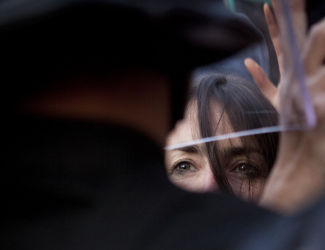
Philippe Leroyer | Flickr (CC BY-NC-ND 2.0)

Special Focus

AWID is an international, feminist, membership organisation committed to achieving gender equality, sustainable development and women’s human rights

Women Human Rights Defenders

WHRDs are self-identified women and lesbian, bisexual, transgender, queer and intersex (LBTQI) people and others who defend rights and are subject to gender-specific risks and threats due to their human rights work and/or as a direct consequence of their gender identity or sexual orientation.

WHRDs are subject to systematic violence and discrimination due to their identities and unyielding struggles for rights, equality and justice.

The WHRD Program collaborates with international and regional partners as well as the AWID membership to raise awareness about these risks and threats, advocate for feminist and holistic measures of protection and safety, and actively promote a culture of self-care and collective well being in our movements.


Risks and threats targeting WHRDs  

WHRDs are exposed to the same types of risks that all other defenders who defend human rights, communities, and the environment face. However, they are also exposed to gender-based violence and gender-specific risks because they challenge existing gender norms within their communities and societies.

By defending rights, WHRDs are at risk of:

  • Physical assault and death
  • Intimidation and harassment, including in online spaces
  • Judicial harassment and criminalization
  • Burnout

A collaborative, holistic approach to safety

We work collaboratively with international and regional networks and our membership

  • to raise awareness about human rights abuses and violations against WHRDs and the systemic violence and discrimination they experience
  • to strengthen protection mechanisms and ensure more effective and timely responses to WHRDs at risk

We work to promote a holistic approach to protection which includes:

  • emphasizing the importance of self-care and collective well being, and recognizing that what care and wellbeing mean may differ across cultures
  • documenting the violations targeting WHRDs using a feminist intersectional perspective;
  • promoting the social recognition and celebration of the work and resilience of WHRDs ; and
  • building civic spaces that are conducive to dismantling structural inequalities without restrictions or obstacles

Our Actions

We aim to contribute to a safer world for WHRDs, their families and communities. We believe that action for rights and justice should not put WHRDs at risk; it should be appreciated and celebrated.

  • Promoting collaboration and coordination among human rights and women’s rights organizations at the international level to  strengthen  responses concerning safety and wellbeing of WHRDs.

  • Supporting regional networks of WHRDs and their organizations, such as the Mesoamerican Initiative for WHRDs and the WHRD Middle East and North Africa  Coalition, in promoting and strengthening collective action for protection - emphasizing the establishment of solidarity and protection networks, the promotion of self-care, and advocacy and mobilization for the safety of WHRDs;

  • Increasing the visibility and recognition of  WHRDs and their struggles, as well as the risks that they encounter by documenting the attacks that they face, and researching, producing, and disseminating information on their struggles, strategies, and challenges:

  • Mobilizing urgent responses of international solidarity for WHRDs at risk through our international and regional networks, and our active membership.

Related Content

Peni Moore

Peni was a radical feminist philosopher, poet, writer, playwright and songwriter.

As the first coordinator for the Fiji Women’s Rights Movement, she left a legacy that was infused with her deep concern for women’s human rights, justice and peace. Peni’s commitment to social, economic and ecological justice and her outstanding work gained local and international respect. She was one of the first in mainstream feminist movements in Fiji to work with, and beside LGBTQI people as a real accomplice, and provided practical assistance to the early Fiji sex worker movement.

Her colleagues described her as a formidable individual and visionary leader for change. She inspired many by her creativity and courage. Her work provided platforms for people to be heard, attain new skills and forge new pathways both at the personal and community level.
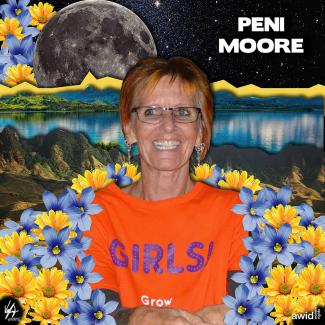
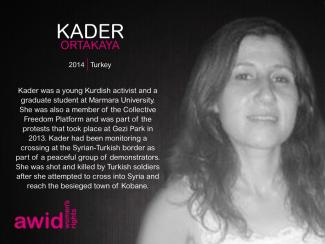
 

Peni Moore, Fiji

Nicole Barakat Snippet EN

Nicole Barakat

Nicole Barakat is a queer femme, SWANA artist born and living on Gadigal Country (so-called Sydney, Australia). She works with deep listening and intuitive processes with intentions to transform the conditions of everyday life. Her work engages unconventional approaches to art-making, creating intricate works that embody the love and patience that characterises traditional textile practices.

Nicole’s Exhibition

¿AWID es una organización feminista?

Membership why page - Loyiso Lindani

I believe empowered women empower women and that is why I’ve had an incredible time being an AWID member. My knowledge and understanding of Feminism and intersectionality has been broadened by the exposure I received being part of the AWID Community Street Team. I hope more women join and share topics and ideas that will help other women.

- Loyiso Lindani, South Africa.

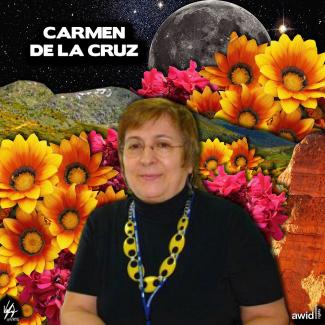
Carmen de la Cruz

Carmen tuvo una larga carrera en la defensa de los derechos de las mujeres tanto en organizaciones no gubernamentales como en el sistema de las Naciones Unidas.

Dio clases en varias universidades españolas y latinoamericanas y publicó numerosos artículos e informes sobre mujeres, género y paz en países en desarrollo. Sus escritos y reflexiones críticas repercutieron en toda una generación de mujeres jóvenes.

En sus últimos años, fue responsable del Área Práctica de Género en el Centro Regional para América Latina del Programa de las Naciones Unidas para el Desarrollo (PNUD), desde donde apoyó iniciativas muy valiosas en favor de la igualdad de género y los derechos humanos de las mujeres.


Carmen de la Cruz, Argentina/ Spain

Nuestras socias

Este proyecto se desarrolla en colaboración con:

Logo for African Women's Development and Communication Network
Logo for Rutgers Center for Women's Global Leadership

L’AWID est-elle une organisation du Nord ou du Sud ?

L’AWID est une organisation mondiale.

Notre travail est de portée internationale. Nous collaborons étroitement avec nos membres et d’autres organisations pour les droits des femmes et autres allié-e-s, tant au niveau local que national et régional. Nous faisons en sorte que leurs réalités nourrissent notre travail.

  • Nous avons des bureaux au Mexique et au Canada.
  • Notre équipe est répartie dans plus de 15 pays aux quatre coins de la planète.
  • Dix des treize membres de notre conseil d’administration proviennent de pays du Sud. 

En savoir plus à propos de l'AWID

Snippet - Intro CSW69_FR

#BloquerLesFascismes

#FreezeFascisms

Depuis l’adoption de la Déclaration et du programme d’action de Beijing il y a 30 ans, les groupes fascistes exercent un pouvoir et une influence croissantes dans les espaces multilatéraux, faisant reculer les acquis en matière d’égalité de genre et de protection des droits humains dans le monde.

À l’approche de la CSW69, nous co-organisons de courageuses initiatives horizontales, sur le terrain et en ligne, pour échanger des stratégies et bâtir un pouvoir féministe au-delà de Beijing+30. Notre présence collective perturbe les mécanismes d’exclusion des institutions dans ces espaces tout en soutenant les mouvements qui s’organisent autour d’alternatives féministes aux systèmes d’oppression.

Participez aux conversations du 10 au 21 mars 2025 pour, collectivement, faire de la CSW69 un espace de résistance et de solidarité.

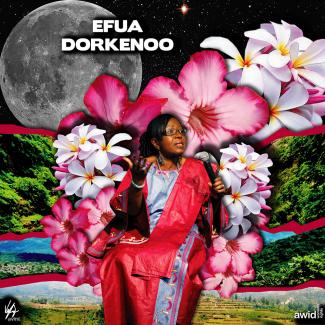
Efua Dorkenoo

Affectueusement connue sous le nom de « Mama Efua », Efua a lutté contre les mutilations génitales féminines (MGF) pendant trois décennies et a contribué à attirer l'attention et l'action de la communauté internationale pour mettre fin à cette pratique néfaste.

En 1983, Efua a cofondé FORWARD (fondation pour la santé, la recherche et le développement des femmes), qui est devenue une organisation de premier plan dans la lutte contre les MGF. Son livre intitulé « Cutting the Rose: Female Genital Mutilation »  (couper la rose), publié en 1994, est considéré comme le premier ouvrage sur les mutilations génitales féminines. Il figure parmi « Les 100 meilleurs livres africains du XXe siècle » de l’Université de Columbia.

Originaire du Ghana et infirmière de formation, Efua a rejoint l'OMS en 1995 et a réussi à faire en sorte que les mutilations génitales féminines fassent partie des agendas politiques des États membres de l'OMS. Elle a également travaillé en étroite collaboration avec le gouvernement nigérian pour élaborer une politique nationale globale qui servirait de base légale aux lois nigérianes contre les mutilations et qui est toujours en vigueur à ce jour.

Son travail de pionnière a abouti à une campagne menée par l'Afrique intitulée « The Girl Generation », qui s'est engagée à mettre fin aux MGF en une génération. Efua a montré comment une seule personne peut devenir la voix unificatrice d'un mouvement : « Une identité partagée peut aider à rassembler des activistes d'horizons différents dans un but commun ». Ces mots, emplis de sagesse, sont plus pertinents que jamais.


Efua Dorkenoo, Ghana

Snippet The revolution will be feminist_Fest (FR)

Session plénière:

La révolution sera féministe — ou il n’y aura pas de révolution

Manal Tamimi Palestine
Bubulina Moreno, Colombia
Karolina Więckiewicz, Poland
Anwulika Ngozi Okonjo, Nigeria

Regardez la vidéo (anglais)


I have written a paper about an issue related to Women’s Rights and Development. How can I share it with AWID’s members?

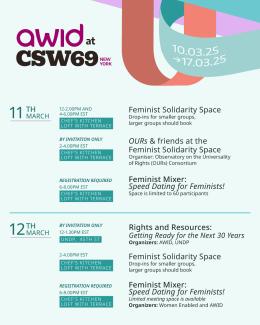
Snippet - CSW69 - Full Calendar - EN

This image shows a full list of AWID at CSW69 activities

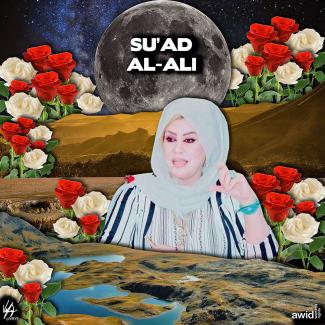
Su’ad Al-Ali

Su’ad was a strong advocate of women’s and children’s rights, and was the head of Al-Weed Al-Alaiami - an Iraqi human rights organisation.

She participated in the July 2018 demonstrations that took place in Basra and several other Iraqi cities protesting unemployment and demanding jobs and proper public services for citizens, as well as calling for the elimination of rampant corruption.

On 25 September 2018, Su’ad was assassinated in the Al-Abbasiyah district in downtown Basra. A video of the incident showed a person approaching her as she was getting into her car, firing a bullet at the back of her head and pointing another bullet at her driver Hussain Hassan, who was injured in the shoulder. Al-Ali was 46 and the mother of four children.


Su'ad Al Ali, Iraq

Snippet Elimination of Discrimination_Fest (EN)

The Elimination of Discrimination Against Sex Workers

Kay Thi Win, Asia Pacific Network of Sex Workers (APNSW)
Thin Pa Pa Htun, Aye Myanmar Association
Xiao Shuang, Northeast Transgender Support Network
Cathy Ketepa, Friends Frangipani Inc. PNG
Rajeshwari Prajapati, Society for Women Awareness Nepal (SWAN)

watch panel

2003: se celebra el primer Diálogo de Alto Nivel

Primer Diálogo de Alto Nivel sobre la Financiación para el Desarrollo, 29 y 30 de octubre de 2003

Uno de los mecanismos de seguimiento de la Conferencia de Monterrey fueron los Diálogos de Alto Nivel sobre la Financiación para el Desarrollo organizados cada dos años por la Asamblea General de la ONU. En total, ya se realizaron ocho mesas redondas en las que se ha continuado el Diálogo acerca de distintos temas como los subsidios a la agricultura, el comercio, el alivio de la deuda y la financiación para los ODM. En todas ellas se prestó especial atención a los obstáculos estructurales que colocan en desventaja a las naciones ‘en desarrollo’.

Otros mecanismos de seguimiento a Monterrey son los siguientes:

  • La reunión especial de alto nivel organizada por el Consejo Económico y Social de la ONU (ECOSOC) que se realiza cada año, bajo liderazgo del Banco Mundial, el Fondo Monetario Internacional, la Organización Mundial del Comercio y la UNCTAD (Conferencia de las Naciones Unidas sobre Comercio y Desarrollo) como seguimiento al Consenso de Monterrey. El ECOSOC también dedica hasta dos días para deliberar sobre los temas de la agenda de la FpD durante su sesión sustantiva.
  • El Comité de Expertos sobre la Cooperación Internacional en Materia Fiscal, que es el órgano de la ONU especializado en el tema impositivo, se ocupa de los distintos aspectos de las políticas fiscales identificados en el Consenso de Monterrey y aporta un marco para el diálogo que permita mejorar y promover la cooperación internacional en cuestiones tributarias entre autoridades nacionales del área fiscal.

Snippet - CSW69 On anti-rights resistance - EN

On anti-rights resistance