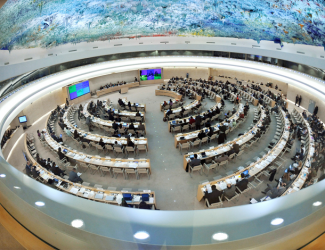

Jean-Marc Ferré | Flickr (CC BY-NC-ND 2.0)
A general view of participants at the 16th session of the Human Rights Council in Geneva, Switzerland.

Special Focus

AWID is an international, feminist, membership organisation committed to achieving gender equality, sustainable development and women’s human rights

Human Rights Council (HRC)

The Human Rights Council (HRC) is the key intergovernmental body within the United Nations system responsible for the promotion and protection of all human rights around the globe. It holds three regular sessions a year: in March, June and September. The Office of the UN High Commissioner for Human Rights (OHCHR) is the secretariat for the HRC.

The HRC works by:

  • Debating and passing resolutions on global human rights issues and human rights situations in particular countries

  • Examining complaints from victims of human rights violations or activist organizations on behalf of victims of human rights violations

  • Appointing independent experts (known as “Special Procedures”) to review human rights violations in specific countries and examine and further global human rights issues

  • Engaging in discussions with experts and governments on human rights issues

  • Assessing the human rights records of all UN Member States every four and a half years through the Universal Periodic Review

Learn more about the HRC


AWID works with feminist, progressive and human rights partners to share key knowledge, convene civil society dialogues and events, and influence negotiations and outcomes of the session.

With our partners, our work will:

◾️ Monitor, track and analyze anti-rights actors, discourses and strategies and their impact on resolutions

◾️ Raise awareness of the findings of the 2017 and 2021 OURs Trends Reports.

◾️Support the work of feminist UN experts in the face of backlash and pressure

◾️Advocate for state accountability
 
◾️ Work with feminist movements and civil society organizations to advance rights related to gender and sexuality.
 

Related Content

Snippet - WCFM type of funding- EN

Type of funding:

Be it core funding, programmes & projects or rapid response/ emergency grants.

Ȃurea Mouzinho

Biography

Ȃurea Mouzinho is a feminist economic justice organizer from Luanda, Angola, with a 10-year career in research, grant-making, advocacy, and movement-building for women's rights and economic justice across Africa and the global south. Currently the Program Manager for Africa at Thousand Currents, she also serves on the Feminist Africa Editorial Board and is a member of Ondjango Feminista, a feminist collective she co-founded in 2016. A new mom to a Gemini boy, Ȃurea enjoys slow days with her young family and taking long strolls by the beach.

She occasionally tweets at @kitondowe.

Add to stories
Off

Snippet Stories of Change Full - Download (EN)

Doris Valenzuela Angulo

Doris Valenzuela Angulo était une activiste sociale, leader et défenseure des droits humains afrodescendante de Buenaventura, en Colombie. Elle faisait partie du réseau national Comunidades Construyendo Paz en Colombia (CONPAZ, Communautés construisant la paix en Colombie) composé d’organisations présentes dans les communautés affectées par le conflit armé œuvrant en faveur de la non-violence et la justice socio-environnementale.

Doris s’opposait à la violence paramilitaire continue, aux pressions incessantes des mégaprojets cherchant à déplacer sa communauté, et à la complicité de  l’État. Confrontée à l’un des contextes les plus difficiles de son pays, elle joua un rôle de premier plan dans l’initiative de résistance non-violente sans précédent Espacio Humanitario Puente Nayero, un lieu urbain conçu pour assurer la cohésion communautaire, la sécurité, la créativité et l’action collective. 

Ce combat non-violent unique en son genre des familles de l’Espacio Humanitario Puente Nayero attira l’attention et le soutien des agences tant locales qu’internationales. En septembre 2014, la Commission interaméricaine des droits de l’Homme accorda des mesures de protection préventives à la communauté, ordonnant au gouvernement colombien d’adopter des mesures nécessaires en vue de protéger la vie et l’intégrité physique des habitant·e·s. Les menaces et la violence des paramilitaires se poursuivirent néanmoins. Malgré l’assassinat de son fils Cristian Dainer Aragón Valenzuela en juillet 2015,Doris continua à mettre toute son énergie à éviter le recrutement forcé des enfants et des jeunes par les néo-militaires. Elle devint alors également une cible, recevant constamment des menaces pour son activisme et le travail qu’elle accomplissait.

Les incessantes agressions et menaces de mort dont elle était l’objet forcèrent Doris à quitter la Colombie. Elle vécut en Espagne de février 2017 à février 2018, dans le cadre du programme de protection temporaire d’Amnesty International pour les défenseur·e·s des droits humains en danger.

Doris a été assassinée en avril 2018 à Murcie, en Espagne, par son ex-compagnon. Elle n’avait que 39 ans. 


Hommages :

« Doris, cette année passée avec toi nous a montré combien une personne peut avoir la capacité de transformer et créer de l’espoir en dépit des événements profondément négatifs et dévastateurs qui jalonnent sa vie... Nous poursuivons notre engagement à défendre tous les droits humains. Ton courage et ta lumière nous guideront toujours. » - Montserrat Román, Amnesty International, Groupe de La Palma, Espagne

Extrait de « Mots pour Doris Valenzuela Angulo », d’Elsa López

« ... Tu le savais. Tu l’as toujours su. Et malgré tout cela, tu as résisté sans faillir à tant d’injustice, de misère, de persécution. Tu t’es élevée, fière et acharnée, contre ceux qui continuaient à vouloir que tu abandonnes tout espoir, que tu t’abaisses, que tu te rendes. Debout, tu as réclamé haut et fort ta liberté et la nôtre, qui était la tienne. Rien ni personne n’est parvenu à paralyser tes efforts pour changer le monde et le rendre plus généreux et plus vivable. Tu vis parmi nous, aujourd’hui plus vivante que jamais malgré la mort. Tu vis encore par tes actes, par ton courage, par ta grandeur lorsque tu pleurais pour cette terre promise que tu invoquais à chacun de tes cris, pour tous ces déserts que tu as habités. Toi. Toujours en vie. Doris Valenzuela Angulo.
Ce ne sont que des mots. Je sais. Je le sais, moi aussi. Mais les mots nous unissent, nous protègent, nous donnent la force et le soutien nécessaires pour continuer à aller vers la lumière que tu défendais tant... »
FRMag - Dieula and the Black Dolls

Dieula y las Muñecas Negras

por Ana María Belique

El Batey Naranjo es una comunidad un poco retirada de la ciudad, pero repleta de personas trabajadoras, llenas de entusiasmo. (...)

Leer

< arte: «Tejedoras de sueños», Diana Mar

Community knowledge to build just futures

Context

Today, many community knowledge systems are at risk.

Fast-paced economic, political, and cultural changes are bulldozing environments, practices and livelihoods. Various forms of knowledge are being erased from practice, commodified and colonized in the massive swallow of globalisation and in the promise of short-term gains or band aid solutions.

Definition

Buen Vivir, a concept adapted from Andean Indigenous peoples’ knowledges, is described as the collective achievement of a life in fulfillment, based
on harmonic and balanced relations among human beings and all living beings, in reciprocity and complementarity. It means acknowledging that human beings are a part
of nature, we depend on nature and are inter-dependent among ourselves.

Inherent in Buen Vivir is a vision that integrates production and reproduction as inseparable processes of the economy, of wealth production and living conditions.

Feminist perspective

In this sense, a broad understanding of Buen vivir from a feminist lens values relationships and resources mobilized in production and reproduction cycles—favouring equilibrium of not just the market kind—to guarantee continuity and changes as long as they are compatible with economic justice and life sustainability.

From a feminist perspective there have also been criticisms of the binary conceptions of gender and complementary of men and women. Binary conceptions leave little space for a deeper discussion on heteropatriarchy and non-conforming gender relationships.

Nevertheless, one of the main contributions of centralizing the principle of Buen Vivir to political, economic and social frameworks, is that equality is no longer the paradigm of individual rights, but the transformation of society as a whole.


Learn more about this proposition:

Part of our series of


  Feminist Propositions for a Just Economy

Clone of Snippet FEA Title Menu (ES)

Las Economías Feministas

QUE AMAMOS

ECONOMIAS DE CUIDADOSAGROECOLOGÍA Y SOBERANÍA ALIMENTARIACOOPERATIVISMO FEMINISTASINDICALISMO FEMINISTA

Simone Jagger

Biography

Simone a 20 ans d’expérience dans le soutien à la gestion et l’administration dans des organisations à but non lucratif, en particulier dans l’enseignement médical post universitaire et la formation aux Technologies de l'Information et de la Communication. Elle possède des qualifications en soutien à la gestion et en études parajuridiques. Elle est basée en Afrique du Sud, aime voyager et agit en tant que généalogiste amatrice.

Position
Assistante Exécutive
Add to stories
Off

Snippet Forum Quoate Sara Abu (ES)

El Foro es un ejemplo vivo de lo que el más grande NOSOTRXS podemos hacer. Vamos al Foro, somos semillas, luego nos sembramos. Esto lo tenemos que celebrar.
- Sara Abu Ghazal, Líbano

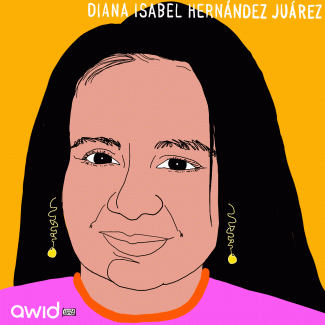
Diana Isabel Hernández Juárez

Diana Isabel Hernández Juárez was a Guatemalan teacher, human rights defender and environmental and community activist. She was the coordinator of the environmental program at Our Lady of Guadalupe Parish on the South coast of the country. 

Diana dedicated her life to co-creating environmental awareness, working especially closely with local communities to address environmental issues and protect natural resources. She initiated projects such as forest nurseries, municipal farms, family gardens and clean-up campaigns. She was active in reforestation programmes, trying to recover native species and address water shortages, in more than 32 rural communities.

On 7 September 2019, Diana was shot and killed by two unknown gunmen while she was participating in a procession in her hometown. Diana was only 35 years old at the time of her death.
 

Film club - Films from Nuestramérica

Notre programme final du Feminist Film Club est maintenant disponible: « Films from Nuestramérica » est une série de films sur les réalités féministes d'Amérique latine et d'Amérique centrale organisée par Alejandra Laprea (Venezuela).

Regardez

Feminist Alternatives Project

As feminists many of us feel frustrated as we lurch from one political ‘moment’ to another; our work constrained by the parameters of organisational mandates, funding trends or political agendas, our time spent arguing over the need for gender analysis rather than building alliances for change.


The Gender & Development Network’s project on Feminist Alternatives provides space to consider what is important, to listen deeply to others and to accept challenges to our assumptions. Transformative progress towards feminist societies requires fundamental change that is context-specific, recognising intersectionality, the multiplicity of feminism, and the pivotal role of women’s collective action.

Rather than attempt to write a single paper, we have therefore produced a collection of thought pieces from academics, activists and practitioners around the world – not to suggest that we have the answers, but rather to encourage and provoke debate with the hope that more articles can be added in the future.

We are delighted to link our collection to AWID’s Feminist Propositions for a Just Economy.

Find out more about the Feminist Alternative project

WITM - Refreshed INFOGRAPHIC 1 ES

¿Alguna vez te preguntaste cómo  son los presupuestos de las organizaciones feministas?

En 2023, las organizaciones feministas y por los derechos de las mujeres tenían un presupuesto anual promedio de USD 22.000. Detrás de ese promedio se esconde la disparidad y la desigualdad: mientras que algunos grupos acceden a recursos a gran escala, la gran mayoría apenas sobrevive con presupuestos muy ajustados.
Una mirada más detallada a los presupuestos reales revela gran diversidad y desigualdad de ingresos. 

Consulta los datos sobre el tamaño de los presupuestos feministas

Nana Abuelsoud

Biography

Nana is a feminist organizer and a reproductive rights and population policy researcher based in Egypt. She is a member of Realizing Sexual and Reproductive Justice (RESURJ), a member of the Advisory Board of the A Project in Lebanon, and a member of the Community Committee of Mama Cash. Nana holds an MSc in Public Health from KIT Institute and Vrije University in Amsterdam. In her work, she follows and contextualizes national population policies while building evidence that addresses modern eugenics, regressive international aid, and authoritarianism. Previously, she was part of the Geneva Foundation for Medical Education and Research, the Egyptian Initiative for Personal Rights, and Ikhtyar Feminist Collective in Cairo.

Add to stories
Off

Qu'est-ce que le Forum international de l'AWID ?

Le Forum international de l’AWID est un événement phare que l’association organise tous les trois ou quatre ans. C'est la plus importante manifestation au monde entièrement consacrée aux mouvements féministes et de justice de genre dans toute leur diversité. Il s'agit d'un rassemblement mondial qui réunit activistes féministes, mouvements alliés, universitaires, bailleurs de fonds et décideur·e·s politiques. Les forums se tiennent successivement dans différentes régions et différents pays du sud mondial.

Jaitun

Jaitun, comúnmente conocida como «Amma», estaba comprometida con garantizar los derechos reproductivos de las mujeres y niñas de India. Se dedicó, particularmente, a abogar por quienes viven en la pobreza y son más marginadas, incluidas las mujeres y niñas dalit y musulmanas.

Jaitun fue la fuerza vital detrás del caso Jaitun versus Janpura Maternity Home & Ors. Su perseverancia por la justicia llevó a que la Corte Suprema de Delhi emitiera una sentencia innovadora, que obligó al gobierno indio a hacerse responsable del incumplimiento de cierto número de obligaciones legalmente vinculantes, tales como la atención a la salud reproductiva y el derecho a la alimentación.

A su hija Fatema, quien vivía por debajo de la línea de pobreza, se le negaron los servicios reproductivos, y tuvo que dar a luz en público, bajo un árbol. En ese momento, tanto Jaitun como Fatema estaban en situación de calle, ya que su casa había sido demolida por el gobierno como parte del programa de reurbanización y gentrificación de Nueva Delhi.

«Desde entonces, esta sentencia ha sido utilizada por innumerables abogadxs y activistas de todo el mundo, incluyendo al ex-Relator Especial de la ONU sobre el derecho a la salud, no solamente como fuente de inspiración, sino como una sólida plataforma para promover la justicia.» - Jameen Kaur

Jaitun ha sido una inspiración para que muchas otras mujeres que viven en la pobreza reclamen sus derechos. Falleció en 2017.

«Con la muerte de Jaitun, hemos perdido una incomparable guerrera de la justicia, pero su espíritu de desafío pervive.» -Jameen Kaur

«En mis dieciocho años como defensora de los derechos humanos, nunca he encontrado una mujer que me inspirara ni que conmoviera mi espíritu de la forma en que lo hacía Amma. Su sonora valentía, su inimitable humor (solíamos compararla con la actriz de Bollywood, Hema Melini) cuando se sentía molesta porque habíamos pasado tanto tiempo lejos de ella... con un brillo en los ojos, decía “Ustedes se han olvidado de Amma, Amma ahora no les habla”, y luego con gran dramatismo se ponía de espaldas para darse vuelta enseguida riendo y estirando los brazos para un abrazo. Su bondad y, en definitiva, su amor y su alegría por el amor y el derecho de todxs nosotrxs a vivir con dignidad. La extraño terriblemente.» - Jameen Kaur

Feminist film club - holding up the skies

Check out the AWID Feminist Film Club program “Holding up the Skies” - a film series on Feminist Realities from Africa and the African Diaspora curated by Gabrielle Tesfaye

WATCH