Organizing creatively, facing an increasing threat
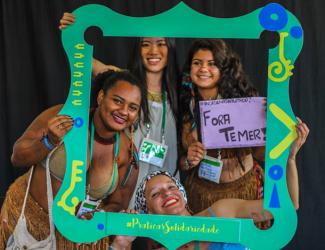
Young feminist activists play a critical role in women’s rights organizations and movements worldwide by bringing up new issues that feminists face today. Their strength, creativity and adaptability are vital to the sustainability of feminist organizing.
At the same time, they face specific impediments to their activism such as limited access to funding and support, lack of capacity-building opportunities, and a significant increase of attacks on young women human rights defenders. This creates a lack of visibility that makes more difficult their inclusion and effective participation within women’s rights movements.
A multigenerational approach
AWID’s young feminist activism program was created to make sure the voices of young women are heard and reflected in feminist discourse. We want to ensure that young feminists have better access to funding, capacity-building opportunities and international processes. In addition to supporting young feminists directly, we are also working with women’s rights activists of all ages on practical models and strategies for effective multigenerational organizing.
Our Actions
We want young feminist activists to play a role in decision-making affecting their rights by:
Fostering community and sharing information through the Young Feminist Wire. Recognizing the importance of online media for the work of young feminists, our team launched the Young Feminist Wire in May 2010 to share information, build capacity through online webinars and e-discussions, and encourage community building.
Researching and building knowledge on young feminist activism, to increase the visibility and impact of young feminist activism within and across women’s rights movements and other key actors such as donors.
Promoting more effective multigenerational organizing, exploring better ways to work together.
Supporting young feminists to engage in global development processes such as those within the United Nations
Collaboration across all of AWID’s priority areas, including the Forum, to ensure young feminists’ key contributions, perspectives, needs and activism are reflected in debates, policies and programs affecting them.
Related Content
#MeToo in China
The #MeToo movement in China was ignited in January 2018, impelled by the momentum of the #MeToo movement around the globe. The movement was a response to cultural and systemic problems in relation to gender and power within China. The foundation of the movement was laid over decades, with many years of debate and advocacy for gender equality finally erupting into a tremendous force across society. #MeToo has been driven mainly by young people, among whom are countless anonymous women and their allies, and they search for opportunities to realize the ultimate “Chinese Dream”: to transform China into a country with gender equality.
The environment for #MeToo movement is extremely adverse in China: the rule of law, the fairness and transparency of government action, and freedom of speech cannot be taken for granted by the movement in China but are the very goals it fights for. From the beginning, it has been an intense struggle, with every victim or activist who comes forward running tremendous risks. From being silenced, humiliated, or retaliated against, to having their safety jeopardized, every success of the #MeToo movement has been won by those who are courageous enough to bear the costs of speaking out and defying censorship.
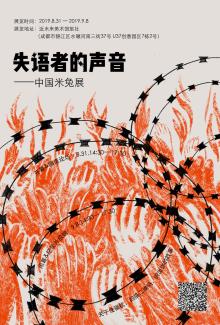
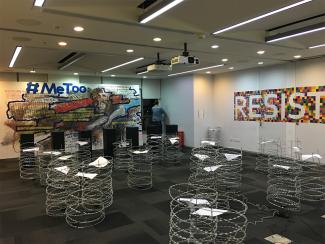
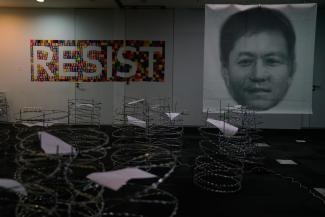
#MeToo in China Exhibition was first held in 2019 and toured in 5 cities. The aim of the exhibition is to bring the personal experiences of the victims and activists to greater prominence and, through engagement with these stories, to inspire our audience to join in the fight. The exhibition has itself become a part of the #MeToo struggle—the exhibition has been beset by challenges on its tour throughout China, on more than one occasion even facing closure.
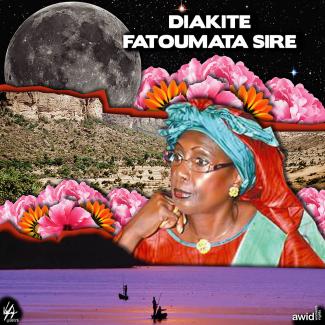
Diakite s'est activement impliquée dans la défense des femmes dans la vie politique et publique au Mali.
Elle a travaillé pour soutenir la formation des candidates aux élections et s'est élevée contre les mutilations génitales féminines (MGF). Elle était un ardente défenseure de la santé et des droits reproductifs.
Liberar a la Iglesia, descolonizar la Biblia para las mujeres de Papúa Occidental
por Rode Wanimbo
«Señor, somos indignas. Somos las que pecaron, porque Eva comió el fruto en el Edén. Solo somos mujeres que cultivan batatas, cuidan cerdos y dan a luz niñxs. Creemos que tú moriste en la cruz para liberarnos. Gracias, en el nombre de Jesús, amén». (...)
< arte: «Offerings for Black Life» [Ofrendas para las vidas negras], Sokari Ekine
Nicole Barakat
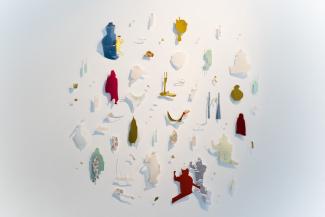
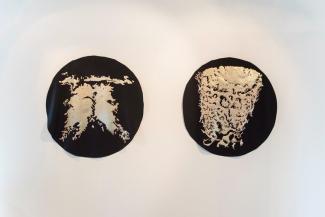
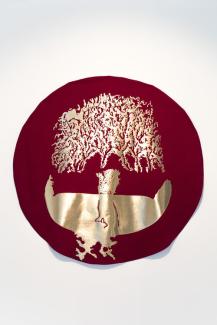
“We transcend time and place” [«Trascendemos el tiempo y el lugar»], papel recuperado cortado a mano (2017)“We will remember who we are and we will persist” [«Recordaremos quiénes somos y persistiremos»], lamé cortado a mano bordado en algodón sobre seda de lana (2018)“We will return home” [«Regresaremos a casa»], lamé cortado a mano bordado en seda sobre terciopelo de algodón (2018)“We will heal in the now” [«Sanaremos en el ahora»], seda cortada a mano, lana, lamé, algodón, impresión digital directa de satén sobre tela de lino (2018)
somos infinitxs
Una exposición de Nicole Barakat que encarna su reconexión con los objetos de la diáspora de sus tierras ancestrales en la región del Sudoeste Asiático y África del Norte (SWANA, por sus siglas en inglés).
Barakat presenta una colección de obras textiles como manifestaciones de su práctica de conectarse con los objetos desplazados, y a menudo robados, que son exhibidos en colecciones de museos occidentales que incluyen el Museo del Louvre de París, el Museo Británico de Londres y el Nicholson Museum de Sydney.
Para burlar a los guardianes y fisurar las vitrinas que retienen estos objetos ancestrales, Barakat recupera formas de conocimiento precoloniales, no lineales y receptivas que son, a menudo, devaluadas y desestimadas por las instituciones coloniales y patriarcales, utilizando la adivinación con la borra del café, el trabajo con los sueños, la escucha intuitiva y las conversaciones con los objetos mismos (fuente).
Sobre Nicole Barakat
Nicole Barakat es una artista femme queer de SWANA, que nació y vive en las tierras de Gadigal (llamadas Sydney) en Australia. Trabaja con procesos intuitivos y de escucha profunda, con la intención de transformar las condiciones de la vida cotidiana. Su obra se desarrolla a través de métodos artísticos no convencionales, creando objetos intrincados que plasman el amor y la paciencia característicos de las prácticas textiles tradicionales.
Sus trabajos incluyen dibujos en papel y en tela cortados y cosidos a mano, esculturas realizadas con su propio cabello, tela y materiales vegetales, así como obras en vivo en las que utiliza su voz como material.
La práctica creativa de Nicole está arraigada en el re-cuerdo y la re-colección de sus conocimientos ancestrales, incluyendo la adivinación con la borra del café y, más recientemente, el trabajo con esencias de plantas y flores para el cuidado y la sanación comunitaria.
Nicole’s creative practice is rooted in re-membering and re-gathering her ancestral knowing, including coffee divination and more recently working with plants and flower essences for community care and healing.
« Andaiye » signifie « une fille revient à la maison » en swahili. Née Sandra Williams le 11 septembre 1942 à Georgetown, Guyane, Andaiye adopte ce nouveau nom en 1970 alors que le mouvement des Black Panthers balaie son pays et toute la région des Caraïbes.
Perçue comme une figure transformatrice sur les fronts de la lutte pour la libération et pour la liberté, Andaiye a été l’une des premières membres de l’Alliance du peuple travailleur (WPA), un parti socialiste en Guyane de lutte contre le régime autoritaire et participait activement à sa direction. Tout au long de sa vie, Andaiye a placé la justice pour la classe ouvrière et les droits des femmes vivant en milieu rural au centre de son action militante, et s’est battue pour l’élimination des obstacles ethniques entre les femmes indo-guyaniennes et celles afro-guyaniennes.
Andaiye fut l’une des membres fondatrices des Red Thread Women, une organisation de défense pour la juste rémunération du travail en soins réalisé par les femmes, en plus d’avoir travaillé à l’Université des Indes occidentales et avec l’organisation CARICOM. N’hésitant jamais à défier les gouvernements, elle a pointé du doigt les déséquilibres en matière de genre dans les conseils de l’État, les lois discriminatoires à l’égard des travailleur·euse·s du sexe, réclamé le droit à l’avortement en Jamaïque et s’est érigée contre les accords commerciaux, tels que le Marché unique des Caraïbes (CSME) qui permettait la libre circulation des travailleuses domestiques migrantes mais n’octroyait pas ce même droit à leurs enfants.
Elle a publié plusieurs essais universitaires, rédigé des articles d’opinion et révisé les derniers ouvrages de Walter Rodney, l’activiste politique guyanien et coleader du WPA assassiné en 1980. Survivante du cancer, Andaiye a été l’une des fondatrices de la Ligue guyanienne contre le cancer et du Groupe d’action des survivant·e·s du cancer. Elle a également siégé au conseil exécutif de l’Association caribéenne pour la recherche et l’action féministes (CAFRA), dirigé le Help and Shelter et été membre du conseil de la Commission nationale guyanienne pour les femmes. Elle a par ailleurs reçu de nombreux prix, dont le prestigieux Golden Arrow of Achievement (quatrième prix le plus important du Guyana).
Andaiye est décédée le 31 mai 2019, à l’âge de 77 ans. Les nombreux hommages que lui ont rendus des activistes, ami·e·s et celles et ceux que sa vie aura inspiré·e·s ont parlé avec éloquence de son incroyable héritage et de la grandeur de son humanité.
En voici quelques-uns :
“« Andaiye m’a profondément marquée... elle représenttait tellement de choses pour moi : une éducatrice, une combattante, elle m’a appris l’autocritique, à réfléchir plus clairement, elle m’a enseigné la survie, ce qu’est le courage sans limite, la compassion, à dépasser les apparences et traiter les gens comme des gens, sans se laisser impressionner par le statut, la classe, la race... rien de tout ça. » Peggy Antrobus, activiste féministe, auteure, universitaire, La Barbade
« Le genre d’idéalisme confiant que démontrait Andaiye, cette disposition à affronter le monde et une croyance tenace qu’on pouvait vraiment le changer... Cette politique de l’espoir... Comment honorer sa vie, son héritage et sa mémoire autrement qu’en poursuivant le travail éthiquement et en continuant à s’autocritiquer? Et de faire en sorte de placer le travail de soins des femmes au centre. » - Tonya Haynes, La Barbade
« Je peux l’entendre se moquer de notre engouement collectif. Donc, je ris tout en pleurant. Chapeau bas, chère Andaiye, et merci pour tout. Que le voyage de ton esprit soit aimant et lumineux. Passe le bonjour à Walter et aux ancêtres. » - Carol Narcisse, La Jamaïque
Nous sommes ravi.es d'annoncer le lancement du nouveau podcast de l'AWID, NOTRE FLAMME FÉMINISTE. Notre série narrative dévoile plus de 40 ans de mouvements féministes et réinvente une voie à suivre.
Dans notre saison pilote, vous entendrez cinq histoires captivantes qui font partie d'une constellation d'activisme féministe aujourd'hui. Animé par Gopika Bashi,notre directrice adjointe des programmes à l'AWID, chaque épisode explore des réalités féministes uniques mais interconnectées qui améliorent la justice de genre et les droits humains.
Produit par notre partenaire de podcast Webby Hueman Group Media, vous pouvez vous abonner à NOTRE FLAMME FÉMINISTE et écouter notre premier épisode ici.
Retrouvez-nous sur Apple Podcasts, Spotify ou partout où vous obtenez vos podcasts. Partagez avec votre réseau ! Aidez-nous à diffuser des histoires qui allument notre feu féministe et nous poussent à l'action.
illustration : « Guérir ensemble », par Upasana Agarwal >
Les tendances antidroits au sein des systèmes régionaux des droits humains
Chapter 6
À la Commission africaine et au Système interaméricain, les antidroits promeuvent les notions essentialistes de culture et de genre pour miner les avancées en matière de droits et décrédibiliser la redevabilité. Les antidroits gagnent en influence dans les systèmes de protection des droits humains régionaux et internationaux.
La Commission africaine des droits de l’Homme et des peuples commence à présenter les droits des femmes et droits sexuels comme mettant en danger sa capacité à adresser les « droits réels » et contraires aux « valeurs africaines », un précédent inquiétant à l’égard des droits. Le retrait de son statut d’observatrice à la Coalition des lesbiennes africaines est un exemple de cette tendance, et traduit la répression de l’engagement féministe panafricaniste.
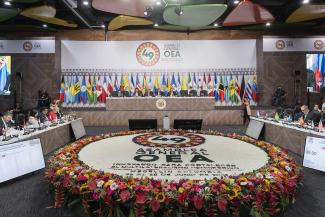
Au sein de l’Organisation des États américains (OEA) et du Système interaméricain de protection des droits humains, les stratégies antidroits incluent l’ONGisation de groupes religieux, l’adoption d’un langage séculier et la prise de contrôle de cadres discriminatoires. L’influence antidroits a pris plusieurs formes, et notamment l’intimidation d’activistes trans et l’entrave à l’introduction d’un langage progressif dans les résolutions.
Sommaire
Réduire les féministes au silence au sein du Système africain de protection des droits humains
Les groupes antidroits en Amérique latine : l’Assemblée générale de l’Organisation des États américains (OEA) et le Système interaméricain de protection des droits humains
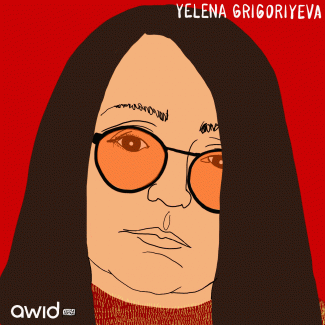
Yelena Grigoriyeva, often called Lena by friends, was a prominent LGBT rights campaigner in Russia.
She was part of democratic, anti-war and LGBT movements. In her activism, Yelena was a fierce critic of President Vladimir Putin and his administration, expressing her opposition against Russia’s annexation of Ukraine’s Crimea peninsula and the ill-treatment of prisoners.
Yelena came out as bisexual earlier in 2019.
"Her coming out was a surprise to me, and I didn't approve of it. I told her 'Listen, Lena, you already have a target painted on you because of your political activity. You've just pinned another to your chest." - Olga Smirnova
Yelena did receive multiple death threats and according to some of her acquaintances, was listed on a homophobic website that called on its visitors to hunt down LGBT persons. She reported the threats to the police, however the Russian state failed to provide protection.
But even in a society where political opposition, as well as members of the LGBT community and advocates for their rights, face continuous and increasing violence, Yelena kept campaigning for social justice and equality.
“She did not miss a single action. And they detained her so often that I already lost count,”
- Olga Smirnova (fellow opposition activist and friend).
Yelena was murdered on 21 July 2019, not far from home. A suspect was arrested but according to some sources, many friends and fellow activists believe that the suspect is a scapegoat and that this was a targeted political killing.
For Yelena’s relatives and friends, her case remains unsolved even though the suspect confessed.
In 2013, Russia passed legislation banning the spreading of what it described as ‘gay propaganda’. In 2014, Human Rights Watch published a report relating to this.
📅 Miércoles 12 de marzo de 2025
🕒 De 12:00 a 01:30 pm, EST
🏢 PNUD, 304 E 45th St. Doha Room, 11th Floor (FF Building)
Organizan: PNUD, Femena, SRI y AWID
Snippet Forum Stories Gen Intro (ES)
¿Qué significa un Foro de AWID para las personas que estuvieron ahí? ¿Qué es esta magia que sucede cuando feministas de todo el mundo se reúnen para celebrar, elaborar estrategias, aprender y compartir la alegría?
AWID habló con más de cuarenta participantes del Foro para oír sus historias de las transformaciones que experimentaron ellxs mismxs como activistas, y que también cambiaron a sus organizaciones y a los movimientos a los que pertenecen. También aprendimos sobre qué cosas deberíamos mantener y desarrollar para que un Foro de AWID sea diferente, y de qué manera podemos mejorar.
Este informe contiene aprendizajes y consejos invaluables para cualquier persona que quiera organizar encuentros presenciales regionales y temáticos, y para nosotrxs en nuestro trabajo de planificación del 15° Foro Internacional de AWID.
¡Desliza para que descubras más!
FRMag - The Story of An Unhappy Tale
The Story of An Unhappy Tale
by Gabriela Estefanía Riera Robles
Juliana. How I would love to be called Juliana! The name is full of power and presence, full of force and vehemence. (...)
< artwork by Borislava Madeit and Stalker Since 1993
Transnational Embodiments - Editor's Note
Lost For Words
Chinelo Onwualu
Ghiwa Sayegh
When we are desperate for change, as we are both in illness and insurrection, our language drains of complexity, becomes honed to its barest essentials... As illness and revolution persist, though, the language made in them and about them deepens, lets in more nuance, absorbed in the acutely human experience of encountering one’s limits at the site of the world’s end. Johanna Hedva
When we began scheming for such an issue with Nana Darkoa, ahead of AWID’s Crear | Résister | Transform: a festival for feminist movements!, we departed from a question that is more of an observation of the state of the world – a desire to shift ground: why do our sexualities and pleasures continue to be tamed and criminalized even as we are told, over and over again, that they bring neither value nor progress? We came to the conclusion that when they are embodied, something about our sexualities works against a world order that continues to manifest itself in border controls, vaccine apartheids, settler colonialism, ethnic cleansing, and rampant capitalism. Could we speak, then, of the disruptive potential of our sexualities? Could we still do that when, in order to be resourced, our movements are co-opted and institutionalized.
When our embodied labor becomes profit in the hands of the systems we seek to dismantle, it is no wonder that our sexualities and pleasures are once again relegated to the sidelines – especially when they are not profitable enough. In many instances during the production of this issue, we asked ourselves what would happen if we refused to accommodate the essential services of capitalism. But can we dare ask that question when we are exhausted by the world? Perhaps our sexualities are so easily dismissed because they are not seen as forms of care. Perhaps what we need is to reimagine pleasure as a form of radical care – one that is also anti-capitalist and anti-institutional.
As we enter our second full year of a global pandemic, our approach to transnational embodiments has had to focus on a single political realization: that taking care is a form of embodiment. And because right now so much of our work is being done without consideration for the borders between and within ourselves, we are all Transnationally Embodied – and we are all failing. We are failing to take care of ourselves and more critically, to take care of each other.
This failure is not of our own making.
Many of our parents thought of labor as transactional, something to be given in exchange for compensation and a guarantee of care. And while that exchange was not always honored, our parents did not expect that their work would provide them fulfillment. They had their leisure, their hobbies, and their communities for that. Today, we their children, who have been conditioned to think of our labor as intertwined with our passion, have no such expectations. We think of work and leisure as one and the same. For too many of us, work has come to embody our whole selves.
However, heteropatriarchal capitalism doesn’t value us, let alone our labor or our sexualities. This is a system that will only demand more and more until you die. And when you die, it will replace you with somebody else. Expectations to be online round the clock mean we simply can’t get away from work, even when we want to. This commercialization of labor, divorcing it from the person, has infiltrated every aspect of our lives and is being perpetuated even in the most feminist, the most radical and revolutionary circles.
Capitalist expectations have always been particularly pernicious to bodies who don’t fit its ideal. And those seeking to consolidate their powers have used the pandemic as an opportunity to target women, sexual minorities, and any others that they see as less than.
This special issue exists because of, and certainly in spite of this.
Almost every contributor and staff member was pushing themselves past their capacity. Every single piece was produced from a place of passion, but also incredible burnout. In a very real way, this issue is an embodiment of transnational labor – and in the digital world we live in, all labor has become transnational labor. As we have to contend with new borders that do not break an old order but reify it, we experienced firsthand, alongside our contributors, how capitalism drains our limits – how it becomes difficult to construct cohesive arguments, especially when these come with a deadline. We collectively became lost for words – because we are lost for worlds.
Feeling lost and alone in the world of heteropatriarchal capitalism is exactly why we need to re-evaluate and rethink our systems of care. In many ways, we turned this issue into a mission of finding pleasure in care. Because it has become more difficult to construct cohesive arguments, visual and creative mediums have come to the forefront. Many who used to write have turned to these mediums as ways to produce knowledge and cut through the mental fog that’s enveloped us all. We brought into the issue other voices, in addition to many whom you heard at the festival, as a way of opening up new conversations, and extending our horizons.
As we are robbed of our words, it is our political duty to continue to find ways to maintain and care for ourselves and each other. So much of our current realities are trying to erase and displace us, while still exploiting our labor. Our embodiment, therefore, becomes a form of resistance; it is the beginning of us finding our way out and into ourselves.
Magaly Quintana era conocida por muchxs en Nicaragua como 'La Maga'. Fue una historiadora feminista, activista y defensora inquebrantable de los derechos de las mujeres que exigía justicia para las víctimas de femicidio.
Magaly se comprometió a documentar y elaborar estadísticas sobre las mujeres y niñas que fueron asesinadas como resultado de la violencia sexual en el país.
"Ella reconstruyó la vida de cada una, de sus familias, para mostrar así las vidas que habían sido destrozadas". - Dora María Téllez
Magaly también criticó al gobierno por la reforma de la Ley 779 que trata la violencia contra las mujeres. Como resultado del arduo trabajo de los movimientos de mujeres nicaragüenses, esta ley, antes de su reforma, incluía importantes disposiciones para penalizar el femicidio. Magaly argumentó que estas reformas legislativas debilitaban la ley, y limitaban la definición de los femicidios a homicidios, invisibilizando, como resultado, los delitos violentos contra las mujeres.
La organización feminista de Magaly se fundó a principios de los ‘80. Fue la directora de Mujeres Católicas por el Derecho a Decidir, que defiende el derecho al aborto terapéutico tras su prohibición en 2006. En 2018, apoyó las protestas contra el gobierno de Daniel Ortega.
Magaly nació en mayo de 1952 y falleció en mayo de 2019.
"Hasta luego, mi querida Magaly Quintana. Muchas gracias, gracias por tu legado. Te veremos de nuevo, tan fuerte y poderosa como siempre."- Erika Guevara Rosas (Directora Americana de Amnistía Internacional).