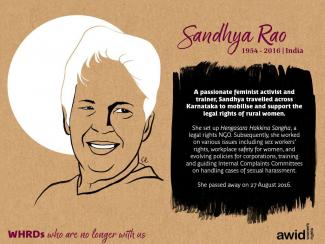
Sandhya Rao
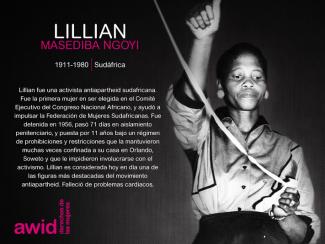
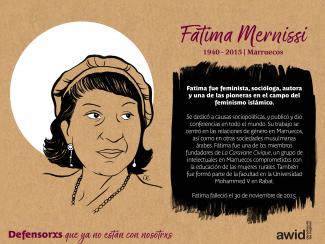
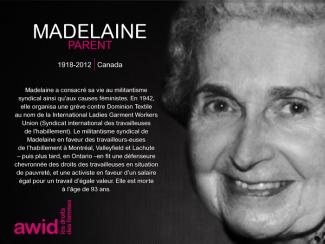
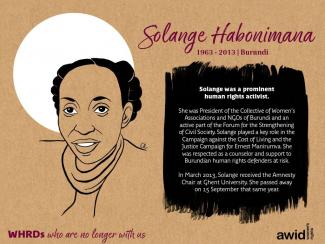
WHRDs are self-identified women and lesbian, bisexual, transgender, queer and intersex (LBTQI) people and others who defend rights and are subject to gender-specific risks and threats due to their human rights work and/or as a direct consequence of their gender identity or sexual orientation.
WHRDs are subject to systematic violence and discrimination due to their identities and unyielding struggles for rights, equality and justice.
The WHRD Program collaborates with international and regional partners as well as the AWID membership to raise awareness about these risks and threats, advocate for feminist and holistic measures of protection and safety, and actively promote a culture of self-care and collective well being in our movements.
WHRDs are exposed to the same types of risks that all other defenders who defend human rights, communities, and the environment face. However, they are also exposed to gender-based violence and gender-specific risks because they challenge existing gender norms within their communities and societies.
We work collaboratively with international and regional networks and our membership
We aim to contribute to a safer world for WHRDs, their families and communities. We believe that action for rights and justice should not put WHRDs at risk; it should be appreciated and celebrated.
Promoting collaboration and coordination among human rights and women’s rights organizations at the international level to strengthen responses concerning safety and wellbeing of WHRDs.
Supporting regional networks of WHRDs and their organizations, such as the Mesoamerican Initiative for WHRDs and the WHRD Middle East and North Africa Coalition, in promoting and strengthening collective action for protection - emphasizing the establishment of solidarity and protection networks, the promotion of self-care, and advocacy and mobilization for the safety of WHRDs;
Increasing the visibility and recognition of WHRDs and their struggles, as well as the risks that they encounter by documenting the attacks that they face, and researching, producing, and disseminating information on their struggles, strategies, and challenges:
Mobilizing urgent responses of international solidarity for WHRDs at risk through our international and regional networks, and our active membership.
To claim your power as an expert on the state of resourcing for feminist movements
 |
 |
 |
 |
 |
 While funders committed significantly more money to gender equality over the last decade, still only 1% of philanthropic and development funding has actually been moved to directly resource feminist-led social change.
In solidarity with movements that continue to be invisibilized, marginalized and without access to core, long-term, flexible and trust-based funding, the WITM survey highlights the actual state of resourcing, challenges false solutions, and points to how funding models must change for movements to thrive and meet the complex challenges of our times.
Nous comptons actuellement parmi nos membres plusieurs centaines d’organisations parmi les plus connues et novatrices. Les critères d’adhésion sont les mêmes que pour les personnes, mais les cotisations diffèrent et les services proposés tentent de répondre à leurs besoins particuliers.
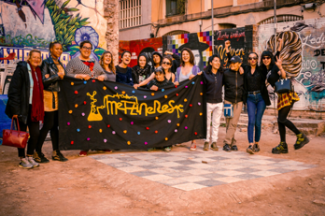
Siga el trabajo de estos colectivos en sus cuentas de redes sociales y sitios internet:

Provide AWID members, movement partners and funders with an updated, powerful, evidence-based, and action-oriented analysis of the resourcing realities of feminist movements and current state of the feminist funding ecosystem.
Identify and demonstrate opportunities to shift more and better funding for feminist organizing, expose false solutions and disrupt trends that make funding miss and/or move against gender justice and intersectional feminist agendas.
Articulate feminist visions, proposals and agendas for resourcing justice.
The AWID international Forum is a gathering of 2,000 women’s rights leaders and activists from around the world. The AWID Forum is the largest recurring event of its kind, and every Forum takes place in a different country in the global South.
The AWID International Forum is both a global community event and a space of radical personal transformation. A one-of-a-kind convening, the Forum brings together feminist, women’s rights, gender justice, LBTQI+ and allied movements, in all our diversity and humanity, to connect, heal and thrive.
When people come together on a global scale, as individuals and movements, we generate a sweeping force.
Join us in Bangkok, Thailand and online in December 2024.


Groups, organizations and/or movements working specifically or primarily for women, girls, gender justice, LBTQI+ and allied people’s rights in all regions and at all levels, both newly formed and long-standing.
La Conferencia de Monterrey sobre la Financiación para el Desarrollo marcó el comienzo de las conversaciones acerca de una agenda de Financiación para el Desarrollo.
Para saber más sobre los seis temas centrales de Monterrey los mecanismos de seguimiento a esta conferencia, consulta Género y financiación para el desarrollo, de Maria Floro, Nilufer Çagatay, John Willoughby y Korkut Ertürk (INSTRAW, 2004).
