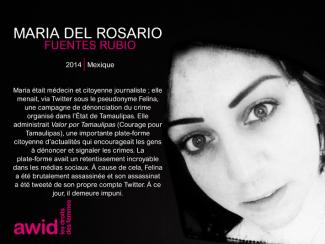
Maria del Rosario Fuentes Rubio
WHRDs are self-identified women and lesbian, bisexual, transgender, queer and intersex (LBTQI) people and others who defend rights and are subject to gender-specific risks and threats due to their human rights work and/or as a direct consequence of their gender identity or sexual orientation.
WHRDs are subject to systematic violence and discrimination due to their identities and unyielding struggles for rights, equality and justice.
The WHRD Program collaborates with international and regional partners as well as the AWID membership to raise awareness about these risks and threats, advocate for feminist and holistic measures of protection and safety, and actively promote a culture of self-care and collective well being in our movements.
WHRDs are exposed to the same types of risks that all other defenders who defend human rights, communities, and the environment face. However, they are also exposed to gender-based violence and gender-specific risks because they challenge existing gender norms within their communities and societies.
We work collaboratively with international and regional networks and our membership
We aim to contribute to a safer world for WHRDs, their families and communities. We believe that action for rights and justice should not put WHRDs at risk; it should be appreciated and celebrated.
Promoting collaboration and coordination among human rights and women’s rights organizations at the international level to strengthen responses concerning safety and wellbeing of WHRDs.
Supporting regional networks of WHRDs and their organizations, such as the Mesoamerican Initiative for WHRDs and the WHRD Middle East and North Africa Coalition, in promoting and strengthening collective action for protection - emphasizing the establishment of solidarity and protection networks, the promotion of self-care, and advocacy and mobilization for the safety of WHRDs;
Increasing the visibility and recognition of WHRDs and their struggles, as well as the risks that they encounter by documenting the attacks that they face, and researching, producing, and disseminating information on their struggles, strategies, and challenges:
Mobilizing urgent responses of international solidarity for WHRDs at risk through our international and regional networks, and our active membership.
On pense souvent que la communication de notre désir se cantonne à l’intimité des quatre murs de nos chambres et à nos relations personnelles. Mais est-il également possible d’envisager ce genre de communication comme étant structurelle, une pratique qui éclairerait notre travail et la manière dont nous sommes, dont nous existons dans le monde?
AWID began preparing this annual report just as the global pandemic began to unravel how we gather, organize and live our lives. It is impossible to review what we have done without COVID-19 tinting our assessment.
Download the full 2019 Annual review
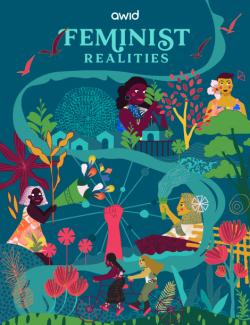
It is an urgently needed affirmation that there are other, more just ways of organizing our lives. During 2019 hundreds of groups shared their experiences and proposals for feminist realities with us, ranging from radical networks of community support in Latin America facilitating self-managed abortion, to practices of community-centered economies in Indonesia and community-centered food systems in India and the US, to a re-imagination and new practice of harm-free rites of passage in Sierra Leone. These are the experiences that will chart a path forward for a “new normal”.
Yet long histories of oppression and violence can make it difficult to imagine the possible. A key part of our work in 2019 was to spark these explorations through a toolkit AWID launched to support groups interested in unearthing the stories and aspirations that are the building blocks of feminist propositions.
Through the Observatory on the Universality of Rights, Feminists for a Binding Treaty, Count Me In! and other alliances, AWID has continued to push back against unfettered corporate power and fascist and fundamentalist agendas that undermine women’s rights and gender justice. With dim prospects for transformative change through multilateral processes and limited responsiveness from most states, we are redoubling our efforts to ensure that feminist movements, in all their diversity, are resourced in ways that match the critical roles they play - supporting their communities, demanding rights and responding to crises. In 2019 we introduced feminist principles and approaches to ground-breaking funds like the Spotlight Initiative and the Equality Fund, and succeeded in leveraging resources through feminist reality seed grant funding from feminist funders.
As we look ahead, it is clear that the context is calling for a transformation of our organizing strategies:
AWID is embarking on a new membership model that lowers barriers to access and emphasizes opportunities for engagement and cross-member connection. We will continue to experiment with different online tools and processes for building community. Cross-movement engagement will stay at the center of our work. AWID’s actions in solidarity with oppressed movements and identities, even and especially where these are marginalized in feminist movements, are important to drive change and support broad and inclusive movements for all.
We are resilient, we adapt, and we show up for each other. And we have to keep doing better. Thank you to all who are part of the journey with us.
Download the full 2019 Annual review

To share your lived experience with mobilizing funding for your organizing
Plus qu’une entorse amusante pour explorer des sensations, le BDSM peut être un moyen d’aborder la douleur émotionnelle et les traumatismes. Cela a été pour moi un moyen de guérison sexuelle, offrant une forme radicale de libération.
From the rising right in many countries and the flurry of funding cuts hitting hard civil society of the Global Majority, to the ongoing genocide in Gaza, the intensification of violent conflicts in Sudan, and climate crisis in many parts of our planet, we are facing real forces of fascism and a world order of impunity. This makes our opportunities to come together and build solidarity particularly valuable and imperative for our survival as a global feminist community. Of course, in 2024, the 15th AWID International Forum finally happened, and what a powerful space it was.
Download the full 2024 Annual Report
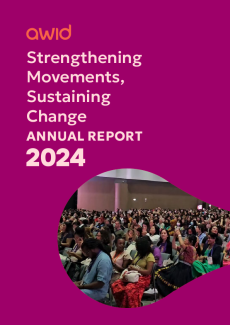
As we look ahead, we build on the powerful calls to action made by feminists at the AWID Forum; Together we can build a world where justice, liberation and care are not aspirations but realities.

L’enquête est disponible en français, anglais, arabe, espagnol, portugais et russe!
Contenido relacionado
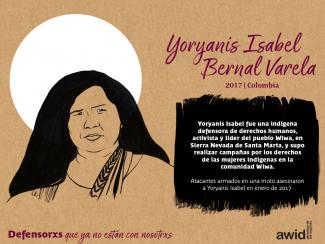
El Heraldo: Mujer asesinada en Valledupar era líder wiwa, defensora de derechos humanos
Survival: Colombia: lideresa indígena de Sierra Nevada asesinada
5 de la tarde, hoy.


La escritura a mano de la invitación—
enroscada y brusca—
la he visto cinco veces en cinco años.
Mi cuerpo se activa,
afiebrado.
Necesito cogerme a mí misma antes.
La marea está alta esta noche y
yo
acabo/me corro.
Quiero bajar la velocidad de todo,
saborear el tiempo y el espacio, grabarlos
en la memoria.
*
Nunca he estado antes en esta parte de la ciudad.
Los lugares desconocidos me excitan,
la forma en que las extremidades y las venas
y los huesos
resisten a la descomposición,
su destino incierto.
En la puerta, lo pienso dos veces.
El vestíbulo está oscuro como el carbón
y me hace detenerme.
Del otro lado,
un portal de olor y color
se abre como una maldición
a una tarde soleada.

La brisa
hace bailar mi cabello,
despierta su curiosidad,
lo obliga a moverse.
Oigo chirriar la silla de ruedas,
dando forma a las sombras.
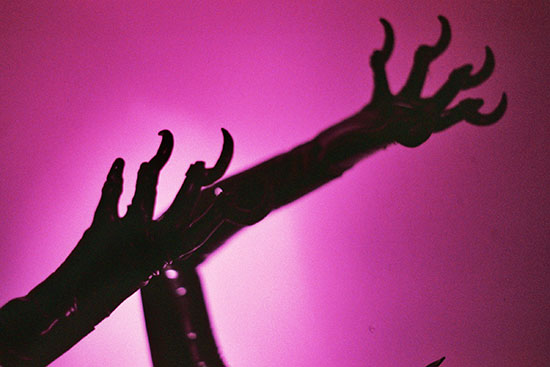
Entonces lx veo:
un rostro de lince
y un cuerpo como el mío
y me encuentro deseando a ambos
de nuevo.
La criatura me hace señas para que me acerque.
Sus gestos escriben una oración;
mientras me muevo hacia ellx
noto sus detalles:
marchitarse, carne, deleite
A su orden, la enredadera que cubre el vestíbulo
abrazando piedras tibias
serpentea hacia arriba por la pared.
Se convierte en un verbo,
«trepar»,
y me reoriento cuando sus garras apuntan
al cantero de la enredadera en el centro.
Oigo las ruedas detrás de mí,
luego ese sonido.
Reverbera
como ningún otro.
Sus largas alas negras
se elevan hacia el cielorraso
y después se lanzan hacia adelante.
La visión felina examina cada detalle,
cada cambio,
cada anhelo.
¿Puede el deseo licuar tus músculos?
¿Puede actuar más dulce que el
tranquilizante más potente?

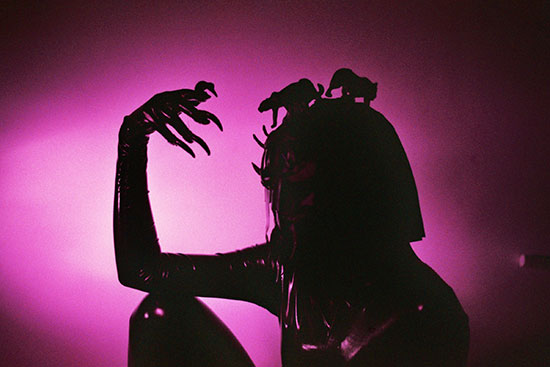
Un lince cose el mundo
a través de nuestras diferencias
tejiendo encaje alrededor de mis rodillas.
¿Puede el deseo aplastar la distancia del mundo, comprimiendo los segundos?
Se acerca todavía más,
el ojo de lince encontrando el ojo humano,
olfateando el aire,
convirtiendo al cuerpo en
urgencia.
Ellx agita sus alas.
Atizadas,
las lianas se enmarañan alrededor de mi cintura/residuo.
Su lengua adelgaza el tiempo,
moviendo los suelos,
calma, con su magia,
lo que se aviva debajo.
Veo el mundo en ti, y el mundo
está exhausto.
Entonces ellx suplica:
Déjame hacer de tí mi banquete.
Isabel est une féministe du Royaume-Uni avec plus d'une décennie d'expérience de réponses féministes aux fascismes, aux fondamentalismes et aux tendances antidroits. À l'AWID, son travail se concentre sur le renforcement des connaissances. Elle a notamment dirigé la production de la série Droits en danger en collaboration avec l'Observatoire sur l'universalité des droits (OUR). Elle est titulaire d’un master en études sur le genre de l’École d’études orientales et africaines (SOAS) et a précédemment travaillé avec Women Living Under Muslim Laws (WLUML). Elle est passionnée par le travail intermouvements, la construction de connaissances centrées sur les mouvements et l’utilisation de l’expression créative pour perturber les systèmes d’oppression. En dehors du travail, Isabel est active dans divers espaces de justice liée au handicap, aux soins collectifs, à l’apprentissage et au plaidoyer.
The full “Where is the Money for Feminist Organizing” report will be published in 2026.
To learn more how AWID has been shining a light on money for and against feminist movements check out the work of our Resourcing Feminist Movements Initiative here.

Trauma is not the event; it is how our bodies respond to events that feel dangerous to us. It is often left stuck in the body, until we address it. There’s no talking our body out of this response – it just is.
Margo Okazawa-Rey is an activist-educator and transnational feminist working on issues of militarism for nearly 30 years. She is a founder member of the International Women’s Network against Militarism and Women for Genuine Security, the US group of the Network. She has long-standing activist commitments with Du Re Bang/My Sisters Place in South Korea and Women’s Centre for Legal Aid and Counselling in Palestine. She also serves on the International Board of PeaceWomen Across the Globe in Bern, Switzerland and is President of the Board of Directors of Association for Women’s Rights in Development (AWID). Her foundational activist/life principle is that love is a radical act. She is also known as DJ MOR Love and Joy.
Le principal objectif de l’enquête WITM est de faire la lumière sur la situation financière de divers mouvements féministes, de défense des droits des femmes, pour la justice de genre, de défense des personnes LBTQI+ et des mouvements alliés dans le monde entier. Sur cette base, nous souhaitons démontrer l’importance d’orienter davantage de fonds, de meilleure qualité, et de transférer le pouvoir vers les mouvements féministes.