Marie Noelle Nyangwile Musuna
WHRDs are self-identified women and lesbian, bisexual, transgender, queer and intersex (LBTQI) people and others who defend rights and are subject to gender-specific risks and threats due to their human rights work and/or as a direct consequence of their gender identity or sexual orientation.
WHRDs are subject to systematic violence and discrimination due to their identities and unyielding struggles for rights, equality and justice.
The WHRD Program collaborates with international and regional partners as well as the AWID membership to raise awareness about these risks and threats, advocate for feminist and holistic measures of protection and safety, and actively promote a culture of self-care and collective well being in our movements.
WHRDs are exposed to the same types of risks that all other defenders who defend human rights, communities, and the environment face. However, they are also exposed to gender-based violence and gender-specific risks because they challenge existing gender norms within their communities and societies.
We work collaboratively with international and regional networks and our membership
We aim to contribute to a safer world for WHRDs, their families and communities. We believe that action for rights and justice should not put WHRDs at risk; it should be appreciated and celebrated.
Promoting collaboration and coordination among human rights and women’s rights organizations at the international level to strengthen responses concerning safety and wellbeing of WHRDs.
Supporting regional networks of WHRDs and their organizations, such as the Mesoamerican Initiative for WHRDs and the WHRD Middle East and North Africa Coalition, in promoting and strengthening collective action for protection - emphasizing the establishment of solidarity and protection networks, the promotion of self-care, and advocacy and mobilization for the safety of WHRDs;
Increasing the visibility and recognition of WHRDs and their struggles, as well as the risks that they encounter by documenting the attacks that they face, and researching, producing, and disseminating information on their struggles, strategies, and challenges:
Mobilizing urgent responses of international solidarity for WHRDs at risk through our international and regional networks, and our active membership.
Juhi est passionnée de technologie, titulaire d'une licence en génie informatique de l'Université Technologique du Gujarat et d'une formation de troisième cycle en télécommunications sans fil et en gestion de projet du Humber College. Passionnée par la résolution de problèmes et aimant garder une longueur d'avance dans un paysage technologique en constante évolution, Juhi s'est retrouvée à naviguer dans divers secteurs en tant que technicienne informatique. Grâce à l'environnement stimulant de la School Board, Juhi a eu l'occasion d'appliquer ses compétences techniques dans divers contextes, relevant toujours de nouveaux défis avec enthousiasme. Au-delà du code et des circuits, Juhi aime les aventures de la vie. Explorer de nouveaux lieux et cultures constitue pour elle une bouffée d’air frais. Qu'il s'agisse de découvrir des trésors cachés de la ville, d'essayer des cuisines exotiques ou de se lancer dans des sports d'aventure palpitants, Juhi est toujours partante pour de nouvelles expériences.
 La Couverture
|
 La puissante
|
 Le lierre
|
 Le hurlement
|

Production et entrepreneuriat |
 L’Artisan·e
|
Absolutely, we want to hear about your experience with resourcing.
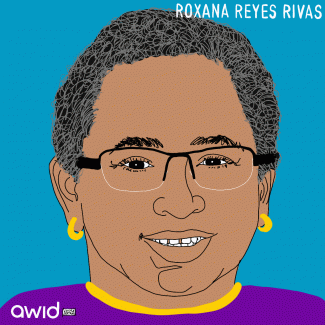
Roxana Reyes Rivas, philosopher, feminist, lesbian, poet, politician and LGBT and women’s rights activist from Costa Rica. Owner of a sharp pen and incisive humour, a laugh a minute. She was born in 1960 and raised in San Ramón of Alajuela, when it was a rural town, and her whole life she would break away from the mandates of what it meant to be a woman.
With El Reguero (Costa Rican lesbian group) she organized lesbian festivals for over a decade, fun-filled formative spaces to come together at a time when the Costa Rican government and society persecuted and criminalized the lesbian existence. For hundreds of women the lesbian festivals where the only place they could be themselves and come together with others like them.
Roxana would often say founding political parties was one of her hobbies. “It’s important for people to understand there are other ways to do politics, that many issues need to be solved collectively”. She was one of the founders of the New Feminist League and VAMOS, a human rights focused political party.
“The philosophical trade is meant to jab, to help people ask themselves questions. A philosopher who doesn’t irritate anyone is not doing her job”. For 30 years Roxana taught philosophy at several Costa Rican public universities. Through her guidance, generations of students reflected about the ethical dilemmas in science and technology.
Roxana’s favourite tool was humour, she created the Glowing Pumpkin award, an acknowledgement to ignorance that she would bestow upon public figures, through her social media channels, mocking their anti-rights expressions and statements.
An aggressive cancer took Roxana at the end of 2019, before she could publish a compilation of her poems, a departing gift from the creative mind of a feminist who always raised her voice against injustice.
Jessica is a queer artist- activist from Toronto, Canada, but is currently based in Bulgaria. Jessica has over 15 years experience in the HIV response working at the intersections of gender and HIV with key populations (sex workers, women who use drugs, LGBTQI communities, incarcerated people and of course people living with HIV). Jessica loves movement building and thinking/taking/strategizing about arts-based interventions. One fun project she started in 2013 was LOVE POSITIVE WOMEN that engages over 125 community groups and organizations globally every February 1-14th to celebrate women living with HIV in their communities.
El financiamiento externo incluye donaciones y otras formas de financiamiento provenientes de fundaciones filantrópicas, gobiernos, donantes bilaterales, multilaterales y corporativos y de donantes individuales, ya sea que estos se encuentren radicados en tu país o en el exterior. Excluye aquellos recursos que las agrupaciones, organizaciones o movimientos generan de manera autónoma como, por ejemplo, cuotas de membresía, contribuciones voluntarias del personal, afiliadxs o adherentes, colectas comunitarias, alquiler de espacios propios o venta de servicios. Para consultar más referencias, en la propia encuesta se encuentran incluidas las definiciones de los distintos tipos de financiamiento y descripciones breves de distintos tipos de donantes.
«Yo no planeaba ser una cantante, el canto planeó estar en mí.» - Dorothy Masuka (entrevista de Mail & Guardian)
Una de estas canciones, titulada «Dr. Malan» (por el político pro-apartheid D.F. Malan) fue prohibida. Luego, en 1961, grabó «Lumumba», una canción sobre el asesinato del líder anticolonial Patrice Lumumba. El trabajo y el activismo de Dorothy atrajeron la atención de la División Especial de la policía sudafricana, y fue forzada a un exilio político que se prolongaría durante tres décadas. Durante ese tiempo, trabajó con grupos independentistas, incluido el Congreso Nacional Africano. En 1992, cuando el apartheid comenzó a desmoronarse y Nelson Mandela fue liberado de prisión, Dorothy regresó a Sudáfrica.
Su trabajo incluye la primera canción que grabó, en 1953, titulada «Hamba Notsokolo», que fue un éxito durante la década de 1950, y hoy es un clásico muy valorado. También escribió «El Yow Phata Phata», una canción que fue adaptada por Miriam Makeba, quien hizo de «Pata, Pata» un hit internacional.
Arraigados en la resistencia, la música y el activismo de Dorothy (popularmente conocida como «Auntie Dot» [«Tía Dot»]) estaban entretejidos, y dejaron un legado magnífico e inspirador.
Dorothy falleció en Johannesburgo el 23 de febrero de 2019 a la edad de 83 años, por problemas de salud.
Entrevista a Dorothy Masuka de Mail & Guardian (en inglés)
Escucha su música:
Ȃurea Mouzinho es una activista feminista por la justicia económica de Luanda, Angola, que tiene una carrera de diez años en investigación, otorgamiento de subvenciones, incidencia y construcción de movimientos por los derechos de las mujeres y la justicia económica en toda África y en el Sur global. Actualmente es Directora de Programa para África en Thousand Currents, y es parte del consejo editorial de Feminist Africa. También integra Ondjango Feminista, una colectiva feminista que cofundó en 2016. Recientemente ha sido madre de un niño de Géminis, y disfruta los días tranquilos con su joven familia y los largos paseos por la playa. Ocasionalmente publica tweets con el nombre de usuarie @kitondowe.
“Nous Sommes la Solution has a vision of an Africa where, in solidarity, rural women involved in decision-making can grow, process, sell and consume family farming products while preserving the environment, for a harmonious and sustainable development.”
L’AWID est engagée en faveur de la justice linguistique, et nous regrettons que l’enquête WITM ne puisse, à l’heure actuelle, être accessible dans d’autres langues. Cependant, si vous avez besoin d’une aide à la traduction ou que vous souhaitez participer à l’enquête dans une autre langue, n’hésitez pas à nous contacter à l’adresse witm@awid.org.
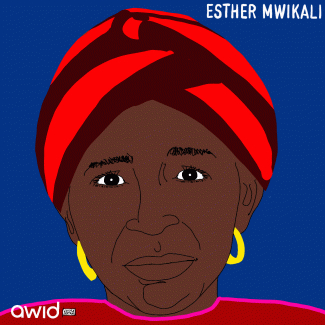
Esther Mwikali habitait dans le village de Mithini, dans le comté de Murang’a au Kenya. Activiste des droits fonciers, importante et appréciée, elle travaillait sur les abus à l’égard de squatters vivant sur des terres revendiquées par des magnats. Esther a participé à une enquête qui comprenait également des violations de droits fonciers à Makaya par de puissants individus.
Suite à l’absence d’Esther lors d’une réunion de village, une équipe de patrouille est partie à sa recherche. Le 27 août 2019, deux jours après sa disparition, on retrouva son corps dans une ferme proche de sa propriété, montrant des signes de torture. Elle fut sauvagement assassinée.
« Esther était reconnue pour son travail auprès des membres de la communauté, empêchant les évictions de terres revendiquées des magnats. Les activistes du coin n’ont aucun doute sur le lien entre son meurtre et les luttes constantes pour les terres dans la région. C’est un tragique rappel de la fréquence alarmante d’assassinats extrajudiciaires régulièrement menés au Kenya » - Global Wittness Report, juillet 2020
« Nous associons la mort de Mwikali aux luttes pour les terres par ici. Nous demandons au gouvernement de mener une enquête sur ce sujet au plus tôt. » - James Mburu, porte-parole des squatters
« Des mesures devraient être prises à l’égard des individus suspectés d’avoir menacé les squatters, et notamment la famille Mwikali. » - Alice Karanja, National Coalition of Human Rights Defenders (coalition nationale des défenseur·e·s des droits humains)
« L’impact de son travail et sa ténacité demeureront encore en vie pour les prochaines décennies au Kenya. CJGEA console avec les personnes endeuillées et appelle à la justice. » - Center for Justice and Governmental Action (Centre pour la justice et l’action gouvernementale, CJGEA) communiqué de presse, 13 septembre 2019
A nomad of cultures, born in Hong Kong, rooted in Turkish-Pakistani heritage, Fatima’s love for narratives - both in reading and co-creating them - fueled her passion for communications activism. Supported by her education in journalism, Fatima has worked for 7 years in digital and media communications fields with NGOs that provide education opportunities and legal aid to refugee and asylum seekers, as well as with the Muslim feminist movement which applies feminist and rights-based lenses in understanding and searching for equality and justice within Muslim legal tradition. She is a regular op-ed writer on feminist issues in the Global South.
Through storytelling in this hyper-digital age of social media, Fatima continues to collaborate with community organizers and grassroots activists to create audiovisual content with the aim to cultivate bridges of understanding towards collective liberation and decolonization. On days when she’s not working, she intently watches independent feminist films coming from Iran, Morocco and Pakistan and on other days, she performs spoken word poetry with her comrades in Kuala Lumpur.
The estimated time to complete the survey is 30 minutes.
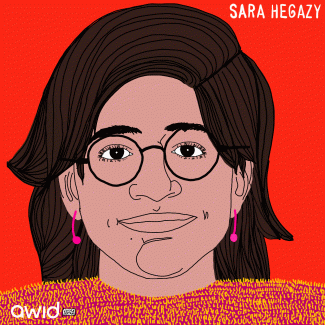
Sara Hegazy, a bold Egyptian LGBTQI+ rights activist, lived in a society where the members of her community, their bodies and lives often face lethal prejudice. The roots of Sara’s resistance were in the deconstruction of a dominant, oppressive and patriarchal system, and its anti-rights actors.
"[In Egypt], every person who is not male, Muslim, Sunni, straight, and a supporter of the system, is rejected, repressed, stigmatized, arrested, exiled, or killed. This matter is related to the patriarchal system as a whole, since the state cannot practice its repression against citizens without a pre-existing oppression since childhood." - Sara Hegazy wrote on March 6, 2020
The suppression of Sara’s voice by the Egyptian government reached its violent peak in 2017, when she was arrested for raising a rainbow flag at the Mashrou’ Leila (Lebanese band whose lead vocalist is openly gay) concert in Cairo. What followed were charges of joining an illegal group along with “promoting sexual deviancy and debauchery”.
"It was an act of support and solidarity — not only with the [Mashrou' Leila] vocalist but for everyone who is oppressed...We were proud to hold the flag. We wouldn't have imagined the reaction of society and the Egyptian state. For them, I was a criminal — someone who was seeking to destroy the moral structure of society." - Sara Hegazy
Sara was jailed for three months, where she was tortured and sexually assaulted. In January 2018, after being released on bail, she sought asylum in Canada where she was safe but imprisoned by the memories of the abuse and violence her body and soul had gone through.
"I left this experience after three months with a very intense, serious case of PTSD [post-traumatic stress disorder]. Prison killed me. It destroyed me." - Sara Hegazy told NPR
Sara took her own life on 14 June 2020, leaving a handwritten note in Arabic:
“To my siblings – I tried to find redemption and failed, forgive me.”
“To my friends – the experience [journey] was harsh and I am too weak to resist it, forgive me.
“To the world – you were cruel to a great extent, but I forgive.”
Her legacy and courage will be carried forward by those who love her and believe in what she fought for.
“To Sarah: Rest, just rest, spared from this relentless violence, this state-powered lethal patriarchy. In rage, in grief, in exhaustion, we resist.” - Rasha Younes, an LGBT rights researcher at Human Rights Watch. Read the complete text
Mashrou’ Leila’s lead vocalist sings tribute to Sara Hegazy