
Carole Seymour-Jones
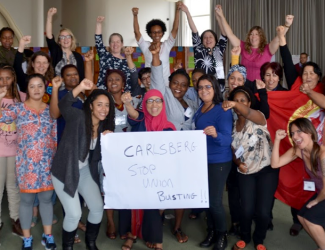
Women human rights defenders (WHRDs) worldwide defend their lands, livelihoods and communities from extractive industries and corporate power. They stand against powerful economic and political interests driving land theft, displacement of communities, loss of livelihoods, and environmental degradation.
Extractivism is an economic and political model of development that commodifies nature and prioritizes profit over human rights and the environment. Rooted in colonial history, it reinforces social and economic inequalities locally and globally. Often, Black, rural and Indigenous women are the most affected by extractivism, and are largely excluded from decision-making. Defying these patriarchal and neo-colonial forces, women rise in defense of rights, lands, people and nature.
WHRDs confronting extractive industries experience a range of risks, threats and violations, including criminalization, stigmatization, violence and intimidation. Their stories reveal a strong aspect of gendered and sexualized violence. Perpetrators include state and local authorities, corporations, police, military, paramilitary and private security forces, and at times their own communities.
AWID and the Women Human Rights Defenders International Coalition (WHRD-IC) are pleased to announce “Women Human Rights Defenders Confronting Extractivism and Corporate Power”; a cross-regional research project documenting the lived experiences of WHRDs from Asia, Africa and Latin America.
"Women Human Rights Defenders confronting extractive industries: an overview of critical risks and Human Rights obligations" is a policy report with a gender perspective. It analyses forms of violations and types of perpetrators, quotes relevant human rights obligations and includes policy recommendations to states, corporations, civil society and donors.
"Weaving resistance through action: Strategies of Women Human Rights Defenders confronting extractive industries" is a practical guide outlining creative and deliberate forms of action, successful tactics and inspiring stories of resistance.
The video “Defending people and planet: Women confronting extractive industries” puts courageous WHRDs from Africa, Asia, and Latin America in the spotlight. They share their struggles for land and life, and speak to the risks and challenges they face in their activism.
Challenging corporate power: Struggles for women’s rights, economic and gender justice is a research paper outlining the impacts of corporate power and offering insights into strategies of resistance.
AWID acknowledges with gratitude the invaluable input of every Woman Human Rights Defender who participated in this project. This project was made possible thanks to your willingness to generously and openly share your experiences and learnings. Your courage, creativity and resilience is an inspiration for us all. Thank you!
The AWID international Forum is a gathering of 2,000 women’s rights leaders and activists from around the world. The AWID Forum is the largest recurring event of its kind, and every Forum takes place in a different country in the global South.
The AWID International Forum is both a global community event and a space of radical personal transformation. A one-of-a-kind convening, the Forum brings together feminist, women’s rights, gender justice, LBTQI+ and allied movements, in all our diversity and humanity, to connect, heal and thrive.
When people come together on a global scale, as individuals and movements, we generate a sweeping force.
Join us in Bangkok, Thailand and online in December 2024.
Feminist movements need core and long-term funding - including savings and reserves - to stay focused on systemic change. Reserves aren’t extras; they're essential for sustainability.
Consultez notre guide : « Un tout petit guide pour l’organisation de festivals féministes internationaux et d’événements en ligne. »
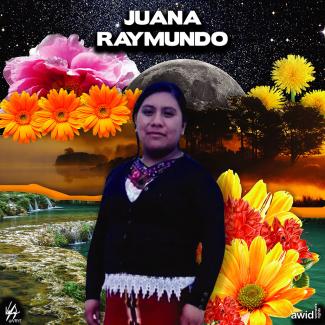
Juana was an Indigenous Mayan Ixil, professional nurse and coordinator of the Farmers’ Development Committee (Comité de Desarrollo Campesino – CODECA).
CODECA is a human rights organisation of Indigenous farmers dedicated to promoting land rights and rural development for Indigenous families) in the Nebaj Quiché micro-region. She first joined CODECA as a member of its youth branch (Juventud de CODECA). At the time of her death had been elected to be part of the Executive Committee of the Movement for the Liberation of Peoples (MLP).
Juana’s body was found by neighbours by a small river on the road near Nebaj and Acambalam Village, Guatemala. According to CODECA, her body showed signs of torture.
La Conferencia de Monterrey sobre la Financiación para el Desarrollo marcó el comienzo de las conversaciones acerca de una agenda de Financiación para el Desarrollo.
Para saber más sobre los seis temas centrales de Monterrey los mecanismos de seguimiento a esta conferencia, consulta Género y financiación para el desarrollo, de Maria Floro, Nilufer Çagatay, John Willoughby y Korkut Ertürk (INSTRAW, 2004).
How movements are resisting fascist agendas in relation to climate change.
📅 Tuesday, November 11, 2025
📍 Beira Rio Hotel, Belém, Pará
CARING ECONOMIESLAND AND AGROECOLOGYFEMINIST COOPERATIVISMFEMINIST UNION ORGANIZING
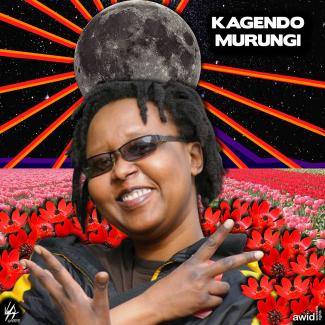
Kagendo es cariñosamente recordada por su familia y amigxs como una férrea activista feminista africana, artista y realizadora cinematográfica
Dedicó más de 20 años a defender los derechos y la dignidad de las personas LGBTIQ y de género no normativo de África. Lxs colegas de Kagendo la recuerdan como alguien con una personalidad jovial, convicciones férreas y amor a la vida. Kagendo murió por causas naturales en su hogar de Harlem, el 27 de diciembre de 2017.
Al producirse su fallecimiento, la escritora y activista keniata Shailja Patel destacó «el compromiso de toda la vida de Kagendo para establecer una relación entre todas las formas de opresión, mostrando de qué manera el colonialismo alentó la homofobia en el continente africano, para convertir así a Kenia en un país donde las personas queer y las mujeres libres puedan vivir y progresar».

La Conférence des Nations Unies de 2009 sur la crise financière et économique mondiale et son incidence sur le développement
Movimientos que marchan en todo el mundo por la justicia climática.
📅 Sábado, 15 de noviembre de 2025
📍 Varias ubicaciones
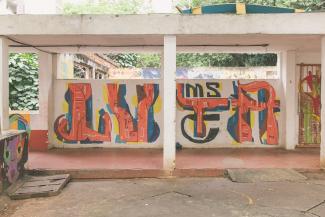 |
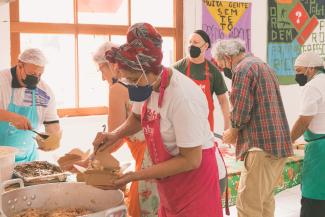 |
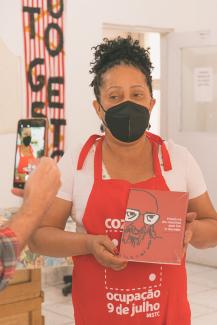 |
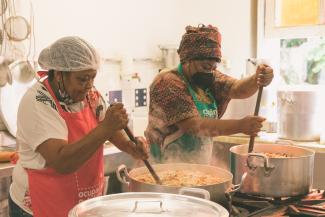
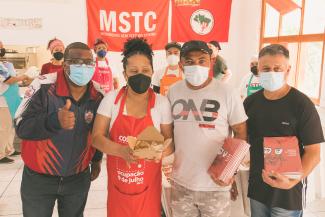 Mujeres y colaboradorxs en la cocina de Ocupação 9 de Julho |
 |
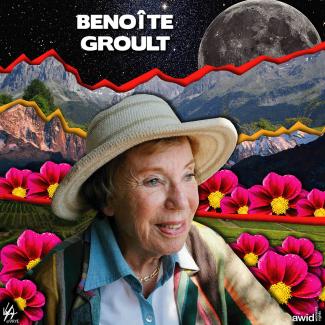
Benoîte était une journaliste, écrivaine et militante féministe française.
Elle a publié plus de 20 romans et de nombreux essais sur le féminisme
Son premier livre « Ainsi Soit-Elle » a été publié en 1975. Le livre explore l’histoire des droits des femmes ainsi que la misogynie et la violence à l’égard des femmes.
Son dernier livre, « Ainsi Soit Olympe de Gouges», a exploré la question des droits des femmes pendant la Révolution française, se concentrant sur la figure de l’ancienne féministe française Olympe de Gouges. De Gouges fut guillotinée en 1793 pour avoir défié l'autorité des hommes et publié la « Déclaration des droits de la femme et de la citoyenne » deux ans auparavant.
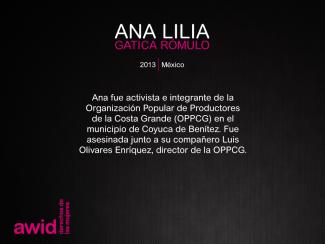
Release of the Zero-Draft Outcome Document, March 2015
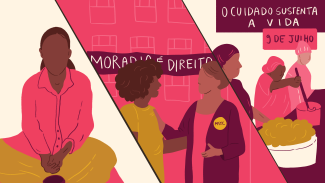
Le logement est un droit | Les soins soutiennent la vie