None On Record

Special Focus

AWID is an international, feminist, membership organisation committed to achieving gender equality, sustainable development and women’s human rights

Young Feminist Activism

Organizing creatively, facing an increasing threat

Young feminist activists play a critical role in women’s rights organizations and movements worldwide by bringing up new issues that feminists face today. Their strength, creativity and adaptability are vital to the sustainability of feminist organizing.

At the same time, they face specific impediments to their activism such as limited access to funding and support, lack of capacity-building opportunities, and a significant increase of attacks on young women human rights defenders. This creates a lack of visibility that makes more difficult their inclusion and effective participation within women’s rights movements.

A multigenerational approach

AWID’s young feminist activism program was created to make sure the voices of young women are heard and reflected in feminist discourse. We want to ensure that young feminists have better access to funding, capacity-building opportunities and international processes. In addition to supporting young feminists directly, we are also working with women’s rights activists of all ages on practical models and strategies for effective multigenerational organizing.

Our Actions

We want young feminist activists to play a role in decision-making affecting their rights by:

  • Fostering community and sharing information through the Young Feminist Wire. Recognizing the importance of online media for the work of young feminists, our team launched the Young Feminist Wire in May 2010 to share information, build capacity through online webinars and e-discussions, and encourage community building.

  • Researching and building knowledge on young feminist activism, to increase the visibility and impact of young feminist activism within and across women’s rights movements and other key actors such as donors.

  • Promoting more effective multigenerational organizing, exploring better ways to work together.

  • Supporting young feminists to engage in global development processes such as those within the United Nations

  • Collaboration across all of AWID’s priority areas, including the Forum, to ensure young feminists’ key contributions, perspectives, needs and activism are reflected in debates, policies and programs affecting them.

Related Content

A few different people from my organization are planning to attend the Forum. Is there a group discount for the Forum?

AWID does not provide group discounts, but we do provide registration discounts to members. (Click here to learn more about becoming a member)

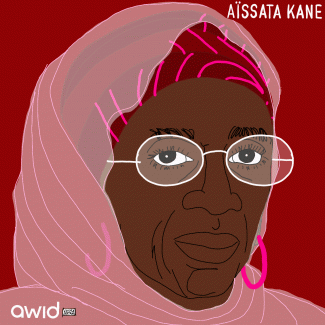
Aïssata Kane

Aïssata Kane, también conocida afectuosamente como «Yaye Kadia»” [«Madre Kadia»], fue una feminista comprometida, durante toda su vida, con la defensa de los derechos de las mujeres africanas y, en especial, mauritanas.

En 1975 fue la primera mujer en ocupar el cargo de Ministra de Protección Familiar y Asuntos Sociales, puesto desde el cual Aïssata trabajó fervientemente para mejorar el estatus de las mujeres de su país.

Este trabajo incluyó el fomento de la educación de niñas y mujeres, la lucha contra la práctica de alimentación forzada de mujeres jóvenes, la incidencia para la inclusión de una legislación sobre derechos maritales, y la promoción de la creación de un cupo de representación femenino en el Parlamento.

«[Aïssata] materializaba todas sus pasiones con humildad, valentía y determinación. No quería molestar a nadie con su lucha en todos estos frentes simultáneos.» - Ball Halimata Dem, sobrina de Aïssata

Fundó la Unión Nacional de Mujeres de Mauritania (UNFM), creando y publicando con otras activistas Marienou, una revista dedicada a la emancipación de las mujeres mauritanas. Aïssata también dirigió varias organizaciones subregionales y locales, por ejemplo, como Presidenta de la Asociación Internacional de Mujeres Francófonas (AIFF) y, como firme ecologista, fue Presidenta de la Asociación para la Protección del Medio Ambiente de Mauritania (APEM).

En 2018, recibió el Premio a la Mujer Pionera, en honor a su trabajo para la promoción del estatus de las mujeres de Mauritania y como reconocimiento de su fuerte liderazgo y su sentido de la innovación.

Aïssata falleció el 10 de agosto de 2019.

ours chapter 5 fr

Chapitre 5

Tactiques, stratégies et impacts des antidroits

Les antidroits ont adopté une double stratégie : outre leurs attaques ouvertes sur le système multilatéral, ils et elles sapent les droits humains depuis l’intérieur. Leur implication vise à prendre le contrôle des processus, instaurer des normes régressives et fragiliser la redevabilité.

En lire plus

Snippet2 - WCFM Movement and Struggle - EN

Fist icon

Movement in focus:

Filter your search by funders’ priority support areas that speak to your organizing efforts

Umyra Ahmad

Biography

Umyra Ahmad is a Malaysian feminist with a background in international and regional advocacy, and human rights education. In AWID, she works on advancing rights related to gender and sexuality at the UN. Prior to joining, she was a programme officer at IWRAW Asia Pacific, where she supported regional, national and grassroots organizations in using UN treaty body mechanisms as a tool for state accountability and access to justice. In Malaysia, she works with queer and refugee collectives and supports coordination of various mutual aid initiatives.

Position
Advancing Universal Rights and Justice Advocacy Lead
Add to stories
Off

Cookies

We’re committed to protecting your privacy, so here we explain how we use cookies on our website.

If you have any questions, please get in touch via the form on our contact page.

What are cookies?

A cookie is a small data file downloaded by your web browser (for example Chrome or Internet Explorer) and stored on your computer. They are downloaded automatically when you visit websites. Cookies are used to perform essential tasks on a website, to record how people use a website and to gather data for marketing.

How we use cookies

We provide essential information on our website to millions of people every year. To do this, we have to manage our website effectively and to reach out to more people who need our support and information. Cookies are a small, but essential way to make all this happen. We use cookies to:

  1. To measure how people use our website. This helps us understand how well different sections of our website are performing. It also helps us track numbers of visitors and helps us ensure our website is robust and works well for every single one of the millions of people who use it.
  2. To record actions so that the website will work well for you. For example, our online shop uses cookies to record items that you place in your shopping basket. We also use cookies in our online donations process and in other tools such as our online breath test.
  3. We also record actions so we can reach people more effectively. This works by using a cookie to remember what pages you have visited so we can tailor our marketing messages based on your interests.

Change your cookie settings

You can update your cookie preferences by clicking on the button below.

Cookie Settings

In addition, most browsers allow you to manage cookies saved on your device – just go to the help section of your browser. To learn more about cookies and how to manage them, visit the ICO website.

Your rights

Cookies never record your credit card details or easily identifiable personal data such as your name and address. You have every right to refuse to accept cookies from our website.

If you disable cookies you will still be able to access nearly all the information on our website. But please remember that this may affect some functionality.

How to disable cookies

You can disable cookies by changing your settings in your web browser or you can use the incognito option on Google Chrome. To find out more about your browser settings, visit the relevant support page below:

Cookies used by this site

Nunca he viajado antes. ¿Qué debería saber?

Reconocemos que el viaje involucra muchos desafíos y por eso brindaremos más información y detalles sobre cómo llegar a Bangkok cuando abramos el proceso de inscripción a principios del próximo año.

Rosane Santiago Silveira

Rosane Santiago Silveira, que l’on appelait affectueusement Rô Conceição, était une activiste brésilienne pour l’environnement et les droits humains qui se battait inlassablement pour protéger l’environnement, là où il était le plus menacé. 

Il pouvait entre autres s’agir de le défendre sur l’île de Barra Valha, mise en danger par une exploitation pétrolière, ou de le protéger avec des campagnes contre l’accaparement des terres et l’expansion de plantations d’eucalyptus dans l’État de Bahia, où Rosane était membre du conseil de la réserve d’extractivistes de Cassurubá.

« La réserve d’extractivistes est une zone protégée où les familles résidentes vivent des produits naturels extraits de la forêt. Ces activités contribuent à protéger l’intégrité de la forêt. » - Global Justice Ecology Project (source initiale : Rede Brasil Atual)

Elle participait à des activités syndicales et des mouvements culturels et de défense des droits humains. Rosane consacrait une grande partie de sa vie à des causes qui lui étaient chères, mais qui concernaient également la terre, les forêts, les rivières et les communautés dont les droits et vies sont constamment en danger. 

Elle a été torturée et assassinée le 29 janvier 2019 à Nova Viçosa, une ville du sud de Bahia. 

« Malheureusement, un sentiment d’insécurité totale règne désormais, parce que l’État ne juge pas ces crimes. Nous étions avec elle à Noël, et tout le monde s’est rendu compte qu’elle était inquiète. Nous savons maintenant qu’elle avait reçu trois menaces de mort », Tuian, le fils de Rosane dans un entretien avec Rádio Brasil Atual. (source initiale : Rede Brasil Atual)

Time for Action: Stop the anti-rights infiltration of the UN!

Call to action

Sign the Call to Action!

Want to join the growing numbers of people saying “enough” to the infiltration of the UN by anti-rights actors?

Join the call — sign and share today.

Snippet - Take the quiz


¡Responde el cuestionario!

"¿Dónde está el dinero para las organizaciones feministas?

¿Cuánto sabes sobre la movilización de recursos feminista?  Responde el cuestionario de AWID “¿Dónde está el dinero para las organizaciones feministas?” y pon a prueba tus conocimientos


Responde el cuestionario en línea      Descárgalo e imprímelo.


Joanne Kobuthi-Kuria

Biography

Joanne es una feminista africana que siente pasión por la lucha contra las desigualdades de género en el continente africano. Ha trabajado con varias organizaciones, medios de comunicación y grupos de reflexión globales, incluidos Amnistía Internacional, Wrthy, el Instituto de Investigación en Desarrollo Local, la BBC, la Comunidad de África Oriental (CAO), entre otros. Integra la junta de Freely in hope, una ONG radicada en Kenia y Zambia, que busca capacitar a lxs sobrevivientes y defensorxs para convertirse en líderes de la lucha para poner fin a la violencia sexual, y de Msingi Trust, un movimiento de activistas que trabajan en la confluencia de la fe y los derechos humanos. Posee una maestría en Administración de Empresas, maestrías en Política Pública y una licenciatura en Derecho. Tiene adicción por los libros, en especial, por la literatura de ficción.

Position
Gerente, Participación de la Membresía y las Bases de Apoyo
Add to stories
Off

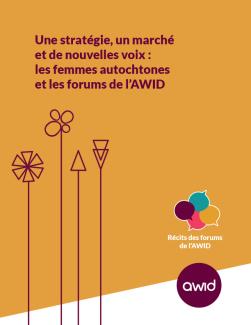
Une stratégie, un marché et de nouvelles voix : les femmes autochtones et les forums de l'AWID

Coverture pour Une stratégie, un marché et de nouvelles voix : les femmes autochtones et les forums de l’AWID


Le Forum a été un espace clé pour le Mouvement des femmes autochtones (Indigenous Women’s Movement, IWM) dans son rapport au féminisme. Aux Forums de l’AWID, elles ont appliqué la même stratégie que celle utilisée pour les Nations Unies. Au cours de ce processus, les deux mouvements ont été transformés : de nouvelles voix et questions ont émergé au sein de l’IWM, et les féministes ont commencé à changer leurs discours et leurs pratiques autour des droits fonciers et de la spiritualité, elles ont mieux compris les droits collectifs et ont inclus l’IWM dans leurs événements et leurs programmes. Mónica Alemán et María Manuela Sequeira, de l’IWM, nous ont raconté cette histoire.

Téléchargez cette récit


Dans leur propre voix : regardez l'interview de María Manuela Sequeira & Mónica Alemán


Découvrez toutes les récits Télécharger le rapport complet

Mon groupe ou moi-même devions participer au Forum qui a été annulé en raison de la pandémie, comment puis-je participer à ce Forum ?

Nous reprendrons contact avec les anciens partenaires pour nous assurer que les efforts passés sont honorés. Si vos coordonnées ont changé depuis le dernier Forum, merci de nous les communiquer afin que nous puissions vous joindre.

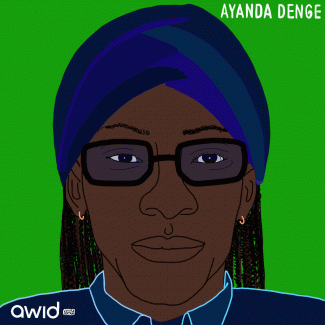
Ayanda Denge

“I am a wonder… Therefore I have been born by a mother! As I begin to stutter, my life has been like no other…” - Ayanda Denge  (read the whole poem below)

Ayanda Denge was a transwomxn, sex worker, activist, poet. She was Xhosa, from Port Elizabeth in the Eastern Cape of South Africa. After travelling through different cities of the country, she moved to Cape Town. 

As a committed and fervent social justice activist, she fought for the rights of sex workers, trans persons, and for those of people living with HIV and AIDS. She was also a motivational speaker on cancer awareness, and campaigned for affordable and social housing, especially for poor and working-class people. Ayanda stood tall as a mountain against different and often abusive faces of discrimination. 

“Being transgender is not a double dose, but it’s a triple dose of stigmatisation and discrimination. You are discriminated against for your sexual identity, you are discriminated against for your work, and you are discriminated against for your HIV status.” - Ayanda Denge, 2016

She was acting chairperson at the Sex Workers Education and Advocacy Taskforce (SWEAT) and also worked as an Outreach Coordinator at Sisonke, a national sex workers’ movement in South Africa. 

“From us, from our regional head office, to SWEAT where I sit on the board, to Sisonke, a movement of sex workers in Cape Town. We all amalgamate, we have one cry and it’s a cry that is recognised internationally by international sex workers. We want decriminalisation of sex work.” - Ayanda Denge, 2016

She lived in the Ahmed Kathrada House, which was being occupied by the Reclaim the City campaign for social housing. In 2018, Ayanda was elected house leader. On 24 March 2019, she was stabbed to death in her room. The year prior, another resident was killed.

Reclaim the City draws a connection between the safety of the house residents and the Provincial Government withholding electricity and the human right to water: 

“We cannot separate the safety of women and LGBTQI people living in the occupation from the refusal by the Western Cape Provincial Government to turn the electricity and water back on at Ahmed Kathrada House.

The house is pitch black at night. We need lights to keep each other safe. It is as if the Province wishes to punish poor and working class people, whose only crime is that we needed a home. While they may disagree with our reasons for occupying, they should be ashamed of themselves for putting politics before the safety and dignity of residents of this city.

Rest in Peace comrade Ayanda Denge, we shall remember you as we carry the torch forward in the struggle for decent well-located housing.”

Poem by Ayanda: 

I am a wonder…
Therefore I have been born by a mother!
As I begin to stutter,
My life has been like no other.
Born in pain
Nourished by rain
For me to gain
Was living in a drain.
As I shed a tear
I stand up and hold my spear.
Voices echo, do not fear
Challenges within a year,
Challenges of hurt are on my case;
Community applauds as they assume I have won my race;
But in reality my work strides at a tortoise pace;
On bended knee I bow and ask for grace.
For the Lord
Is my Sword;
To remind humanity
That he provides sanity.
Why Lord am I this wonder?
The Lord answers me with the rain and thunder,
For questioning my father
Who has in the book of lambs
A name called Ayanda.
From the streets my life was never sweet
The people I had to meet;
At times I would never greet;
Even though I had to eat;
I’d opt to take a bow
Rather than a seat

Listen to the poem in Ayanda’s voice

“For my life represents that of a lotus flower, that out of murky and troubled waters I bloomed to be beautiful and strong...” - Ayanda Denge, watch and listen 


Tributes: 

“Ayanda, I want to say to you that you are still a survivor, in our hearts and minds. You are gone but you are everywhere, because you are love. How beautiful it is to be loved, and to give love. And Ayanda, that is the gift that you have given us. Thank you for all of the love, we truly did need you. Going forward, I promise to you that we will all commit to continue with the struggle that you have dedicated so much energy and your time to. And we will commit ourselves to pursuing justice in this awful ending to your life.” - Transcript of a message, in a farewell Tribute to Ayanda

“Ayanda was an activist by nature. She knew her rights and would not mind fighting for the rights of others. For me, it was no shock that she was involved with many organizations and it was known that she was a people’s person. It did not need to be the rights of LGBTI but just the rights of everyone that she stood for.” - Ayanda’s sister
 

Nota de lxs editorxs | Sin palabras

Nota de lxs editorxs

Sin palabras

Cuando el trabajo de nuestros cuerpos se convierte en ganancias en las manos de los sistemas que buscamos desmantelar, no sorprende que nuestras sexualidades y placeres queden relegados una vez más a las márgenes, especialmente cuando no son lo suficientemente rentables. En muchos momentos durante la producción de este número, nos preguntamos qué sucedería si nos negáramos a dar cabida a los servicios esenciales del capitalismo. 

Leer más

WITM - Refreshed INFOGRAPHIC 3 FR

Comment les féministes s’autofinancent ?

Les organisations féministes et de défense des droits des femmes ne dépendent pas uniquement des financements institutionnels, elles s’autofinancent. Nos mouvements sont animés par la passion, la solidarité, l’engagement politique et le soin collectif.
Ces ressources autonomes et autogénérées sont souvent invisibles dans les budgets, mais elles sont le pilier de notre action collective.

 Explorez les données sur l’autofinancement

Jessica Whitbread

Biography

Jessica est une artiste-activiste queer de Toronto, au Canada, mais qui vit actuellement en Bulgarie. Elle a plus de 15 ans d'expérience dans la riposte au VIH, travaillant aux intersections du genre et du VIH auprès de populations clés (travailleurs·ses du sexe, femmes consommatrices de drogues, communautés LGBTQI, personnes incarcérées et, bien sûr, personnes vivant avec le VIH). Jessica aime créer du mouvement et réfléchir/entreprendre/élaborer des stratégies sur des interventions basées sur les arts. L'un des projets amusants qu'elle a lancé en 2013 était LOVE POSITIVE WOMEN (Femmes positives à l’amour), qui implique plus de 125 groupes et organisations communautaires du monde entier, du 1er au 14 février, pour célébrer les femmes vivant avec le VIH dans leurs communautés.

Position
Responsable de l’Adhésion et de l’Engagement des Membres
Add to stories
Off