Protection of the Family
The Issue
Over the past few years, a troubling new trend at the international human rights level is being observed, where discourses on ‘protecting the family’ are being employed to defend violations committed against family members, to bolster and justify impunity, and to restrict equal rights within and to family life.
The campaign to "Protect the Family" is driven by ultra-conservative efforts to impose "traditional" and patriarchal interpretations of the family, and to move rights out of the hands of family members and into the institution of ‘the family’.
“Protection of the Family” efforts stem from:
- rising traditionalism,
- rising cultural, social and religious conservatism and
- sentiment hostile to women’s human rights, sexual rights, child rights and the rights of persons with non-normative gender identities and sexual orientations.
Since 2014, a group of states have been operating as a bloc in human rights spaces under the name “Group of Friends of the Family”, and resolutions on “Protection of the Family” have been successfully passed every year since 2014.
This agenda has spread beyond the Human Rights Council. We have seen regressive language on “the family” being introduced at the Commission on the Status of Women, and attempts made to introduce it in negotiations on the Sustainable Development Goals.
Our Approach
AWID works with partners and allies to jointly resist “Protection of the Family” and other regressive agendas, and to uphold the universality of human rights.
In response to the increased influence of regressive actors in human rights spaces, AWID joined allies to form the Observatory on the Universality of Rights (OURs). OURs is a collaborative project that monitors, analyzes, and shares information on anti-rights initiatives like “Protection of the Family”.
Rights at Risk, the first OURs report, charts a map of the actors making up the global anti-rights lobby, identifies their key discourses and strategies, and the effect they are having on our human rights.
The report outlines “Protection of the Family” as an agenda that has fostered collaboration across a broad range of regressive actors at the UN. It describes it as: “a strategic framework that houses “multiple patriarchal and anti-rights positions, where the framework, in turn, aims to justify and institutionalize these positions.”
Related Content
Aurai-je l’occasion de faire part de mon opinion sur des questions qui ne sont pas incluses dans l’enquête?
Oui, nous vous invitons à détailler des points importants pour vous en répondant à la ou aux questions ouvertes à la fin de l’enquête.
2014: lacement du processus préparatoire de la 3ème Conférence sur le FdD
Lancement du processus préparatoire intergouvernemental de la troisième Conférence sur le financement du développement, octobre 2014
- Un processus préparatoire, co-facilité par l’ambassadeur guyanais George Wilfred Talbot et l’ambassadeur norvégien Geir O. Pedersen, a été instauré pour mener des discussions préliminaires relatives à la troisième Conférence sur le FdD prévue en juillet 2015 à Addis Abeba, en Éthiopie.
- Dans le cadre de ces préparations, deux séries de séances de fond informelles ont été organisées au siège de l’ONU à New York afin d’apporter des éléments d’information pouvant servir aux sessions de rédaction du futur document final.
- À cette occasion, le WWG sur le FdD a été réactivé dans le but d’intégrer les perspectives féministes et de défense des droits des femmes aux discussions et délibérations, avant et pendant la troisième Conférence sur le FdD. À l’heure actuelle, le groupe est co-animé par l’AWID, Development Alternatives with Women for a New Era (DAWN) et la Feminist Task Force (FTF).
- Le WWG sur le FdD a prononcé deux déclarations lors de la première série de sessions et présenté un document écrit lors de la seconde. Il a, dans les deux cas, souligné l’invisibilité des inégalités entre les genres dans ce processus préparatoire, tout comme celle de l’inclusion d’autres formes de discrimination et d’inégalité. Le travail du WWG met en lumière les rapports de pouvoir entre les genres et leurs points d’intersection avec d’autres catégories, telles que la race, le handicap, l’appartenance ethnique, l’âge, la richesse et l’identité sexuelle, ce qui accentue la répartition inégale des chances et des ressources dans toutes les sociétés de la planète.
- Les organisations de la société civile se sont dites inquiètes de l’étroitesse de l’espace qui leur a été accordé pour prendre part aux deux sessions de fond informelles. Elles ont notamment évoqué le risque que l’espace de participation de la société civile aux négociations portant sur le document final de janvier 2015 ne soit lui aussi limité.
Snippet Video C&H (ES)
Leidiane Drosdoski Machado
Is my participation confidential?
Absolutely. Your responses will be deleted at the end of data processing and analysis, and used for research purposes only. Data will NEVER be shared outside of AWID and will be only processed by AWID staff and consultants working on the WITM project. We prioritize your privacy and security. Our detailed privacy policy is available here.
July 2015
Women's Forum on Financing for Gender Equality
- The Forum took place on 10 July 2015 in Addis Ababa and convened feminists, grassroots women, gender advocates, academics and representatives of women’s rights organizations/networks with specific inputs by UN representatives and other policy makers.
- The objectives of the Women's Forum were to: share information on the state of play in the latest FfD negotiations; jointly analyze the FfD panorama and follow-up; build a common women’s rights positioning; and strategize on how to meaningfully and substantively engage from a feminist perspective at the Addis FfD Conference.
- The Women's Forum was organized by the Women's Working Group on FfD, in collaboration with FEMNET, African Women's Development Fund (AWDF) and the Post 2015 Women's Coalition with support from UN Women.
- Read the Women's Working Group reaction to the Addis Ababa Action Agenda
- The CSO FfD Forum took place in Addis Ababa on 11-12 July 2015 and aimed to: inform participating CSOs on the state of play of the official process and coordinate civil society participation in the 3rd FfD Conference; develop a collective CSO Forum Declaration as well as the CSO messages for the FfD Conference Roundtables, the CSO FfD Group-led side events and any other opportunities that might emerge; and plan and organize future areas of CSO engagement on Financing for Development, beyond the 3rd FfD Conference.
- Read the Declaration from the Addis Ababa Civil Society Forum on Financing for Development
- For more information, please visit the CSO FfD Group's website or contact the Addis Ababa CSO Coordinating Group (addiscoordinatinggroup@gmail.com).
The Third UN International Conference on Financing for Development
- The third Conference on Financing For Development took place in Addis Ababa, Ethiopia, from 13-16 July 2015 and focused on: assessing the progress made in the implementation of the 2002 Monterrey Consensus and the 2008 Doha Declaration; addressing new and emerging issues, including in the context of the recent multilateral efforts to promote international development cooperation. Taking into account: the current evolving development cooperation landscape; the interrelationship of all sources of development finance; the synergies between financing objectives across the three dimensions of sustainable development (economic, social and environmental); and the need to support the United Nations development agenda beyond 2015; and reinvigorating and strengthening the financing for development follow-up process.
- The Addis Ababa Action Agenda was adopted on 15 July 2015 by Heads of State, Governments and High Representatives at the UN.
- The feeling however from developing countries, CSOs and more specifically women's organisations was that the Addis Ababa Action Agenda failed to meet the target. The Women's Working Group expressed its strong disappointment and demanded structural changes in the global economic governance and development architecture. Read their reaction to the outcome document. Hundreds of civil society organizations and networks from around the world also expressed deep concerns and reservations. Read their response to the outcome document.
Snippet FEA FIGHT LIKE SOMEONE WHO CARES (FR)
São Paulo, Brésil
COZINHA OCUPAÇÃO 9 DE JULHO
Lutte comme quelqu'un·e qui
PREND SOIN
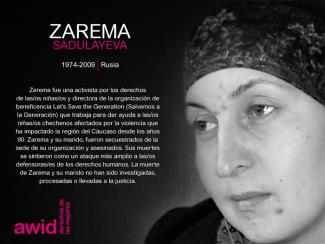
Zarema Sadulayeva
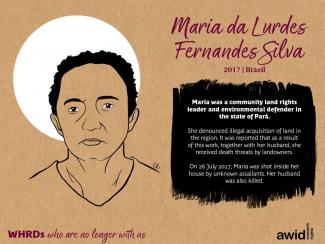
Maria da Lurdes Fernandes Silva
¿Cuántas respuestas a la encuesta desean recoger?
Nuestra meta es alcanzar un total de 200 respuestas, prácticamente el doble de la cifra registrada en la última encuesta ¿Dónde está el dinero? de 2011.
¿Cuál es el tema del 14° Foro Internacional de AWID?
El tema del 14° Foro Internacional de AWID es «Realidades feministas: nuestro poder en acción».
Entendemos las realidades feministas como los diferentes modos de existir y ser que nos muestran lo que es posible, a pesar de los sistemas de poder dominantes, y en desafío y resistencia contra ellos. Entendemos estas realidades feministas como recuperaciones y corporizaciones de esperanza y poder, multidimensionales, dinámicas, y arraigadas en contextos y momentos históricos específicos.
Snippet FEA Introducing Carmen Silva Ferreira (EN)
We have the pleasure to introduce you to Carmen Silva Ferreira.
She was born in Bahia, the Northeastern part of Brazil. She is an immigrant, a social activist and a mother of 8 children.
Carmen experienced homelessness at the age of 35, after migrating to Sao Paulo on her own. This led her to become a fierce advocate for vulnerable, marginalized and invisibilized communities most affected by the housing crisis. She eventually became one of the founders of MSTC in 2000.
As a visionary political organizer and the current leader of the MSTC, Carmen’s work has laid bare the city's housing crisis and provided inspiration to others on different ways to organize and manage occupations. She stood strong on the forefront of several occupations. One of them is the 9 de Julho Occupation, which now serves as a stage for direct democracy, and a space where everyone can be heard, seen, appreciated and work together.
Carmen has been long celebrated for her boldness in giving life back to abandoned buildings in the heart of São Paulo.
To know more about her life, you can follow her on Instagram!
Ana Fabricia Cordóba Cabrera
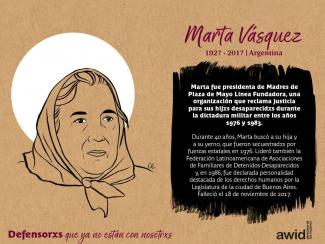
Marta Vásquez
Snippet - WITM FAQ - FR
Foire aux questions - FAQ
¿En qué será diferente este Foro?
Siempre hemos trabajado para garantizar que nuestros Foros sean desarrollados conjuntamente con nuestrxs afiliadxs, los movimientos, y nuestros colectivos prioritarios.
Para el Foro 2020 queremos profundizar y fortalecer este espíritu y esta práctica de creación conjunta y colaboración. También reconocemos la necesidad de mejorar el equilibrio entre la inclusión de muchas voces y experiencias y el espacio para que lxs participantes y el equipo respiren, se tomen una pausa, y disfruten de un poco de tiempo de inactividad.
Este Foro será diferente en cuanto a que:
- Tendremos muchas menos actividades organizadas, porque queremos que la gente tenga tiempo para relacionarse y hablar entre sí, experimentar, procesar, etc. Es fundamental que sepas que puedes venir al Foro, participar y ser muy activx, y no facilitar ninguna actividad organizada (o «sesión»).
- Tendremos Espacios Abiertos (al menos una tarde entera sin ninguna actividad organizada), y también espacios físicos disponibles durante todo el Foro para que la gente organice sus propias reuniones.
- Tendremos un Comité de Contenido y Metodología compuesto por feministas de distintas regiones con experiencia en metodologías participativas, para apoyar al equipo de AWID y a quienes lideren actividades en el Foro en el uso de formatos creativos e interesantes para las actividades del Foro.
Snippet FEA ASOM Challenges Story 1 (ES)
DESAFÍOS
- Cambio Climático
- Acesso a créditos
- Intermediários