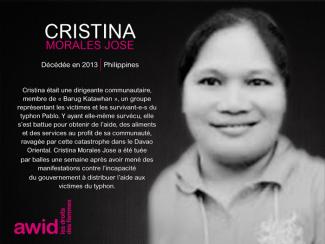
Cristina Morales Jose
Over the past few years, a troubling new trend at the international human rights level is being observed, where discourses on ‘protecting the family’ are being employed to defend violations committed against family members, to bolster and justify impunity, and to restrict equal rights within and to family life.
The campaign to "Protect the Family" is driven by ultra-conservative efforts to impose "traditional" and patriarchal interpretations of the family, and to move rights out of the hands of family members and into the institution of ‘the family’.
Since 2014, a group of states have been operating as a bloc in human rights spaces under the name “Group of Friends of the Family”, and resolutions on “Protection of the Family” have been successfully passed every year since 2014.
This agenda has spread beyond the Human Rights Council. We have seen regressive language on “the family” being introduced at the Commission on the Status of Women, and attempts made to introduce it in negotiations on the Sustainable Development Goals.
AWID works with partners and allies to jointly resist “Protection of the Family” and other regressive agendas, and to uphold the universality of human rights.
In response to the increased influence of regressive actors in human rights spaces, AWID joined allies to form the Observatory on the Universality of Rights (OURs). OURs is a collaborative project that monitors, analyzes, and shares information on anti-rights initiatives like “Protection of the Family”.
Rights at Risk, the first OURs report, charts a map of the actors making up the global anti-rights lobby, identifies their key discourses and strategies, and the effect they are having on our human rights.
The report outlines “Protection of the Family” as an agenda that has fostered collaboration across a broad range of regressive actors at the UN. It describes it as: “a strategic framework that houses “multiple patriarchal and anti-rights positions, where the framework, in turn, aims to justify and institutionalize these positions.”
Meet Sabrina Sanchez, remarkable trans migrant woman, sex worker, organizer, transfeminist and one of the founders of the union OTRAS.
Originally from Mexico City, she migrated to Spain 17 years ago after getting a degree in communications and started working as a sex worker.
It didn’t take long before she became involved with trans activism and sex worker activism in Barcelona. After joining the collective Asociación de Profesionales del Sexo (Association of Sex Workers, Aprosex), she started working in its secretariat and founded the Spanish sex workers union OTRAS.
She currently lives in Amsterdam where she works as the coordinator of the European Sex Workers’ Alliance.
Fun fact: she’s also a car mechanic and serious runner!
The theme of the 14th AWID International Forum is: “Feminist Realities: our power in action”.
In this Forum, we will celebrate and amplify powerful propositions that are around us, in all stages of development.
Os dados serão processados para fins estatísticos para esclarecer o estado de financiamento dos movimentos feministas globalmente e serão divulgados apenas em forma agregada. A AWID não divulgará informações sobre uma organização específica ou informações que permitam identificar uma organização através da respetiva localização ou características sem o respetivo consentimento comprovado.
A war that exists only for those of us living in this territory.
I live in a country no one understands, which few can really see, where various realities co-exist, and where the truth is murdered time and again.
I live in a country where one has to pay for the audacity of thinking for oneself, for taking on the challenge of seeing life another way.
I live in a country of women who have had to invent and reinvent, time and again, how they live and how to get by.
I live in Venezuela, in a time of an unusual and extraordinary threat.
Since 2012 my country has been subjected to an unconventional war. There are no defined armies or fire power. Their objective is to dislocate and distort the economy, affecting all households, daily life, the capacity of a people to dream and build a different kind of politics, an alternative to the patriarchal, bourgeois, capitalist democracy.
Venezuelan women are the primary victims of this economic war. Women who historically and culturally are responsible for providing care, are the most affected and in demand. However, in these years of economic and financial embargo, Venezuelan women have gone from being victims to the protagonists on the front lines defending our territory.
Battles are fought from the barrios, kitchens, and small gardens. We defend the right of girls and boys to go to school, and to be given something so simple as some arepas for breakfast.
Arepas are a kind of corn cake that can be fried, roasted or baked and served sweet or savoury as a side or main dish. It is a staple in the diet of all Venezuelans.
In Venezuela, arepas mean culture, family, food sovereignty, childhood nostalgia, the expert hands of grandmothers molding little balls, the warmth that comforts you when recovering from illness.
Arepas connect us as a people with the pre-Colombian cultures of corn, a resistance that has endured for more than five centuries. They are the Caribbean expressed differently on firm ground.
They are an act of resistance.
When my mother was a girl, they would start grinding the dry corn early in the morning to make arepas. The women would get up and put the kernels of corn in wooden mortars and pound it with heavy mallets to separate the shells. Then they would boil, soak, and grind the corn to make dough, and finally they would mold it into round arepas. The process would take hours and demand a lot of physical effort.
In the mid-20th century a Venezuelan company industrialized the production of corn meal. For an entire generation that seemed like an act of liberation, since there was now a flour that you could simply add water to and have hot arepas in 45 minutes time.
But that also meant that the same generation would lose the traditional knowledge on how to make them from scratch. My grandmother was an expert arepa maker, my mother saw it as a girl, and for me the corn meal came pre-packaged.
In the war with no military, the pre-cooked corn meal came to be wielded as an instrument of war by the same company that invented it, which was not so Venezuelan anymore: today the Polar group of companies is transnational.
We women began to recuperate our knowledge by talking with the eldest among us. We searched in the back of the closets for our grandmothers’ grinders, the ones we hadn’t thrown away out of affection. Some families still prepared the corn in the traditional way for important occasions. In some towns there were still communal grinding stations which had been preserved as part of local history or because small family businesses refused to die. All of these forms of cultural resistance were activated, and we even went so far as to invent new arepas.
Today we know that in order to resist we cannot depend on one food staple. Although corn arepas continue to be everyone’s favourite, we have invented recipes for arepas made of sweet potato, cassava, squash, and celery root.
We have learned that we can use almost any root vegetable to make arepas. Cooperative businesses have developed semi-industrial processes to make pre-cooked corn meal. In other words, we have recuperated our arepas and their preparation as a cultural good that belongs to all.
My artivism aims to decolonize our senses in everyday life. I like to create spaces that communicate how we weave together our different struggles, and that render visible dissident (re)existences, other possible worlds, and living bodies here in the SOUTH.
As we continue to fight in our struggles, let us remember how essential it is that we support each other, believe each other, and love ourselves and our sisters. When this system fucks us over, we must take time to look after our (physical and mental) health, that of our sisters, and to understand that each one of us carries unique stories, making us fighters in resist

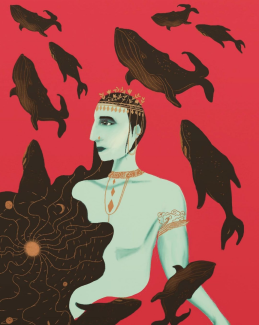
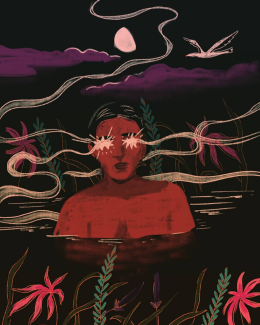
These portraits are inspired by the voices of resistance and protest movements in Latin America, especially by the key role that feminised bodies play in these struggles. It is a tribute to the grassroots feminist movements in resistance.
Jessica est une artiste-activiste queer de Toronto, au Canada, mais qui vit actuellement en Bulgarie. Elle a plus de 15 ans d'expérience dans la riposte au VIH, travaillant aux intersections du genre et du VIH auprès de populations clés (travailleurs·ses du sexe, femmes consommatrices de drogues, communautés LGBTQI, personnes incarcérées et, bien sûr, personnes vivant avec le VIH). Jessica aime créer du mouvement et réfléchir/entreprendre/élaborer des stratégies sur des interventions basées sur les arts. L'un des projets amusants qu'elle a lancé en 2013 était LOVE POSITIVE WOMEN (Femmes positives à l’amour), qui implique plus de 125 groupes et organisations communautaires du monde entier, du 1er au 14 février, pour célébrer les femmes vivant avec le VIH dans leurs communautés.
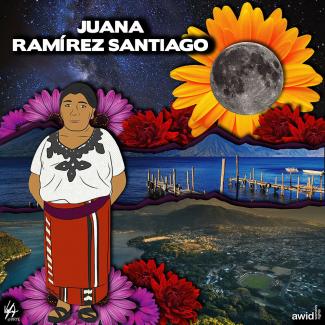
Ayant co-fondé le réseau Red de Mujeres Ixiles de Nebaj, une organisation de défense des droits des femmes autochtones, membre de l’Initiative mésoaméricaine des femmes défenseur-e-s des droits humains (IM-Defensoras en espagnol), Juana était actuellement membre de son conseil d’administration.
Elle était également sage-femme et mère de 7 enfants. Juana avait reçu des menaces de mort qui avaient été signalées au bureau du procureur. Juana est la troisième défenseure autochtone assassinée dans la région en 2018. L'Ombudsman pour le Guatemala a signalé qu'au total 20 défenseur-e-s ont été tué-e-s dans le pays cette année.
Juana Ramírez Santiago a été abattue par des assaillants non identifiés alors qu'elle traversait un pont à Nebak, Quiché, au Guatemala. Les enquêtes visant à identifier les auteurs sont en cours.
Enciende tu fuego feminista leyendo nuestras investigaciones y publicaciones varias sobre financiamiento, defensoras de derechos humanos, construcción de movimientos, fundamentalismos, justicia económica, seguimiento y evaluación feminista y más
كلا. يبني هذا الاستطلاع على المعلومات التي حشدتها جمعية حقوق المرأة في التنمية حول كيفية الحصول على تمويل أكبر وأفضل للحركات النسوية وحركات التغيير الاجتماعي وهذه الدورة الثالثة لاستطلاع "أين التمويل للتنظيمات النسوية". نهدف للقيام بالاستطلاع مرة كل ثلاثة أعوام.
Ȃurea Mouzinho is a feminist economic justice organizer from Luanda, Angola, with a 10-year career in research, grant-making, advocacy, and movement-building for women's rights and economic justice across Africa and the global south. Currently the Program Manager for Africa at Thousand Currents, she also serves on the Feminist Africa Editorial Board and is a member of Ondjango Feminista, a feminist collective she co-founded in 2016. A new mom to a Gemini boy, Ȃurea enjoys slow days with her young family and taking long strolls by the beach.
She occasionally tweets at @kitondowe.
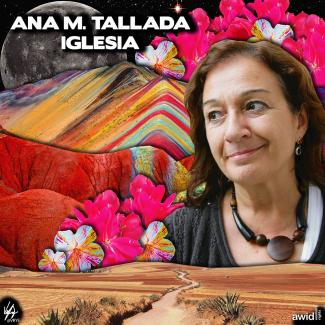
Ana was a strong advocate of women’s rights and worked with a broad cross-section of women, from those in grassroots networks to those in the private sector.
She believed in building bridges across sectors. Ana was a member of the National Network for the Promotion of Women (RNPM), and was active in developing many social programs that address issues such as sexual and reproductive health and rights.
par Karina Ocampo
C’est dans un recoin caché du Chiapas, au Mexique, que nous sommes arrivées, femmes et dissidentes sexuelles, pour organiser nos actions. (...)
< illustration : « La muerte sale por el Oriente » [la mort se lève à l’Est], par Sonia Madrigal
Если у вас есть какие-либо вопросы или сомнения, пожалуйста, свяжитесь с нами через форму здесь, указав «Опрос «Где деньги?» (WITM Survey) в качестве заголовка вашего сообщения. или напишите нам по адресу witm@awid.org


Simone a 20 ans d’expérience dans le soutien à la gestion et l’administration dans des organisations à but non lucratif, en particulier dans l’enseignement médical post universitaire et la formation aux Technologies de l'Information et de la Communication. Elle possède des qualifications en soutien à la gestion et en études parajuridiques. Elle est basée en Afrique du Sud, aime voyager et agit en tant que généalogiste amatrice.
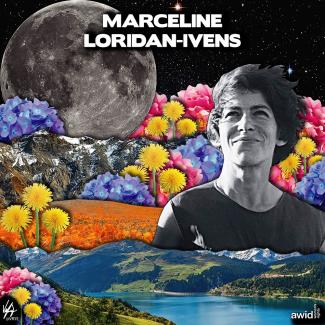
Nacida en 1928, Marceline trabajó como actriz, guionista y directora.
Dirigió The Birch-Tree Meadow en 2003, protagonizada por Anouk Aimee, así como varios otros documentales. También fue una sobreviviente del Holocausto. Tenía solo quince años cuando ella y su padre fueron arrestadxs y enviadxs a campos de concentración nazis. Los tres kilómetros entre su padre en Auschwitz y ella en Birkenau eran una distancia infranqueable, sobre la cual escribió en una de sus novelas más influyentes: Pero no regresaste.
Al hablar sobre su trabajo, una vez afirmó: «Todo lo que puedo decir es que todo lo que pueda escribir, todo lo que pueda develar, es mi tarea hacerlo».