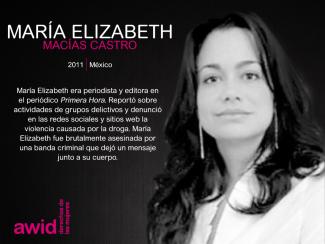
Maria Elizabeth Macias Castro
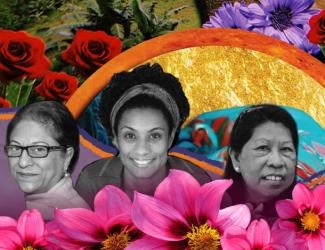
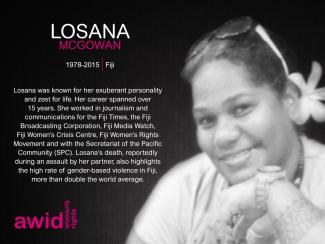
AWID’s Tribute is an art exhibition honouring feminists, women’s rights and social justice activists from around the world who are no longer with us.
This year’s tribute tells stories and shares narratives about those who co-created feminist realities, have offered visions of alternatives to systems and actors that oppress us, and have proposed new ways of organising, mobilising, fighting, working, living, and learning.
49 new portraits of feminists and Women Human Rights Defenders (WHRDs) are added to the gallery. While many of those we honour have passed away due to old age or illness, too many have been killed as a result of their work and who they are.
This increasing violence (by states, corporations, organized crime, unknown gunmen...) is not only aimed at individual activists but at our joint work and feminist realities.
The portraits of the 2020 edition are designed by award winning illustrator and animator, Louisa Bertman.
AWID would like to thank the families and organizations who shared their personal stories and contributed to this memorial. We join them in continuing the remarkable work of these activists and WHRDs and forging efforts to ensure justice is achieved in cases that remain in impunity.
“They tried to bury us. They didn’t know we were seeds.” - Mexican Proverb
It took shape with a physical exhibit of portraits and biographies of feminists and activists who passed away at AWID’s 12th International Forum, in Turkey. It now lives as an online gallery, updated every year.
To date, 467 feminists and WHRDs are featured.
Fadila M. fue una activista tribal soulaliyate de Azrú, en la región Ifrane de Marruecos. Luchó contra una forma específica de discriminación territorial dirigida a las mujeres tribales.
Como parte del Movimiento de Mujeres Soulaliyate por el Derecho a la Tierra, trabajó para reformar el marco legislativo relacionado con la administración de la propiedad comunitaria, a través de la adopción, en 2019, de tres proyectos de ley que garantizan la igualdad de mujeres y varones.
Según las leyes consuetudinarias vigentes, las mujeres no tenían derecho a beneficiarse de la tierra, en especial aquellas que eran solteras, viudas o divorciadas. En Marruecos, los derechos a las tierras colectivas eran transmitidos tradicionalmente entre los varones de la familia mayores de 16 años. Desde 2007, Fadila M. ha sido parte del movimiento de mujeres, la primera movilización nacional de base por los derechos a la tierra. Una de sus conquistas ha sido que, en 2012, las mujeres soulaliyate pudieron registrarse por primera vez en las listas de beneficiarixs, y recibir compensaciones relacionadas con la cesión de tierras. El movimiento también logró la enmienda del dahir (decreto del Rey de Marruecos) de 1919, para garantizar el derecho a la igualdad de las mujeres.
Fadila M. falleció el 27 de septiembre de 2018. Las circunstancias de su muerte no son claras. Participó en una marcha de protesta relacionada con el tema de las tierras colectivas y, si bien las autoridades informaron que su muerte fue accidental y que tuvo un paro cardíaco camino al hospital, la sección local de la Asociación de Derechos Humanos de Marruecos (AMDH) señaló que Fadila fue sofocada por un miembro de la fuerza policial utilizando una bandera marroquí. Su familia solicitó una investigación, pero los resultados de la autopsia no fueron dados a conocer.
Más información sobre el Movimiento de Mujeres Soulaliyate por el Derecho a la Tierra (en inglés)
Nota: Como no ninguna fotografía/imagen de Fadila M. disponible, la obra de arte (en lugar de un retrato) pretende representar por lo que luchó y trabajó: la tierra y los derechos a vivir y tener acceso a esa tierra y lo que crece en ella.
From building prospect funders lists with *templates*, to understand how to write a solid grant proposal, with ‘Getting the Money we Need’ Guide really we don't have to figure this out alone anymore
Read and download the guide hereText-only version
Du 2 au 5 décembre 2024, à Bangkok, en Thaïlande ! Nous nous rassemblerons au Centre national de convention de la Reine Sirikit (QSNCC) et aussi virtuellement en ligne.
some text some text some text some text some text some text some text some text some text some text some text some text
some text some text some text some text some text some text some text some text some text some text some text some text
We’re beginning a new year--2023. COVID-19 continues to infect and re-infect many, many people around the world. We are witnessing the resurgence of right-wing and fascist governments, even in places we may not have expected like Sweden. War, armed conflict, and dramatic increase in militarization, militarism, and military spending are enabling the unbridled capital accumulation by the few, with participation of seemingly “strange” alliances locking arms, both visibly and invisibly, where economic and political elites of the Global North and Global South are benefitting beyond our wildest imagination. In the meanwhile, our people and the natural environment pay enormous costs and suffer all the expected and unexpected consequences.
As all of you and all of us at AWID know, feminists in multiple movements around the world are resisting and organizing against multiple faces of tyranny, creating alternative structures, implementing grassroots strategies, and building transnational alliances. We are generating joy, inspiring one another, singing, and dancing within and against the prevailing culture of killing and cynicism that seems to have engulfed so much of the world.
We--Staff and Board--of AWID are prepared and inspired more than ever before to face challenges by strengthening our relationships with our members and organizational partners, meeting and getting to know those who we are yet to meet and do what we do best: support the global feminist movements. Although we were sad facing the departures of our beloved former Co-Eds Cindy and Hakima, our wonderful new Co-EDS Faye and Inna along with committed and creative staff have embraced the moment that encapsulates both opportunities and threats.
For sure, all of us at AWID and all our movement folks know: As the Caribbean US poet and activist June Jordan wrote to the South African women activists during the height of the apartheid regime, “We are the ones we have been waiting for”!

Rosa Candida Mayorga Muñoz était une travailleuse sociale, leader syndicale et défenseure des droits humains du Guatemala. On la surnommait affectueusement Rosita.
Dans les années 1980, Rosa devient la première femme à siéger au comité exécutif du syndicat de l’Institut d’électrification nationale (STINDE), syndicat qu’elle avait rejoint en premier lieu pour défendre les droits des femmes au travail. Cela signifiait, à ses yeux, de lutter pour l’égalité des chances dans une entreprise où de nombreuses femmes affrontaient un système discriminatoire et violent mis en place par la direction de l’entreprise. Rosa avait également subi du harcèlement sexuel sur son lieu de travail, tant de la part de collègues que de responsables. Elle n’entendait cependant pas rester silencieuse.
Rosa a continué à se battre et fait partie des efforts pour façonner la lutte afin qu’elle prenne la forme du « Pacte collectif pour les conditions de travail du INDE-STINDE ». Ce pacte était le premier du genre et le premier au Guatemala à caractériser le concept de harcèlement (sexuel). Il fait désormais référence dans la loi guatémaltèque pour les questions de travail, et sert d’encouragement aux autres syndicats.
« Elle n’avait d’autres outils pour se battre que ses propres idéaux... Elle a été intimidée à plusieurs reprises, harcelée pour abandonner la lutte, mais son courage a fait naître l’espoir chez les syndicalistes de la base. Rosita a créé une image de respect non seulement au sein de son syndicat mais également face aux autorités de l’institution et au sein du mouvement des femmes. Elle a été reconnue comme une pionnière du mouvement des femmes du syndicat, dans un espace qui avait davantage été dominé par les hommes. » - Maritza Velasquez, ATRAHDOM
Rosa est décédée le 4 avril 2018, elle avait 77 ans.
A closer look at actual budgets reveals major income diversity and inequality.
Please calculate your costs of travel to Bangkok, accommodations and per diem, visa, any accessibility needs, and incidentals, on top of a registration fee that will be announced soon. Hotels in the Sukhumvit area in Bangkok range from USD$50 to $200 per night, double occupancy.
AWID members receive a discount at registration, so if you are not a member yet, we invite you to consider becoming a member and joining our global feminist community.
Un réseau complexe et mouvant d’antidroits exerce une influence croissante dans les sphères internationales et les politiques locales. Souvent soutenu·e·s par des financements d’origine imprécise, ces acteur·rice·s renforcent leur impact en créant des alliances tactiques entre thématiques, régions et croyances.
Our funder database is currently under revision. We know feminists still need and deserve more and better resources!
Please join our mailing list to stay informe about this update.
You can also become a member and find and create connections with feminists around the world.
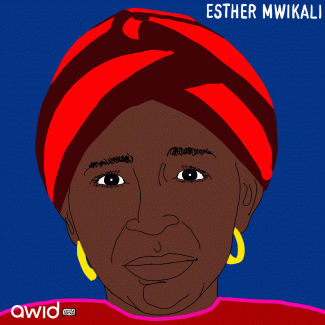
Esther Mwikali’s home was in Mithini village, Murang’a County, Kenya. A prominent and valued land rights activist, she looked into abuses against squatters who are living on land claimed by tycoons. The investigation Esther was part of also involved land rights’ violations in Makuyu by powerful individuals.
After failing to attend a village meeting, a search party went looking for Esther. On 27 August 2019, two days after her disappearance, her body was found on a farm near her homestead, displaying signs of torture. She was brutally murdered.
“Esther was renowned for her work to prevent community members being evicted from land claimed by tycoons. Local activists had no doubt her murder was related to the area’s ongoing land struggles, a tragic reminder of the alarming regularity with which extra-judicial killings are routinely carried out in Kenya,” - Global Witness Report, July 2020
“We associate Mwikali’s death with land struggles around here. We are asking the Government to investigate the matter without delay.” - James Mburu, spokesperson for the squatters
“Action should be taken on individuals who are alleged to have threatened the squatters including Mwikali's family.” - Alice Karanja, National Coalition of Human Rights Defenders
“The impact of her work and tenacity will remain alive in Kenya for decades. CJGEA consoles with the bereaved and it calls for justice.” - Center for Justice and Governmental Action (CJGEA) Press Release, 13 September 2019
Les organisations féministes et de défense des droits des femmes ne dépendent pas uniquement des financements institutionnels, elles s’autofinancent. Nos mouvements sont animés par la passion, la solidarité, l’engagement politique et le soin collectif.
Ces ressources autonomes et autogénérées sont souvent invisibles dans les budgets, mais elles sont le pilier de notre action collective.
Somos plenamente conscientes de los obstáculos prácticos y la angustia emocional asociada con los viajes internacionales, especialmente desde el Sur Global. AWID está trabajando con la Oficina de Convenciones y Exhibiciones de Tailandia para brindar apoyo a lxs participantes del Foro en la obtención de visas. En el momento de la inscripción se facilitará más información sobre esta ayuda para la obtención de visados, incluidos los datos de contacto para saber dónde y cómo solicitarla.
Follow our feminist superhero as she reclaims the narrative from anti-rights actors across the globe and saves the day, in this comic by illustrator Sophia Andreazza.
Le Forum a été un espace clé pour le Mouvement des femmes autochtones (Indigenous Women’s Movement, IWM) dans son rapport au féminisme. Aux Forums de l’AWID, elles ont appliqué la même stratégie que celle utilisée pour les Nations Unies. Au cours de ce processus, les deux mouvements ont été transformés : de nouvelles voix et questions ont émergé au sein de l’IWM, et les féministes ont commencé à changer leurs discours et leurs pratiques autour des droits fonciers et de la spiritualité, elles ont mieux compris les droits collectifs et ont inclus l’IWM dans leurs événements et leurs programmes. Mónica Alemán et María Manuela Sequeira, de l’IWM, nous ont raconté cette histoire.
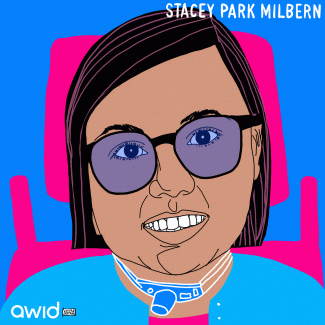
"No sé mucho sobre la espiritualidad o lo que sucede cuando morimos, pero mi vida de coreana crip queer me hace pensar que nuestros cuerpos terrenales son sólo una fracción de lo que somos, y no considerar a nuestros antepasadxs es quedarse con solo un atisbo de lo que somos". - Stacey Park Milbern
Stacey, junto con algunxs amigxs, co-creó el Club de Cultura de Justicia para la Discapacidad, un grupo dedicado a apoyar a varias comunidades, especialmente aquellas más vulnerables, que, entre otras cosas, está ayudando a las personas sin hogar a acceder a recursos durante la pandemia del COVID-19.
También fue coproductora de una campaña con mucho impacto para el documental de Netflix "Crip Camp", integrante de la junta directiva de la Fundación WITH, y dirigió organizaciones a nivel local, estatal y nacional. Stacey escribió además de manera hermosa y poderosa:
"Mis antepasadxs son personas forzosamente separadas de sus amores a causa de la guerra y el desplazamiento. Es gracias a ellxs que hoy conozco el poder de construir un hogar con lo que tienes, dondequiera que estés, con quien quiera que estés. Mis antepasadxs son queers que vivieron en el sur de América. Es gracias a ellxs que entiendo la importancia de las relaciones, del lugar y de vivir la vida al máximo, aunque sea peligroso. Todxs mis antepasadxs conocen el anhelo. El anhelo es a menudo nuestro lugar de conexión..." - Stacey Park Milbern
Stacey nació en Seúl, Corea, y creció en Carolina del Norte, para después continuar con su viaje en el área de la bahía de San Francisco. Stacey falleció por complicaciones de una cirugía en su cumpleaños número 33, el 19 de mayo de 2020.
Para leer un ensayo de Stacey Park Milbern (en inglés)
Para escuchar una entrevista con Stacey Park Milbern (en inglés)
#StaceyTaughtUs: Record your story for the Disability Visibility Project (en inglés)
"Ella fue, como mucha gente diría, una líder nata. En cierta medida, ella lo abarcó todo. ¿Sabes? Ella supo liderar desde la primera línea, desde el medio y también desde atrás. Era capaz de hacer todo eso de alguna manera." - Andraéa LaVant, activista por los derechos de las personas con discapacidad.
"Qué golpe perder a Stacey cuando nuestras comunidades necesitan de su liderazgo más que nunca, y en un momento en que su fuerza, perspicacia y agallas estaban recibiendo un mayor reconocimiento, más allá de los círculos de las personas con discapacidad, y le ofrecían una plataforma mayor para avanzar con el trabajo de su vida... No tendremos la suerte de aprender hasta dónde su carismático liderazgo nos habría llevado. Pero, sin ningún tipo de dudas: Lo que Stacey nos dio, en un tiempo relativamente corto, continuará beneficiando a otrxs en los próximos años". - Fondo de Educación y Defensa de los Derechos de las Personas con Discapacidad (DREDF, por sus siglas en inglés).