
Orouba Barakat
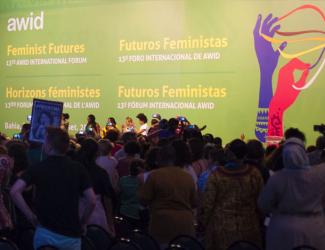
In September 2016, the 13th AWID international Forum brought together in Brazil over 1800 feminists and women’s rights advocates in a spirit of resistance and resilience.
This section highlights the gains, learnings and resources that came out of our rich conversations. We invite you to explore, share and comment!
One of the key takeaways from the 2016 Forum was the need to broaden and deepen our cross-movement work to address rising fascisms, fundamentalisms, corporate greed and climate change.
With this in mind, we have been working with multiple allies to grow these seeds of resistance:
And through our next strategic plan and Forum process, we are committed to keep developing ideas and deepen the learnings ignited at the 2016 Forum.
AWID Forums started in 1983, in Washington DC. Since then, the event has grown to become many things to many peoples: an iterative process of sharpening our analyses, vision and actions; a watershed moment that reinvigorates participants’ feminisms and energizes their organizing; and a political home for women human rights defenders to find sanctuary and solidarity.
There are many reasons why your response to the WITM survey matters. The survey offers the opportunity to share your lived experience of mobilizing funding to support your organizing; claim your power as an expert on how money moves and who it reaches; and contribute to collective and consistent advocacy to funders moving more and better funding. Over the last two decades, AWID’s WITM research has proven to be a key resource for activists and funders. We wholeheartedly invite you to join us in its third iteration to highlight the actual state of resourcing, challenge false solutions, and point out how funding must change for movements to thrive and meet the complex challenges of our times.
La recherche documentaire peut se dérouler tout au long de votre initiative. Elle peut vous aider à encadrer vos travaux, à choisir des questions de sondage et à comprendre vos résultats.
Dans cette section
- Préciser le contexte
- S’appuyer sur les connaissances existantes
- Sources éventuelles d’information pour la recherche documentaire
1. Sites Web et rapports annuels des donateurs
2. Sources d’information en ligne
La réalisation de recherches documentaires tout au long de votre initiative peut vous aider à encadrer vos travaux, à choisir les questions de sondage et à vous fournir une clarté contextuelle, tout en rehaussant votre compréhension des résultats de votre sondage. Vous pourriez notamment comparer les similarités et les différences entre les résultats de votre sondage et l’information diffusée par la société civile et les donateurs.
Il se peut que vous déceliez des tendances dans les résultats de votre sondage et que vous souhaitiez mieux les comprendre.
Par exemple, vos données de sondage pourraient révéler que les budgets des organisations diminuent, mais cela ne vous dit pas pour quelle raison cette situation se produit. L’analyse des publications vous donne un contexte et vous révèle certaines des raisons pour lesquelles ces tendances surviennent.
La recherche documentaire garantit également que vous appuyez votre recherche sur les connaissances existantes touchant à votre sujet d’intérêt, confirmant ainsi la validité et la pertinence de vos résultats.
Vos résultats pourraient être complémentaires ou contradictoires par rapport aux connaissances actuelles, mais ils doivent faire référence aux données existantes sur le sujet.
Pour que votre recherche soit complète et englobe tout le panorama du financement qui entoure votre sujet, examinez une gamme de secteurs de financement.
Vous pouvez notamment considérer :
- Les fonds pour les femmes
- Les fondations privées et publiques
- Les organisations non gouvernementales internationales (ONGI)
- Les agences bilatérales et multilatérales
- Les acteurs et actrices du secteur privé
- Les philanthropes
- Les groupes de financement participatif
Inclure tout secteur pertinent dans le cadre de référence de votre recherche.
Par exemple, vous pourriez décider qu’il est important d’effectuer des recherches sur les organisations non gouvernementales (ONG) locales.
Voici des sources directes d’information sur les actions des bailleurs de fonds qui contiennent habituellement des renseignements sur les politiques et les budgets. Si vous réalisez vos recherches avant d’interviewer les donateurs, vos questions seront mieux ciblées et vos interviews plus solides.

• 1-2 mois
• 1 personne (ou plus) chargée de la recherche
7. Synthétisez les résultats de votre recherche
Foro de Mujeres sobre Financiación para la Igualdad de Género
Foro de las OSC en la Conferencia Internacional sobre la FpD
Tercera Conferencia Internacional de la ONU sobre la Financiación para el Desarrollo
“Nous Sommes la Solution a une vision d'une Afrique où, solidairement, les femmes rurales impliquées dans la prise de décision peuvent cultiver, transformer, vendre et consommer les produits de l'agriculture familiale tout en préservant l'environnement, pour un développement harmonieux et durable”

No. Valoramos muchísimo su trabajo, pero no estamos buscando respuestas de fondos de mujeres/feministas por el momento. Alentamos a compartir la encuesta con sus socios beneficiarios y con sus redes feministas.
In the current context, we have identified five major threats to the struggle towards feminist just economies.
“Financialisation refers to the increasing importance of financial markets, financial motives, financial institutions, and financial elites in the operation of the economy and its governing institutions both at the national and international levels”. - Gerald Epstein
Epstein Gerald A. 2006: Financialization and the World Economy. Edward Elgar Publishing.
Financial institutions exert a strong influence over economic governance and the direction of development policy. The growing dominance of the corporate sector and international financial institutions in defining local and global public policies, has resulted in the capture of the State in the interest of capital. The current financial system, including controversial credit and debt policies, are integral to the reproduction and expansion of capital accumulation processes.
This raises important questions of how to regulate and re-think the global financial system, not only to avoid serious negative consequences of debt-driven crises,but to allow for sustainable livelihoods and the realization of economic and social rights without retrogression.
For more details, see the article by Balakrishnan and Heintz “Debt, Power, and Crisis: Social Stratification and the Inequitable Governance of Financial Markets”
For the past 20 years, trade agreements (both bilateral or multilateral) have expanded their role demonstrating increased interest in Intellectual Property Rights (IPR) to be given to corporations.
IPR has clearly benefitted transnational corporations with huge impacts on the ability of poorer nations and peoples to realize human rights, notably:
In addition, agriculture import liberalisation resulting in an influx of cheap goods jeopardise women’s self-employed farmers in poor countries and food security. Investment protection clauses included in trade agreements limit the policy space of national governments to create and enforce regulations on issues as crucial as environmental protection, labour rights, and the duration of copyrights.
Feminist movements have been, and are, at the forefront of resistance to these agreements exposing its pitfalls.
(See for example, the reactions by feminist networks around the globe to both the Transatlantic and TransPacific Trade and Investment Partnership Agreement negotiations.)
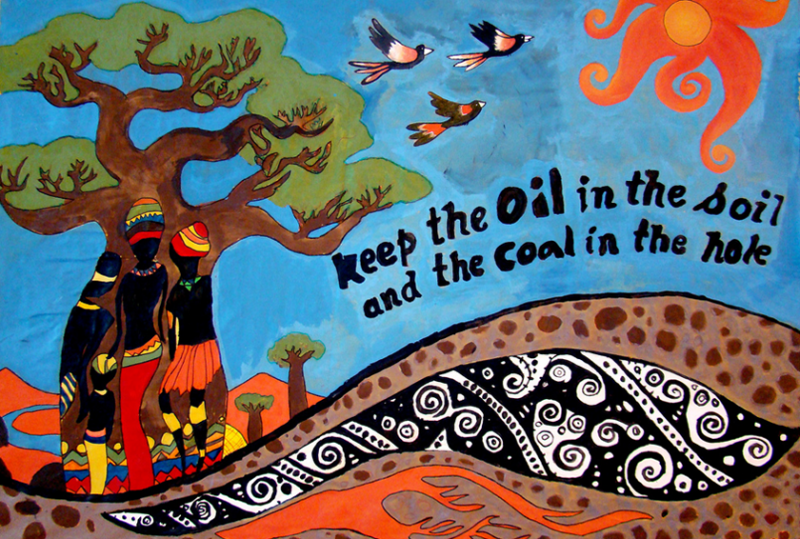
The commodification of the Earth’s resources and resulting environmental degradation and climate change produced by decades of aggressive industrialisation, plunder and extractivism of the world’s resources, have damaged biodiversity and ecological resilience. These damages are now threatening the existence of human society itself.
The international community has failed to address production and consumption patterns sitting at the root of the problem. Instead, governments –with the support of large corporations interested in making a profit - are leaning towards a “green economy” approach promoting “energy-efficient technologies” (including nuclear energy, biofuels, genetically modified organisms and geo-engineering) and carbon trade schemes as the silver bullet.
While the processes of land and resource appropriation is not new – in fact, they are central struggles in colonial histories- what is new is the advanced means by which land and natural resource wealth are becoming commodities in new markets.
International Financial Institutions play a central role in promoting land markets in developing countries. These institutions finance land reforms that enable powerful actors to use land for speculative gain in exchange of meagre promises of jobs and growth. Land-grabbing has far reaching negative impacts on local peoples’ access to essential goods and services apart from displacement and environmental degradation that are associated with it.
People who are resisting land grabbing, among them women human rights defenders, face diverse forms of violence including physical attacks and sexual abuse, on a daily basis.
This patriarchal foundation is particularly hegemonic in today’s neoliberal models.
The many ways in which political economy and development are connected to sexuality or gender is evident: think how capitalism defines what can even be characterized as labour and ties human worth to wage-labour productivity.
For the most part, women’s position in the global economy continues to be one of gender-based labour exploitation with women’s work undervalued in precarious jobs, domestic subsistence, reproduction, and in unwaged household production. Because reproductive labour has been naturalized as women's unpaid work, it has provided an immense subsidy to capitalism at the same time as a source of gender oppression and subjugation.
This situation is aggravated by the fact that as social protection mechanisms begin to dwindle, women’s care burden increases.
Further, the phenomenon of global migration spurred on by thousands of economic refugees escaping oppressive poverty across the globe is not estranged to that of capitalist gender power relations. Remittances become a major source of development financing for the families and communities, but at a major cost for women migrants who struggle to earn a living wage in their new country.
In the same vein, we have seen how patriarchal capitalist systems are using violence and oppression to maintain their status quo. Rising global expenditures in militarism and violence, both perpetrated by state and non-state actors, is increasingly used to control dissent, women’s bodies and voice and settle economic, political and social disputes.
Across the world, violence, incarceration and discrimination disproportionately targets
An intersectional analysis linking gender, race, ethnicity, age, ability, nationality, sexual orientation and gender identity, among other status is needed to challenge structural violence and its links with a capitalist global system.
A profound crisis in the current global governance system is also evident in the feeble inter-governmental agreements reached and how they often lack the most fundamental accountability mechanisms. The multilateral system that served global governance before is failing to respond to the current multiple crises. The same system continues to be deeply undemocratic, with increasing presence and power by corporations occupying the spaces where States used to be.
These threats challenge feminists to re-think our framework and strategies. To renew and reactivate our commitment to movement building with others for a just economy.
They challenge us to consider broad agendas for socio-economic transformations, from a feminist perspective, in ways that address the realities of the majority of the impoverished. Now is the time to bring about change for a just economy and to address the persistent systemic challenges.
Le 14e Forum a pour thème « Réalités féministes: notre pouvoir en action ».
Nous concevons les Réalités féministes comme différentes façons d’exister et d’être qui nous révèlent ce qui est possible, au mépris et malgré les systèmes de pouvoir dominants, et en résistance à ces derniers. Nous concevons ces réalités féministes comme des revendications et des incarnations d’espoir et de pouvoir, et comme des réalités multidimensionnelles, dynamiques et ancrées dans des contextes et des moments historiques spécifiques.


Oui, l’enquête est accessible depuis les téléphones intelligents.
La activista y académica Soma Kishore Parthasarathy señala que existen diversas formas de pensar los bienes comunes.
En un sentido más convencional, se los entiende como recursos naturales destinados a ser usados por quienes dependen de su uso. Sin embargo, el concepto de «bienes comunes» se ha expandido para incluir recursos como los conocimientos, la herencia, la cultura, espacios virtuales e incluso el clima. Es un concepto anterior al régimen de propiedad individual y que aportó las bases para la organización social. Las definiciones que aportan las entidades gubernamentales limitan su alcance a los recursos de la tierra y materiales.
El concepto de los bienes comunes se apoya en la práctica cultural de compartir espacios de subsistencia y recursos como dones de la naturaleza, para el bien común, y para la sostenibilidad de lo que es común a todxs.
Los bienes comunes de la humanidad están cada vez más amenazados porque las naciones y fuerzas del mercado continúan colonizándolos, explotándolos y ocupándolos.
En algunos contextos favorables, los «bienes comunes» tienen el potencial de habilitar una posición de autonomía sobre todo para las mujeres bajo opresión económica desde la que pueden negociar sus múltiples necesidades y aspiraciones.
Cuando a las mujeres y a otros géneros oprimidos se les niega el acceso a los bienes comunes y la posibilidad de controlarlos, se refuerza el patriarcado.
Por eso, una economía feminista busca restaurar los derechos legítimos de las comunidades a estos recursos comunes. Esa autonomía les permite mantenerse a sí mismas al mismo tiempo que desarrollan sistemas más igualitarios de gobernabilidad y de uso de esos recursos. Una economía feminista reconoce los roles de las mujeres y les ofrece las mismas oportunidades para tomar decisiones, es decir, las coloca en igualdad de condiciones como demandantes de esos recursos.
Nous avons toujours veillé à ce que nos Forums soient développés conjointement avec nos partenaires, nos mouvements et nos groupes prioritaires.
Pour cette édition 2020, nous visons à approfondir et renforcer cet esprit et cette pratique de co-création et de collaboration. Nous reconnaissons également la nécessité d’améliorer l’équilibre entre l’inclusion de nombreuses voix et les expériences, tout en laissant aux participant-e-s et au personnel la possibilité de respirer, faire une pause et profiter de certains temps d’arrêt.
Ce Forum sera différent des diverses façons suivantes:

