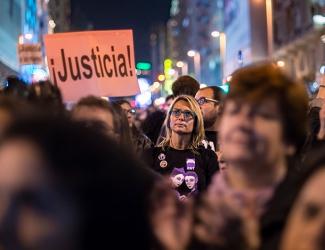
Advancing Universal Rights and Justice
Uprooting Fascisms and Fundamentalisms
Across the globe, feminist, women’s rights and gender justice defenders are challenging the agendas of fascist and fundamentalist actors. These oppressive forces target women, persons who are non-conforming in their gender identity, expression and/or sexual orientation, and other oppressed communities.
Discriminatory ideologies are undermining and co-opting our human rights systems and standards, with the aim of making rights the preserve of only certain groups. In the face of this, the Advancing Universal Rights and Justice (AURJ) initiative promotes the universality of rights - the foundational principle that human rights belong to everyone, no matter who they are, without exception.
We create space for feminist, women’s rights and gender justice movements and allies to recognize, strategize and take collective action to counter the influence and impact of anti-rights actors. We also seek to advance women’s rights and feminist frameworks, norms and proposals, and to protect and promote the universality of rights.
Our actions
Through this initiative, we:
- Build knowledge: We support feminist, women’s rights and gender justice movements by disseminating and popularizing knowledge and key messages about anti-rights actors, their strategies, and impact in the international human rights systems through AWID’s leadership role in the collaborative platform, the Observatory on the Universality of Rights (OURs)*.
- Advance feminist agendas: We ally ourselves with partners in international human rights spaces including, the Human Rights Council, the Commission on Population and Development, the Commission on the Status of Women and the UN General Assembly.
- Create and amplify alternatives: We engage with our members to ensure that international commitments, resolutions and norms reflect and are fed back into organizing in other spaces locally, nationally and regionally.
- Mobilize solidarity action: We take action alongside women human rights defenders (WHRDs) including trans and intersex defenders and young feminists, working to challenge fundamentalisms and fascisms and call attention to situations of risk.
Related Content
Why are you asking for the name of the group, organization and/or movement completing the survey and our contact information?
We are asking for this data to facilitate the review of responses, avoid duplication and be able to contact your group in case you have been unable to complete the questionnaire and/or you have doubts or further questions. You can learn more about how we use the personal information we collect through our work here.
What is at stake for women’s rights?
Development financing has specific threats and opportunities for women's and all people’s human rights. Transformative development financing and policies can make an important contribution to the systemic changes that are needed to ensure the respect, protection and fulfillment of women’s human rights.
2015 is an important year for the FfD process. The Third International Conference on FfD took place from 13-16 July 2015 in Addis Ababa, Ethiopia and governments are finalising the post-2015 development agenda including agreements on how the new Sustainable Development Goals will be financed.
The current stage of the FfD process is an important opportunity to establish a financing framework that will ensure effective financing for the implementation of the post 2015 agenda and the Sustainable Development Goals (SDGs). It is also an opportunity to address the structural conditions, and systemic changes needed, for the full implementation of other agendas and commitments such as Human Rights Conventions, and the Beijing Platform for Action.
Over the last 13 years, women’s rights and feminist organizations have actively engaged in the FfD process.
Snippet - WITM why - AR
لماذا عليّ تعبئة الاستطلاع؟
What languages will be included in the Forum?
English, French, Spanish and Mandarin.
Snippet - WITM To make - PT
Para dar ênfase à complexidade do financiamento de várias formas de organização feminista;
Snippet - WITM About the survey - PT
Sobre o inquérito
- GLOBAL E DIVERSO: Reflete sobre as realidades de financiamento da organização feminista em escala global e separadas por regiões
- CONTEXTUALIZADO: Dá enfâse às vozes, perspetivas e experiências vividas dos movimentos feministas com toda a sua riqueza, coragem e diversidade, nos seus respetivos contextos
- CRIADO EM COLABORAÇÃO: Desenvolvido e testado em colaboração conjunta com membres da AWID e parceires do movimento
- COMPLEMENTAR: Contribui para os testemunhos existentes e aprofunda os mesmos sobre o estado de financiamento para a organização feminista, de direitos das mulheres e de justiça de género por ativistas, financiadores feministas e aliados
- MULTILINGUE: Disponível em árabe, inglês, francês, português, russo e espanhol.
- CONFIDENCIAL: Damos prioridade à sua privacidade e ao seu anonimato. A AWID jamais divulgará informações sobre uma organização específica ou informações que permitam identificar uma organização através da respetiva localização ou características. A nossa política de privacidade detalhada está disponível aqui.
- ACESSÍVEL: Acessível para pessoas com uma variedade diversificada de habilidades auditivas, de movimento, visuais e cognitivas, sendo que demora aproximadamente 30 minutos a ser realizado.
- REPRODUZÍVEL: Pode ser reproduzido através dos movimentos nos seus respetivos contextos; ferramentas de inquérito e conjuntos de dados estarão disponíveis publicamente para abranger mais inquéritos e advocacia coletiva.
Snippet - WITM FAQ - PT
Perguntas Frequentes
Может ли одна группа заполнить несколько опросов?
Нет, мы просим только один заполненный опрос от каждой группы.
Posso realizar o inquérito fora do KOBO e partilhar as minhas respostas convosco por e-mail?
Somente no caso de problemas de acessibilidade e/ou se realizar o inquérito noutro idioma; caso contrário, encorajamo-lo a utilizar o KOBO para a recolha e análise padronizadas de dados do WITM.
كم سؤال في الاستطلاع؟
هنالك 47 سؤال في الاستطلاع، منها 27 سؤال اجباري* والعشرين الباقين هي أسئلة اختيارية. أغلب الأسئلة هي أسئلة متعددة الخيارات. ندعوكم/ن للإجابة على جميع الأسئلة.
English article
English body
Как вы будете представлять и обрабатывать данные, собранные в ходе опроса?
Данные будут обработаны в статистических целях, чтобы осветить состояние ресурсного обеспечения феминистских движений во всем мире, и представлены будут только в обобщенном виде. AWID не будет публиковать информацию о конкретных организациях или отображать информацию, которая позволила бы идентифицировать организации по их местоположению или характеристикам, без их согласия.
Before you begin
Before starting the WITM research methodology, it is important you prepare the background and know what to expect.
Capacity
With AWID’s WITM research methodology, we recommend that you first review the entire toolkit.
While this toolkit is designed to democratize WITM research, there are capacity constraints related to resources and research experience that may affect your organization’s ability use this methodology.
Use the “Ready to Go?” Worksheet to assess your readiness to begin your own WITM research. The more questions you can answer on this worksheet, the more prepared you are to undertake your research.
Trust
Before beginning any research, we recommend that you assess your organization’s connections and trust within your community.
In many contexts, organizations may be hesitant to openly share financial data with others for reasons ranging from concerns about how the information will be used, to fear of funding competition and anxiety over increasing government restrictions on civil society organizations.
As you build relationships and conduct soft outreach in the lead-up to launching your research, ensuring that your objectives are clear will be useful in creating trust. Transparency will allow participants to understand why you are collecting the data and how it will benefit the entire community.
We highly recommend that you ensure data is collected confidentially and shared anonymously. By doing so, participants will be more comfortable sharing sensitive information with you.
First step
We also recommend referring to our “Ready to Go?” Worksheet to assess your own progress.