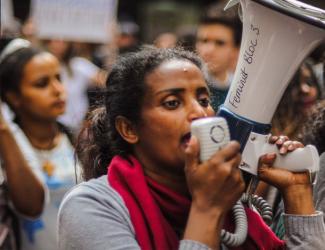
Resourcing Feminist Movements
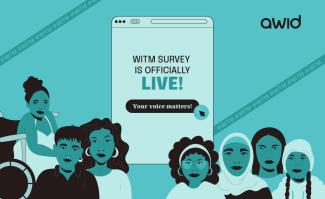
The “Where is the Money?” #WITM survey is now live! Dive in and share your experience with funding your organizing with feminists around the world.
Learn more and take the survey
Around the world, feminist, women’s rights, and allied movements are confronting power and reimagining a politics of liberation. The contributions that fuel this work come in many forms, from financial and political resources to daily acts of resistance and survival.
AWID’s Resourcing Feminist Movements (RFM) Initiative shines a light on the current funding ecosystem, which range from self-generated models of resourcing to more formal funding streams.
Through our research and analysis, we examine how funding practices can better serve our movements. We critically explore the contradictions in “funding” social transformation, especially in the face of increasing political repression, anti-rights agendas, and rising corporate power. Above all, we build collective strategies that support thriving, robust, and resilient movements.
Our Actions
Recognizing the richness of our movements and responding to the current moment, we:
-
Create and amplify alternatives: We amplify funding practices that center activists’ own priorities and engage a diverse range of funders and activists in crafting new, dynamic models for resourcing feminist movements, particularly in the context of closing civil society space.
-
Build knowledge: We explore, exchange, and strengthen knowledge about how movements are attracting, organizing, and using the resources they need to accomplish meaningful change.
-
Advocate: We work in partnerships, such as the Count Me In! Consortium, to influence funding agendas and open space for feminist movements to be in direct dialogue to shift power and money.
Related Content
Rising together - Logo and Button - EN
Call for Activities: Deadline extended to February 1st 2024!
Co-create the The 15th AWID International Forum in Bangkok, Thailand.
Interesting References
Explore these projects put together by AWID teams to promote feminist advocacy and perspectives.
Snippet - Intro WITM - EN
Where is the Money for Feminist Organizing? Survey Results
Thanks to our global feminist community! From May to August 2024, nearly 1,200 organizations working for Women's rights, gender justice, and LBTQI+ equality shared their experiences in the WITM survey. The results offer a unique picture of how feminist movements are resourced and where gaps remain.
Stay tuned for the upcoming report for more analysis!
Snippet - WITM about research col 2 - EN
The full “Where is the Money for Feminist Organizing” report will be published in 2026.
To learn more how AWID has been shining a light on money for and against feminist movements check out the work of our Resourcing Feminist Movements Initiative here.
How do you define external funding?
External funding includes grants and other forms of funding from philanthropic foundations, governments, bilateral, multilateral or corporate funders and individual donors – from both within your country or abroad. It excludes resources that groups, organizations and/or movements generate autonomously such as, for example, membership fees, the voluntary contributions of staff, members and/or supporters, community fundraisers, venue hires or sale of services. For ease and clarity, definitions of the different types of funding as well as short descriptions of different donors are included in the survey.
I don't feel comfortable sharing the name of my group and our contact information with AWID, should I still fill out the survey?
Absolutely. These questions are optional, we value your right to remain anonymous. Please fill the survey regardless of your decision to share the name and contact information of your group, organization and/or movement.
AWID in 2016: Co-Creating Feminist Futures
AWID is pleased to share our 2016 Annual Report.
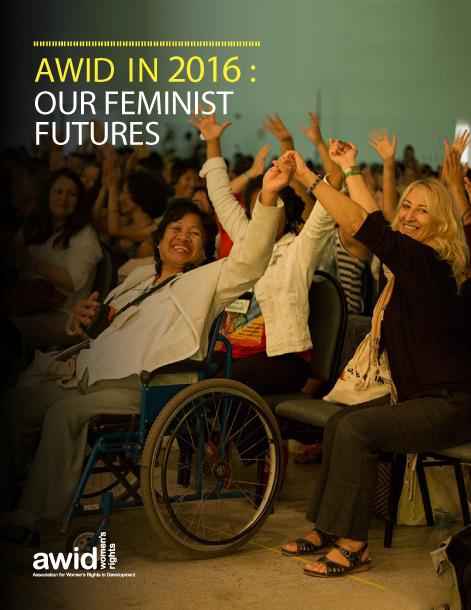
2016 was an incredible year for AWID, we convened the 13th International AWID Forum in Bahia, Brazil, a space for strategizing and alliance building with feminists and other justice movements, which was attended by over 1800 participants from 120 countries and territories across the globe.
We know that women’s rights and feminist movements are key actors in creating sustainable transformative change. Within our movements, organizing, resisting and responding to the challenging context is sharpening, and in our increasingly connected world, the potential for collective action across diverse movements has dramatically grown.
This is the crucial work that AWID seeks to amplify and support every day.
What we achieved in 2016
We expanded solidarity and joint action across diverse movements
A highlight of 2016 was our ground-breaking 13th International Forum with the theme: “Feminist Futures: Building Collective Power for Rights and Justice”, where we harnessed the thinking and energy of nearly 500 partners, presenters, panelists, moderators, artivists, writers, facilitators, IT innovators, and performers, many of them leaders in their movements. We also supported the convening of the first and historical Black Feminisms Forum (BFF) organised by a working group of Black Feminists from across the world.
We strengthened knowledge of issues and strategies
- On challenging corporate power - we produced ‘Challenging corporate power: Struggles for women’s rights, economic and gender justice’ with the Solidarity Center, revealing the scale and scope of corporate power and outlining how corporations in collusion with elites and other powerful actors, are impacting the lives of women and oppressed peoples.
- On feminist economies - we released ‘Feminist Propositions for a Just Economy’ with the Center for Women’s Global Leadership (CWGL) and the African Women’s Development and Communication Network FEMNET.
- On Young Feminist Activism - we published ‘Brave, Creative, Resilient: The Global State of Young Feminist Organizing’, a young feminist mapping project.
We contributed to collective advocacy
AWID, in partnership with other feminist and women’s rights organisations, engaged in advocacy and dialogue to explore better solutions for women’s rights agendas including our work with the Count Me In! consortium .
We increased the visibility of movements
The experiences of women with disabilities, Black and Afro-descendant women, sex workers, Indigenous women, trans and intersex people, domestic workers and how their lives are impacted by multiple oppressions and violence were placed front and center of the Forum process.
We also launched the 2016 WHRD Tribute to commemorate defenders who are no longer with us, during the 16 Days of activism, and thanks to the contributions from our members,
We drove attention to groups and issues that do not usually receive adequate mainstream media coverage through our partnership with The Guardian and Mama Cash.
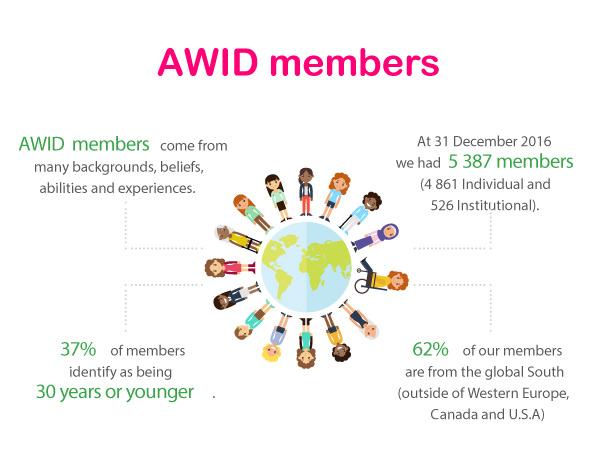
Our members
Snippet - WITM why - PT
Por Que Devo Realizar Este Inquérito?
Inna Michaeli
Inna is a feminist queer activist and sociologist with many years of deep engagement in feminist and LGBTQI+ struggles, political education and organizing by and for migrant women, and Palestine liberation and solidarity. She joined AWID in 2016 and served in different roles, most recently as Director of Programs. She is based in Berlin, Germany, grew up in Haifa, Palestine/Israel, was born in St. Petersburg, Russia, and carries these political geographies and resistance to colonial past and present into her feminism and transnational solidarity.
Inna is the author of “Women's Economic Empowerment: Feminism, Neoliberalism, and the State” (Palgrave Macmillan, 2022), based on the dissertation which earned her a doctoral degree from the Humboldt University of Berlin. As an academic, she taught courses on globalization, knowledge production, identity and belonging. Inna holds an MA in Cultural Studies from the Hebrew University of Jerusalem. She is a Board Member of the Jewish Voice for a Just Peace in the Middle East (Germany), and previously of +972 Advancement of Citizen Journalism. Previously Inna worked with the Coalition of Women for Peace and she is passionate about mobilizing resources for grassroots activism.
Snippet - WITM Start the survey 1 - RU

Опрос доступен на английском, арабском, испанском, португальском, русском и французском языках!
Michelle D'Cruz
Michelle is a Southeast Asian feminist who enjoys conspiring to bring people together and spark conversations for social change and feminist knowledge sharing, through art, poetry, music and games. With a background in digital advocacy and communications strategy development, she has contributed to initiatives in digital rights, human rights research, and civil society coalition building throughout Southeast Asia. She has an LLB from National University of Singapore, enjoys following her feet down random city streets and likes coffee a little too much.
Snippet - WITM about research - RU
Об исследовании «Где же деньги для феминистских объединений?»
Глобальный опрос «Где деньги для феминистских объединений?» является ключевым элементом третьего этапа нашего исследования, ориентированного на конкретные действия: «Где деньги для феминистских объединений» (короткое название – «Где деньги?»). Результаты опроса будут доработаны и обстоятельно изучены в ходе бесед с активистами и донорами, а также сопоставлены с другими имеющимися аналитическими материалами и исследованиями о состоянии ресурсов феминистских движений и инициатив по достижению гендерного равенства во всем мире.
Полный отчет организации «Где деньги для феминистских объединений?» будет опубликован в 2026 году.
 Чтобы узнать больше о том, как AWID освещает вопросы финансирования феминистских движений, ознакомьтесь с историей инициативы «Где деньги?» и нашими предыдущими отчетами здесь.
Khaoula Ksiksi
Khaoula Ksiksi is a passionate advocate for justice, equity, and liberation. As a Gender, Equality, Diversity, and Inclusion (GEDI) Advisor, she works to make inclusivity a lived reality, not just a policy, across humanitarian programs and crisis contexts. She collaborates with teams to challenge structural oppression using bold, transformative tools rooted in lived experience.
Her activism began on the frontlines of Tunisia’s anti-racism movement. With Mnemty, she helped push through the country’s first anti-discrimination law, forcing a national reckoning with racial injustice. She later co-founded Voices of Black Tunisian Women to amplify Black women’s leadership, build solidarity networks, and demand visibility in a society that often silences them.
Khaoula is also a founding member of Falgatna, a radical queer-feminist movement fighting for SOGIESC rights and supporting LGBTQI+ communities through direct action, digital resistance, and survivor-centered advocacy.
Previously, she led regional feminist and climate justice projects at the Rosa Luxemburg Foundation in North and West Africa.
At the heart of her work is a deep belief: no one is free until we all are. Her activism is both a fight and a love letter to her people, her communities, and the world we deserve.
Почему мне стоит принять участие в опросе?
Есть много причин, по которым ваше участие в опросе очень важно. Это возможность поделиться своим опытом привлечения финансирования для деятельности вашей организации; заявить о себе как об эксперте в вопросах движения денежных средств и их получателей; внести свой вклад в коллективную и последовательную адвокацию среди доноров, чтобы привлечь более объемное и эффективное финансирование. За последние два десятилетия исследования AWID в этой области зарекомендовали себя как ключевой ресурс для активисток(-тов) и доноров. Мы приглашаем вас присоединиться к нам в реализации третьей части инициативы «Где деньги?», чтобы осветить реальное состояние ресурсного обеспечения, оспорить ошибочные решения и указать на то, как необходимо изменить финансирование, чтобы движения процветали и реагировали на сложные вызовы нашего времени.
Are you a Northern or a Southern organization?
AWID is a global organization.
The main focus of our work is global. We also work closely with members and other women’s rights organizations and allies at the local, national and regional levels so that their realities inform our work.
- We have offices in Mexico and Canada
- Our staff are located in 15 countries around the world
- Ten of our 13 Board members are from the global South.
Nós redistribuímos recursos para os nossos parceires beneficiários e identificamo-nos como um fundo feminista e/ou de mulheres. Devemos participar no inquérito?
Não, apreciamos muito o vosso trabalho, mas atualmente não solicitamos respostas de fundos feministas e de mulheres. Encorajamos-vos a partilhar o inquérito com os vossos parceires beneficiários e as vossas redes feministas.
2010: The fourth High-level Dialogue is held
The theme of the Fourth High-level Dialogue on Financing for Development, 23-24 March 2010: The Monterrey Consensus and Doha Declaration on Financing for Development: status of implementation and tasks ahead. It had four round tables on: the reform of the international monetary and financial systems; impact of the financial crisis on foreign direct investments; international trade and private flows; and the role of financial and technical development cooperation, including innovative sources of development finance, in leveraging the mobilization of domestic and international financial resources for development.
There was also the informal interactive dialogue involving various stakeholders that focused on the link between financing for development and achieving the Millennium Development Goals.
هل استطيع الوصول للاستطلاع وتعبئته من هاتفي؟
نعم، يمكن تعبئة الاستطلاع من خلال الهاتف الذكي.
I’m trying to submit a proposal but the online form is not working?
For any questions related to the Call for Forum Activities please contact us, selecting Forum Call for Activities as the subject of your email.
Нужно ли мне как-то подготовиться, чтобы пройти опрос?
Поскольку опрос посвящен исследованию реалий обеспечения феминистских организаций ресурсами, большинство вопросов касаются финансирования вашей организации в период с 2021 по 2023 год. Вам необходимо будет иметь при себе данную информацию для заполнения анкеты (например, годовые бюджеты и информацию об основных источниках финансирования).