Left
Half
Left

Analyses Spéciales

L´AWID est une organisation féministe mondiale qui consacre ses efforts à la justice de genre, au développement durable et aux droits humains des femmes

La mémoire comme forme de résistance : un hommage

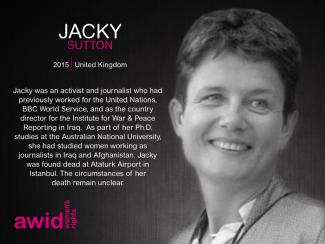
L’hommage se présente sous forme d’une exposition de portraits d’activistes du monde entier qui ne sont plus parmi nous qui ont lutté pour les droits des femmes et la justice sociale. 


En 2020, nous adoptons une démarche légèrement différente 

Cette année, tout en continuant à convoquer la mémoire de celleux qui ne sont plus parmi nous, nous souhaitons célébrer leur héritage et souligner les manières par lesquelles leur travail continue à avoir un impact sur nos réalités vécues aujourd’hui.

49 nouveaux portraits de féministes et de défenseur·e·s viennent compléter la gallerie. Bien que de nombreuses des personnes que nous honorons dans cet hommage sont décédé·e·s du fait de leur âge ou de la maladie, beaucoup trop d’entre iels ont été tué·e·s à cause de leur travail et de qui iels étaient.

Les histoires des activistes à l'honneur dans cet Hommage font vivre leur héritage et continuent d'inspirer le travail et l’action de nos mouvements.

Visiter notre exposition virtuelle

Les portraits de l'édition 2020 ont été illustrés par Louisa Bertman, artiste et animatrice qui a reçu plusieurs prix.

L’AWID tient à remercier nos membres, les familles, les organisations et les partenaires qui ont contribué à cette commémoration. Nous nous engageons auprès d’elleux à poursuivre le travail remarquable de ces féministes et défenseur·e·s et nous ne ménagerons aucun effort pour que justice soit faite dans les cas qui demeurent impunis.

« Ils ont essayé de nous enterrer. Ils ne savaient pas que nous étions des graines » - Proverbe mexicain

L'Hommage a été inauguré en 2012

Le premier hommage aux défenseur-e-s des droits humains a pris la forme d’une exposition de portraits et de biographies de féministes et d’activistes disparu·e·s lors du 12e Forum international de l’AWID en Turquie. Il se présente maintenant comme une gallerie en ligne, mise à jour chaque année.

Depuis, 467 féministes et défenseur-e-s des droits humains ont été mis·es à l'honneur.

Visiter notre exposition virtuelle

Contenu lié

Rosa Candida Mayorga Muñoz

Rosa Cándida Mayorga Muñoz fue una trabajadora social guatemalteca, líder sindical y defensora de los derechos laborales. La llamaban cariñosamente «Rosita».

En la década de 1980, Rosa se convirtió en la primera mujer integrante del Comité Ejecutivo del Sindicato de Trabajadores del Instituto Nacional de Electrificación (STINDE), un sindicato al que se había incorporado originalmente para defender los derechos laborales de las mujeres. Para ella, esto significaba luchar por la igualdad de oportunidades en una empresa en la que muchas mujeres enfrentaban un sistema discriminatorio y violento creado por las autoridades de la compañía. Rosa también había sufrido acoso sexual en su lugar de trabajo, tanto por parte de sus compañeros de trabajo, como de los funcionarios. Sin embargo, no era alguien a quien se pudiera acallar.

Rosa continuó con su pelea y fue parte del esfuerzo por configurar la lucha en una forma más específica, la del «Pacto colectivo de condiciones de trabajo INDE -STINDE». Este pacto fue pionero: el primero en tipificar el concepto de acoso (sexual) en Guatemala. Sirve como referencia para la legislación guatemalteca en temas laborales, y es un estímulo para otros sindicatos.

«No tenía herramientas de lucha más que sus propios ideales... Muchas veces fue intimidada, hostigada para dejar por un lado la lucha, pero su valentía a enfrentar generaba la imagen de la esperanza para los sindicalistas de bases. Rosita se trazó una imagen de respeto, no solo dentro de su sindicato, sino ante las autoridades de la institución, ante el movimiento de mujeres; fue reconocida, como pionera, del movimiento de mujeres sindicalistas, en un espacio que había sido más desarrollado por hombres.» - Maritza Velasquez, ATRAHDOM

Rosa falleció el 4 de abril de 2018, a la edad de 77 años.

Will there be a young feminist space? A disability justice space? A digital/tech hub? Funder coffee hours? Wellbeing and healing spaces?

We will share information about the program, the spaces, and the way for everyone to participate in shaping them, as soon as we can, and ways for you to participate in shaping them - on the road to the Forum, and during the Forum. Please stay tuned!

Crear | Résister | Transform: un recorrido por el Festival

Mientras el capitalismo heteropatriarcal continúa forzándonos al consumismo y el acatamiento, observamos que nuestras luchas están siendo compartimentadas y separadas por fronteras tanto físicas como virtuales. 

Y con los desafíos adicionales presentados por una pandemia global que todavía deben ser superados, esta estrategia de «divide y vencerás» ha sido favorable para la proliferación de la explotación en muchas áreas.

No obstante esto, desde el 1° hasta el 30 de septiembre de 2021, un festival para movimientos feministas! de AWID nos llevó a un viaje sobre lo que significa encarnar nuestras realidades en espacios virtuales. En el Festival se reunieron activistas feministas de todo el mundo, no solo para compartir experiencias de libertades duramente conquistadas, de resistencias y de solidaridades más allá de las fronteras, sino para articular lo que podría ser una forma transnacional de compañerismo.

Esta solidaridad tiene el potencial de desafiar las fronteras, tejiendo una visión del futuro que es transformadora, porque es abolicionista [del complejo industrial carcelario] y anticapitalista. A lo largo de un mes, a través de las infraestructuras digitales que ocupamos con nuestra cuiridad / queeridad, nuestra resistencia y nuestros imaginarios, el Festival nos mostró una forma de desviarnos de los sistemas que nos hacen cómplices de la opresión de otras personas y de nosotrxs mismxs.

Si bien Audre Lorde nos enseñó que las herramientas del amo nunca desarmarán la casa del amo, Sara Ahmed nos demostró que podemos utilizarlas en forma indebida. Dado que teníamos que dar espacio a la asamblea, y a pesar de todas las otras demandas sobre nuestro tiempo, fue posible imaginar una disrupción de la realidad del capitalismo heteropatriarcal.

Ahora bien, si entendemos la asamblea como una forma de placer, entonces, se hace posible establecer el vínculo entre el placer transgresor y la resistencia transnacional/transdigital: entre las clases de placer que desafían las fronteras por un lado, y la cuiridad / queeridad, lo camp, las luchas por la tierra y los movimientos indigenistas, el anticapitalismo y la organización política anticolonial por el otro.
 
Esta edición intentó captar un sentido de cómo el ejercicio de la asamblea en el Festival adoptó múltiples formas e imaginaciones. Además de contar con las colaboraciones directas de algunxs de sus conferencistas y soñadorxs, trajimos a una plétora de otras voces del Sur global para que conversaran sobre muchos de sus temas y sujetxs. Lo que sigue es una muestra de algunos de los paneles del Festival que más nos inspiraron.

Snippet - COP30 - Radical Democracy - ES

Democracia radical y justicia climática: el debate ausente en la COP30

Modelos de gobernanza alternativos como vías para salir de la crisis climática.

📅 Miércoles 12 de noviembre de 2025
📍 Seminario Mar Nossa Sra Da Assunção, Pará, Brasil

Más información aquí

9. Advocate and tell the world!

The results of your research will also shape your advocacy – for example, your results will have revealed which sectors fund the most and which sectors you feel need donor education.

In this section

Build your advocacy strategy

In the “Frame your research” section of this toolkit we recommend that you plot out what goals you hope to accomplish with your research. These goals will allow you to build an advocacy strategy once your research is complete.

An advocacy strategy is a plan of distributing your research results in a way that allows you to accomplish your goals, falling under the broader goal of advocating with key sectors to make positive changes for resources for women’s rights organizing.

Using the goals defined in your research framing:

  • List the potential groups of contacts who can be interested in your research results
  • For each group, explain in one sentence how they can help you achieve your goal.
  • For each group, mark what tone you are supposed to use to talk to them (formal professional, commentary casual, do they understand the field’s jargon?)
  • List every media that can allow you to reach these audiences, in the proper tone (social media to build community feeling, press release for official announcement to a general audience, etc.)

From this list – as exhaustive as possible, chose which ones are the most efficient for achieve your goals. (See below for specific examples of audiences and advocacy methods)

Once you have a strategy, you can start the dissemination.

Back to top


Reach out to your network

To disseminate your results, reach out first to the contacts through whom you distributed your survey, as well as to all your survey and interview participants.

  • First, take this opportunity to thank them for contributing to this research.
  • Share with them the main survey results and analysis.
  • Make it easy for them to disseminate your product through their networks by giving them samples of tweets, Facebook posts or even a short introduction that they could copy and paste on their website.

Do not forget to state clearly a contact person and ask for a confirmation once they have published it.

On top of making you able to track who disseminated your report, it will help build stronger relationships within your network.

Back to top


Adapt your strategy to the sector

As an example, we present below a list of sectors AWID engages in advocacy.

  • Use this list as a point of departure to develop your own sector-specific advocacy plan.
  • Create an objective for what you hope to accomplish for each sector.
  • Be sure to add any additional sectors to this list that are relevant for your particular research, such as local NGOs or local governments, for example.

Your list of advisory organizations and individuals will also be useful here. They can help you disseminate the report in different spaces, as well as introduce you to new organizations or advocacy spaces.

1. Women’s rights organizations

Sample objectives: Update women’s rights organizations on funding trends; brainstorm collaborative efforts for resource mobilization using research findings; influence how they approach resource mobilization

Examples of possible advocacy methods:

  • Offer seminars, learning cafés or other events throughout your region, in relevant languages, in order to update women’s rights organizations with the findings of your research.

  • If you can’t physically reach everyone in your region, think about setting-up a webinar and online presentations.

  • Present your findings at larger convenings, such as the Commission on the Status of Women (CSW).

  • Beyond your own organizations’ newsletters and website, write articles on different platforms that are frequented by your target audience.
    Some examples: World Pulse, OpenDemocracy, feministing.

2. Bilaterals and multilaterals

Sample Objective: Raising awareness about how funding is not meeting established commitments and how this sector needs to improve funding mechanisms to finance women’s rights organizing.

Identify which bilateral & multilaterals have the most influence on funding – this could include local embassies.

Examples of possible advocacy methods:

  • Enlist ally organizations and influential individuals (some may already be your advisors for this research process) to do peer education.
  • Seek their assistance to disseminate research finding widely in large multilaterals (like the UN).
  • Present at and/or attend influential spaces where bilaterals and multilaterals are present, such as GENDERNET .
  • Publish articles in outlets that are read by bilaterals and multilaterals such as devex, Better Aid, Publish What You Pay.

3. Private foundations

Sample Objective: Expand the quality and quantity of support for women’s rights organizations.

Examples of possible advocacy methods:

4. Women’s funds

Sample Objective: Encourage them to continue their work at higher scale.

Examples of possible advocacy methods:

  • Hold presentations at the women’s funds in your region and in countries that you hope to influence.
  • Disseminate your research findings to all women’s funds that impact the region, priority issue or population you are focusing on.
  • Consider doing joint efforts based on the results of the findings. For example, you could propose to collaborate with a fund to develop an endowment  that closes the funding gaps found in your research.

5. Private sector and new donors

Sample Objective: Increase their understanding of the field and encourage coherence between their philanthropic interests and business practice.

Examples of possible advocacy methods:

  • Enlist ally organizations and influential individuals (some may already be your advisors for this research process) to do peer education.
  • Arrange meetings with influential private actors to present your research findings.
  • Host your own meeting, inviting private sector actors, to share the findings and to advocate for your position.

Make sure to adapt your presentations, propositions and applications to each targeted group.

Back to top


Previous step

8. Finalize and format


Are you ready to start your own research?

We strongly recommend referring to our Ready to Go worksheet to assess your own advancement.

Estimated time:

• 1-2 years, depending on advocacy goals

People needed:

• 1 or more communications person(s)

Resources needed:       

• List of spaces to advertise research
• List of blogs and online magazines where you can publish articles about your research finding
• List of advisors
• Your WITM information products
Sample of Advocacy Plan


Previous step

8. Finalize and format


Ready to Go? Worksheet

Download the toolkit in PDF

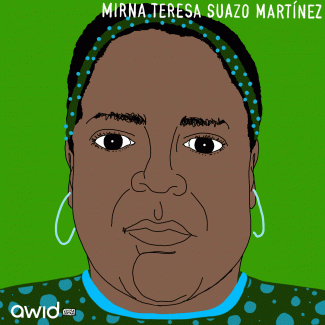
Mirna Teresa Suazo Martínez

Mirna Teresa Suazo Martínez faisait partie de la communauté garifuna (afro-descendante et autochtone) Masca et vivait sur la côte nord des Caraïbes du Honduras. Elle était leader de sa communauté et fervente défenseure du territoire autochtone, une terre qui a été violée le jour où l'Institut national agraire du Honduras a accordé des licences territoriales à des personnes extérieures à la communauté. 

Ce fait déplorable a été à l'origine de harcèlements, d'abus et de violences répétés contre Masca, où les intérêts économiques de différents groupes se sont heurtés à ceux des forces armées et des autorités honduriennes. Selon l'Organisation fraternelle noire du Honduras (OFRANEH), la stratégie de ces groupes consiste à expulser et exterminer la population autochtone. 

« Masca, la communauté garifuna située près de la vallée du Cuyamel, se trouve dans la zone d’influence de l’une des villes présumées modèles, une situation qui a déclenché des pressions territoriales le long de la côte garifuna. » - OFRANEH, 8 septembre 2019

Mirna Teresa, présidente du conseil d'administration de la communauté de Masca à Omoa, avait elle aussi fermement rejeté la construction de deux centrales hydroélectriques sur la rivière Masca, qui porte le même nom que sa communauté.

« La communauté garífuna attribue l'aggravation de la situation dans leur région à son opposition à l'exploitation touristique, à la monoculture de palmiers africains et au trafic de drogue, tandis qu'elle cherche parallèlement à construire une vie alternative au travers de la culture de la noix de coco et d'autres produits d'autoconsommation ». - Voces Feministas, 10 septembre 2019 

Mirna Teresa a été assassinée le 8 septembre 2019 dans son restaurant « Champa los Gemelos ». 

Elle est l'une des six femmes défenseures garifunas à avoir été assassinées rien qu'entre septembre et octobre 2019. Selon l'OFRANEH, les autorités n'ont pas mené d'enquête sur ces crimes.

« En ce qui concerne les communautés garífuna, une grande partie des homicides sont liés au régime foncier et à la gestion des terres. Cependant, les querelles entre les organisations criminelles ont abouti à des meurtres, à l’instar de ceux ayant eu lieu récemment à Santa Rosa de Aguán ». - OFRANEH, 8 septembre 2019

CFA 2023 - breadcrumbs Menu _ awid-forum-thai

Snippet Kohl - Plénière | S’organiser pour gagner!

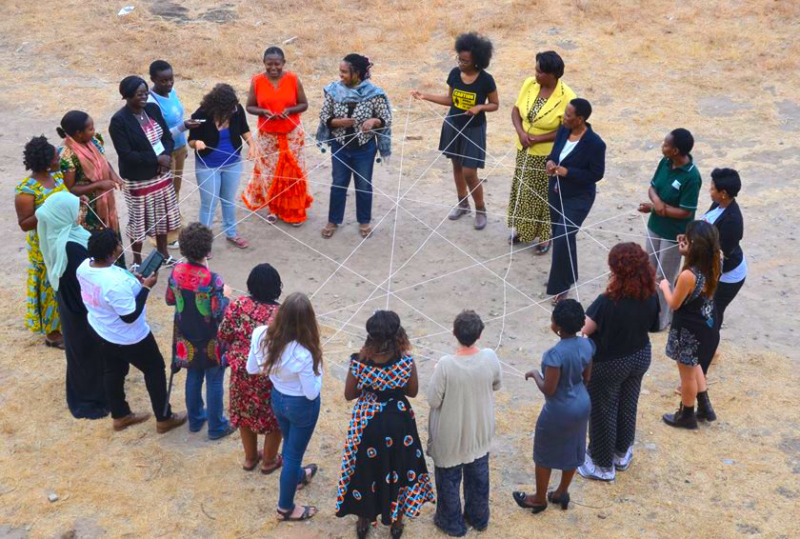
Plénière | S’organiser pour gagner!

avec Nazik Abylgaziva, Amaranta Gomez Regalado, Cindy Weisner et Lucineia Freitas.

YOUTUBE

Snippet - COP30 - Actions - FR

Événements et actions à la COP30

Du 8 au 16 novembre 2025

Economía solidaria

Definición

La economía solidaria (que incluye la economía cooperativa y la llamada economía del don) es un marco alternativo que adquiere formas diferentes según el contexto y está siempre abierto a los cambios.

Este marco de referencia se asienta sobre los siguientes principios:

  • solidaridad, mutualismo (ayuda mutua), y cooperación
  • equidad en todas las dimensiones
  • bienestar social
  • sostenibilidad
  • democracia social y económica
  • pluralismo

En una economía solidaria, quienes producen participan en procesos económicos que guardan íntima relación con sus realidades, con la preservación del medio ambiente y la cooperación mutua.

Contexto

Según la geógrafa feminista Yvonne Underhill-Sem, la economía del don es un sistema económico en el que los bienes y servicios circulan entre las personas sin que haya acuerdos explícitos acerca de su valor o de una reciprocidad esperada en el futuro.

Lo que hay detrás del otorgamiento de dones es una relación humana, una generación de buena voluntad y el acto de prestar atención a nutrir a toda la sociedad y no solo a lo que concierne a unx mismx y su familia: se trata del colectivo.

En el Pacífico, por ejemplo, esto se manifiesta en la recolección, preparación y procesamiento de recursos terrestres y marinos para tejer alfombras, abanicos, guirnaldas y objetos ceremoniales, así como en la cría de ganado y el almacenamiento de las cosechas estacionales.

Perspectiva feminista

Las mujeres tienen diversos incentivos para involucrarse en actividades económicas y que van desde satisfacer sus aspiraciones profesionales y ganar dinero para gozar de una vida confortable en el largo plazo hasta llegar a fin de mes, pagar deudas y huir del desgaste de una vida rutinaria.

Para acomodarse a los diferentes ambientes en los que operan las mujeres, el concepto de economía solidaria está en permanente desarrollo, discusión y debate.


Para leer más acerca de esta propuesta:


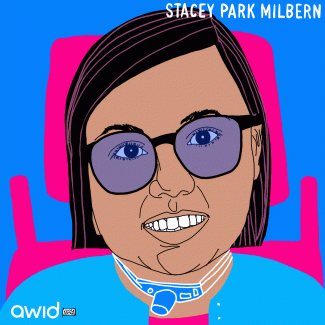
Stacey Park Milbern

“I do not know a lot about spirituality or what happens when we die, but my crip queer Korean life makes me believe that our earthly bodyminds is but a fraction, and not considering our ancestors is electing only to see a glimpse of who we are.” - Stacey Park Milbern

Stacey Park Milbern was a self-identifying queer disabled woman of colour and a trailblazer. A long-standing and respected organizer and leader in the disability rights and justice movement, she also advocated for the rights of many different communities, not just her own. Stacey’s activism had mighty roots in her experience at the intersections of gender, disability, sexuality and race.

Stacey, along with some friends, co-created the Disability Justice Culture Club, a group working to support various and especially vulnerable communities, including helping homeless people gain access to resources during the COVID-19 pandemic. 

She was also a co-producer of an impact campaign for Netflix’s documentary “Crip Camp”, a board member of the WITH Foundation, and led organizations at local, state and national levels. Stacey wrote beautifully and powerfully:

“My ancestors are people torn apart from loves by war and displacement. It’s because of them I know the power of building home with whatever you have, wherever you are, whoever you are with. My ancestors are queers who lived in the American South. It’s because of them I understand the importance of relationships, place and living life big, even if it is dangerous. All of my ancestors know longing. Longing is often our connecting place...” - Stacey Park Milbern

She was born in Seoul, Korea and grew up in North Carolina, later  continuing her journey in the San Francisco Bay Area. Stacey passed away of complications from surgery on her 33rd birthday on 19 May 2020. 


Read an essay by Stacey Park Milbern
Listen to an interview with Stacey Park Milbern
#StaceyTaughtUs: Record your story for the Disability Visibility Project

Tributes:

“She was, a lot of people would say, a leader. She kind of encompassed all of it. You know, sometimes there's like a lead from the front, lead from the middle, lead from the back. And she was just somehow able to do all of that.” - Andraéa LaVant, disability rights activist

“What a blow to lose Stacey when our communities need her leadership more than ever, and at a time when her strength, insight, and grit were receiving increased recognition outside of disability circles, giving her a greater platform to advance her life’s work...We will not have the gift of learning where her charismatic leadership would have taken us. But let there be no doubt: What Stacey gave us, in a relatively short time, will continue benefiting others for years to come.” - Disability Rights Education and Defense Fund (DREDF)

CFA 2023 - Who, where, when - FR

Quand : du 2 au 5 décembre 2024
Où : Bangkok, Thaïlande; et en ligne
Qui : Environ 2 500 féministes du monde entier participant en personne, et 3 000 participant virtuellement
Body

Sexting Like a Feminist: Humor in the Digital Feminist Revolution | Title Snippet

Sextoter comme une féministe : humour et révolution féministe numérique

par Chinelo Onwualu

Snippet - COP30 - Our Tools title - EN

Boîte à outils pour les organisations à la COP30