Análisis Especiales

AWID es un organización feminista internacional de membresía, que brinda apoyo a los movimientos que trabajan para lograr la justicia de género y los derechos de las mujeres en todo el mundo.

Confrontando al extractivismo y al poder corporativo

Defensoras de derechos humanos de todo el planeta defienden sus tierras, medios de subsistencia y sus comunidades ante las industrias extractivas y el poder corporativo. Ellas hacen frente a fuertes intereses económicos y políticos que promueven el robo de tierras, el desplazamiento de comunidades, la pérdida de los medios de subsistencia y la degradación del medioambiente.


¿Por qué resistir a las industrias extractivas?

El extractivismo es un modelo económico y político de desarrollo que mercantiliza la naturaleza y prioriza la ganancia por sobre los derechos humanos y el medioambiente. Arraigado en la historia colonial, refuerza las desigualdades sociales y económicas tanto a nivel local como global. Muchas veces, las mujeres negras, rurales e indígenas son las más afectadas por el extractivismo, y además son notablemente excluidas de la toma de decisiones. Desafiando estas fuerzas patriarcales y neocoloniales, las mujeres se alzan en defensa de los derechos, las tierras, las personas y la naturaleza.

Riegos críticos y violencia específica de género

Las defensoras que enfrentan a las industrias extractivas, experimentan una diversidad de riesgos, amenazas y violaciones, incluidas la criminalización, la estigmatización, la violencia y laintimidación. Sus historias dan cuenta de marcados aspectos de violencia sexual y de género. Entre los perpetradores se incluyen autoridades estatales y locales, las corporaciones, la policía, el ejército, las fuerzas paramilitares y de seguridad privada, y en algunos casos, sus propias comunidades.

Actuar juntxs

AWID y la Coalición Internacional de Mujeres Defensoras de Derechos Humanos (WHRDIC por su sigla en inglés) tienen el placer de anunciar «Defensoras de derechos humanos confrontado al extractivismo y al poder corporativo»; un proyecto interregional de investigación que documenta las experiencias vividas por las defensoras de Asia, África y América Latina.

Alentamos a activistas, integrantes de movimientos sociales, la sociedad civil organizada, donantes y responsables de políticas públicas, a leer y utilizar estas producciones para el trabajo de incidencia, con fines educativos y como fuente de inspiración:

¡Comparte tu experiencia y tus preguntas!

Cuéntanos cómo estás utilizando la herramienta sobre las defensoras que confrontan a las industrias extractivas y al poder corporativo.

◾️ ¿De qué manera estos recursos pueden ayudarte en tu activismo y tu trabajo de defensa?

◾️ ¿Qué informaciones o conocimientos adicionales necesitas para la mejor utilización de estos recursos?

Comparte tus comentarios


¡Gracias!

AWID reconoce con gratitud las invaluables contribuciones de cada Defensora de Derechos Humanos que ha sido parte de este proyecto. Esta guía ha sido posible gracias su generosidad y apertura al compartir sobre sus experiencias y lecciones. Su coraje, creatividad y resiliencia son una inspiración para todxs nosotrxs. ¡Muchas gracias!

Contenido relacionado

En su lucha por los derechos humanos enfrentan la injusticia en América Latina

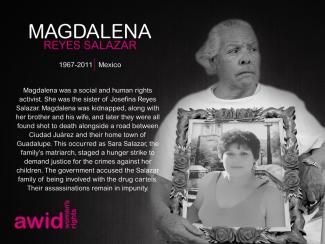
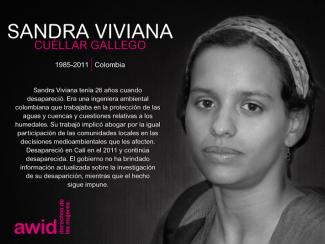
Este año honramos a 19 defensoras de la región de América Latina y el Caribe. De ellas, 16 fueron asesinadas, incluyendo a 6 periodistas y 4 defensoras LGBTQI. Únete a nosotras en la conmemoración de  sus vidas y trabajo,  compartiendo los memes aquí incluidos con tus colegas, amistades y redes; y tuiteando las etiquetas #WHRDTribute y #16Días.


Por favor, haz click en cada imagen de abajo para ver una versión más grande y para descargar como un archivo.

[scald=2398:sdl_editor_representation]
[scald=2396:sdl_editor_representation]
[scald=2393:sdl_editor_representation]
[scald=2390:sdl_editor_representation]
[scald=2389:sdl_editor_representation]
[scald=2388:sdl_editor_representation]


Kate McInturff

Active dans l’organisation Peacebuild, en passant par l'Alliance canadienne féministe pour l'action internationale, Amnesty International et au Centre canadien de politiques alternatives (CCPA), Kate était une passionnée des droits des femmes et de l'égalité de genre qui a consacré sa carrière à lutter contre les inégalités et à faire du monde un lieu plus empathique.

Kate a été membre du comité de coordination de Social Watch et a contribué aux rapports nationaux canadiens de Social Watch. En tant que chercheuse principale du CCPA, Kate a été saluée dans son pays pour ses travaux de recherche, ses écrits et la production du rapport annuel intitulé « Les meilleures et les pires endroits du Canada où vivre en tant que femme ».

Entourée de sa famille, Kate est décédée paisiblement après trois ans de lutte contre le cancer du côlon. Ses proches la décrivent comme une « féministe drôle, sans peur et sans complexes ».


Kate McInturff, Canada

Snippet FEA Nous Sommes la Solution (ES)

The logo of We Are The Solution with green silhouettes of four rural woment

Nous Sommes la Solution es un movimiento de mujeres rurales por la soberanía alimentaria en África Occidental. Originalmente fundada como una campaña contra la agricultura hiper-industrializada, Nous Sommes la Solution se ha convertido en un movimiento de más de 500 asociaciones de mujeres rurales de Burkina Faso, Senegal, Ghana, Gambia, Guinea Bissau, Malí y Guinea.

Este movimiento liderado por mujeres está construyendo y fortaleciendo la soberanía alimentaria y de semillas en África Occidental. Alimentan a las comunidades, fortalecen las economías locales, amplían el conocimiento de las mujeres agricultoras y mitigan los efectos devastadores de la crisis climática a través de las prácticas agroecológicas. También organizan talleres, foros y transmisiones de radio comunitarias para compartir sus mensajes, conocimientos tradicionales y prácticas agroecológicas en las comunidades rurales.

En colaboración con universidades y centros públicos de investigación, Nous Sommes la Solution trabaja para restaurar las variedades indígenas de arroz (un alimento esencial de África Occidental) y promover economías alimentarias locales basadas en principios agroecológicos para influir en la formulación de políticas nacionales, mientras apoya a las mujeres en la creación de asociaciones agrícolas y su acceso a la propiedad y gestión colectiva de las tierras agrícolas.

Snippet - WITM RESOURCES - AR

المصادر

(متوفرة باللغة الإنجليزية)

WHRDs from the South and Southeast Asian region

7 Women Human Rights Defenders from across the South and Southeast Asian region are honored in this year’s Online Tribute. These defenders have made key contributions to advancing human and women’s rights, indigenous people’s rights, and the right to education. These WHRDs were lawyers, women’s rights activists, scholars, and politicians. Please join AWID in commemorating t their work and legacy by sharing the memes below with your colleagues, networks and friends and by using the hashtags #WHRDTribute and #16Days. 


Please click on each image below to see a larger version and download as a file


Mary Assad

An expert on social development and anthropologist by training, Mary was best known as a pioneer in the battle against Female Genital Mutilation (FGM).

Born in Cairo Egypt in 1922, Mary’s work in development started early, as she joined the Youth Women’s Christians’ Association (YWCA). Mary was a member of the World Council of Churches and became increasingly concerned with issues regarding women’s health. Her long struggle against FGM proved fruitful in 2008, when Egypt finally criminalized the practice.

She is remembered as a mentor to many Egyptian feminists and activists.


Mary Assad, Egypt

Snippet FEA What are the objectives (FR)

Quels sont les Objectifs de Nous Sommes la Solution?

على من يجب تعبئة الاستطلاع؟

المجموعات، المنظمات والحركات التي تعمل خصوصاً وبالأساس على حقوق النساء، حقوق الفتيات، العدالة الجندرية، حقوق مجتمعات الميم - عين وحلفائها/يفاتها في جميع المناطق وعلى جميع المستويات، إن كانت مجموعات جديدة أو قديمة.

Before you begin

Before starting the WITM research methodology, it is important you prepare the background and know what to expect.


Capacity

With AWID’s WITM research methodology, we recommend that you first review the entire toolkit.

While this toolkit is designed to democratize WITM research, there are capacity constraints related to resources and research experience that may affect your organization’s ability use this methodology.

Use the “Ready to Go?” Worksheet to assess your readiness to begin your own WITM research. The more questions you can answer on this worksheet, the more prepared you are to undertake your research.

Trust

Before beginning any research, we recommend that you assess your organization’s connections and trust within your community.

In many contexts, organizations may be hesitant to openly share financial data with others for reasons ranging from concerns about how the information will be used, to fear of funding competition and anxiety over increasing government restrictions on civil society organizations.

As you build relationships and conduct soft outreach in the lead-up to launching your research, ensuring that your objectives are clear will be useful in creating trust. Transparency will allow participants to understand why you are collecting the data and how it will benefit the entire community.

We highly recommend that you ensure data is collected confidentially and shared anonymously. By doing so, participants will be more comfortable sharing sensitive information with you. 


First step

1. Gather your resources

We also recommend referring to our “Ready to Go?” Worksheet to assess your own progress.

Mridula Prasad

Mridula fue una firme promotora de la salud de las mujeres en una época en la que el tema de la salud sexual y reproductiva de las mujeres se consideraba tabú en Fiji.

Mridula orientó los primeros trabajos del movimiento por los derechos de las mujeres en Fiji sobre derechos sexuales y reproductivos y, en septiembre de 1999, el Fondo de Población de las Naciones Unidas le otorgó un premio regional sobre salud y derechos reproductivos. Fue una activista férrea, comprometida e incansable y apasionada por la salud y el empoderamiento de las mujeres.

Fue una valiosa integrante del movimiento de mujeres y del movimiento feminista de Fiji y sus aportes se recordarán por siempre. Falleció en 2017 por causas naturales.

Mridula Prasad, Fiji

Snippet FEA NSS Quote (EN)

“It’s the indigenous knowledge and the practices that have always supported food sovereignty and this knowhow is in the hands of the women … Ecofeminism for me is the respect for all that we have around us.”

Mariama Sonko
Interview to The Guardian

Что подразумевается под внешним финансированием?

Внешнее финансирование включает гранты и другие формы финансирования от благотворительных фондов, правительств, двусторонних, многосторонних или корпоративных спонсоров и индивидуальных доноров – как внутри вашей страны, так и из-за рубежа. Сюда не входят ресурсы, которые группы, организации и/или движения генерируют самостоятельно, такие как, например, членские взносы, добровольные взносы "сотрудниц(-ков), участниц(-ков) и/или сторонниц(-ков), сборы через сообщество, сдача помещений в аренду или продажа услуг. Для удобства в опрос включены определения различных видов финансирования и краткие описания различных доноров.

4. Collect and analyze your data

This section will guide you on how to ensure your research findings are representative and reliable.

In this section:

Collect your data

1. Before launch

  • First determine the best way to reach your survey population.
    For example, if you want to focus on indigenous women’s rights organizers, do you know who the key networks are? Do you have contacts there, people who can introduce you to these organizations or ways of reaching them?
  • Determine if your key population can be easily reached with an online survey, if you need to focus on paper survey distribution and collection or a mix of both. This decision is very important to ensure accessibility and inclusiveness.
  • Be prepared! Prior to advertizing, create a list of online spaces where you can promote your survey.
    If you are distributing paper versions, create a list of events, spaces and methods for distributing and collecting results.
  • Plan your timeline in advance, so you can avoid launching your survey during major holidays or long vacation periods.
  • Make it easy for your advisors and partners to advertize the survey – offer them pre-written Twitter, Facebook and email messages that they can copy and paste.

2. Launch

  • Send the link to the survey via email through your organization’s email databases.
  • Advertize on your organization’s social media. Similar to your newsletter, you can regularly advertize the survey while it is open.
  • If your organization is hosting events that reach members of your survey population, this is a good space to advertize the survey and distribute paper versions as needed.
  • Invite your advisors to promote the survey with their email lists and ask them to copy you so you are aware of their promotional messages. Remember to send them follow-up reminders if they’ve agreed to disseminate.
  • Approach funders to share your survey with their grantees. It is in their interest that their constituencies respond to a survey that will improve their own work in the field.

3. During launch

  • Keep the survey open for a minimum of four weeks to ensure everyone has time to take it and you have time to widely advertize it.
  • Send reminders through your email databases and your partners databases asking people to participate in the survey. To avoid irritating recipients with too many emails, we recommend sending two additional reminder emails: one at  midway point while your survey is open and another a week before your survey closes.
  • As part of your outreach, remember to state that you are only collecting one response per organization. This will make cleaning your data much easier when you are preparing it for analysis.
  • Save an extra week! Halfway through the open window for survey taking, check your data set. How have you done so far? Run initial numbers to see how many groups have responded, from which locations, etc. If you see gaps, reach out to those specific populations. Also, consider extending your deadline by a week – if you do so, include this extension deadline in one of your reminder emails, informing people know there is more time to complete the survey. Many answers tend to come in during the last week of the survey or after the extended deadline.

If you also plan to collect data from applications sent to grant-making institutions, this is a good time to reach out them.

When collecting this data, consider what type of applications you would like to review. Your research framing will guide you in determining this.

Also, it may be unnecessary to see every application sent to the organization – instead, it will be more useful and efficient to review only eligible applications (regardless of whether they were funded).

You can also ask grant-making institutions to share their data with you.

See a sample letter to send to grant-making institutions

Back to top


Prepare your data for analysis

Your survey has closed and now you have all this information! Now you need to ensure your data is as accurate as possible.

Depending on your sample size and amount of completed surveys, this step can be lengthy. Tapping into a strong pool of detail-oriented staff will speed up the process and ensure greater accuracy at this stage.

Also, along with your surveys, you may have collected data from applications sent to grant-making institutions. Use these same steps to sort that data as well. Do not get discouraged if you cannot compare the two data sets! Funders collect different information from what you collected in the surveys. In your final research report and products, you can analyze and present the datasets (survey versus grant-making institution data) separately.

1. Clean your data

  • Resolve and remove duplications: If there is more than one completed survey for one organization, reach out to the organization and determine which one is the most accurate.
  • Remove ineligible responses: Go through each completed survey and remove any responses that did not properly answer the question. Replace it with “null”, thus keeping it out of your analysis.
  • Consistently format numerical data: For example, you may remove commas, decimals and dollar signs from numerical responses. Financial figures provided in different currencies may need to be converted.

2. Code open-ended responses

There are two styles of open-ended responses that require coding.

Questions with open-ended responses

For these questions, you will need to code responses in order to track trends.

Some challenges you will face with this is:

  1. People will not use the exact same words to describe similar responses
  2. Surveys with multiple language options will require translation and then coding
  3. Staff capacity to review and code each open-ended response.

If using more than one staff member to review and code, you will need to ensure consistency of coding. Thus, this is why we recommend limiting your open-ended questions and as specific as possible for open-ended questions you do ask. 

For example, if you had the open-ended question “What specific challenges did you face in fundraising this year?” and some common responses cite “lack of staff,” or “economic recession,” you will need to code each of those responses so you can analyze how many participants are responding in a similar way.

For closed-end questions

If you provided the participant with the option of elaborating on their response, you will also need to “up-code” these responses.

For several questions in the survey, you may have offered the option of selecting the category “Other” With “Other” options, it is common to offer a field in which the participant can elaborate.

You will need to “up-code” such responses by either:

  • Converting open-ended responses to the correct existing categories (this is known as “up-coding”). As a simple example, consider your survey asks participants “what is your favorite color?” and you offer the options “blue,” “green,” and “other.” There may be some participants that choose “other” and in their explanation they write “the color of the sky is my favorite color.” You would then “up-code” answers like these to the correct category, in this case, the category “blue.”
  • Creating a new category if there are several “others” that have a common theme. (This is similar to coding the first type of open-ended responses). Consider the previous example question of favorite color. Perhaps many participants chose “other” and then wrote “red” is their favorite. In this case, you would create a new category of “red” to track all responses that answered “red.”
  • Removing “others” that do not fit any existing or newly created categories.

3. Remove unecessary data

Analyze the frequency of the results

For each quantitative question, you can decide whether you should remove the top or bottom 5% or 1% to prevent outliers* from skewing your results. You can also address the skewing effect of outliers by using median average rather than the mean average. Calculate the median by sorting responses in order, and selecting the number in the middle. However, keep in mind that you may still find outlier data useful. It will give you an idea of the range and diversity of your survey participants and you may want to do case studies on the outliers.

* An outlier is a data point that is much bigger or much smaller than the majority of data points. For example, imagine you live in a middle-class neighborhood with one billionaire. You decide that you want to learn what the range of income is for middle-class families in your neighborhood. In order to do so, you must remove the billionaire income from your dataset, as it is an outlier. Otherwise, your mean middle-class income will seem much higher than it really is.

Remove the entire survey for participants who do not fit your target population. Generally you can recognize this by the organizations’ names or through their responses to qualitative questions.

4. Make it safe

To ensure confidentiality of the information shared by respondents, at this stage you can replace organization names with a new set of ID numbers and save the coding, matching names with IDs in a separate file.

With your team, determine how the coding file and data should be stored and protected.

For example, will all data be stored on a password-protected computer or server that only the research team can access?

Back to top


Create your topline report

A topline report will list every question that was asked in your survey, with the response percentages listed under each question. This presents the collective results of all individual responses. 

Tips:

  • Consistency is important: the same rules should be applied to every outlier when determining if it should stay or be removed from the dataset.
  • For all open (“other”) responses that are up-coded, ensure the coding matches. Appoint a dedicated point person to randomly check codes for consistency and reliability and recode if necessary.
  • If possible, try to ensure that you can work at least in a team of two, so that there is always someone to check your work.

Back to top


Analyze your data

Now that your data is clean and sorted, what does it all mean? This is the fun part where you begin to analyze for trends.

Are there prominent types of funders (government versus corporate)? Are there regions that receive more funding? Your data will reveal some interesting information.

1. Statistical programs

  • Smaller samples (under 150 responses) may be done in-house using an Excel spreadsheet.

  • Larger samples (above 150 responses) may be done in-house using Excel if your analysis will be limited to tallying overall responses, simple averages or other simple analysis.

  • If you plan to do more advanced analysis, such as multivariate analysis, then we recommend using statistical software such as SPSS, Stata or R.
    NOTE: SPSS and Stata are expensive whereas R is free.
    All three types of software require staff knowledge and are not easy to learn quickly.

Try searching for interns or temporary staff from local universities. Many students must learn statistical analysis as part of their coursework and may have free access to SPSS or Stata software through their university. They may also be knowledgeable in R, which is free to download and use.

2. Suggested points for analysis

  • Analysis of collective budget sizes
  • Analysis of budget sizes by region or type of organization
  • Most common funders
  • Total amount of all funding reported
  • Total percentages of type of funding (corporate, government, etc)
  • Most funded issues/populations
  • Changes over time in any of these results.

Back to top


Previous step

3. Design your survey

Next step

5. Conduct interviews

Estimated time:

• 2 - 3 months

People needed:

• 1 or more research person(s)
• Translator(s), if offering survey in multiple languages
• 1 or more person(s) to assist with publicizing survey to target population
• 1 or more data analysis person(s)

Resources needed:

• List of desired advisors: organizations, donors, and activists
• Optional: an incentive prize to persuade people to complete your survey
• Optional: an incentive for your advisors

Resources available:

Survey platforms:

Survey Monkey
Survey Gizmo (Converts to SPSS for analysis very easily)

Examples:
2011 WITM Global Survey
Sample of WITM Global Survey
Sample letter to grantmakers requesting access to databases

Visualising Information for Advocacy:
Cleaning Data Tools
Tools to present your data in compelling ways
Tutorial: Gentle Introduction to Cleaning Data


Previous step

3. Design your survey

Next step

5. Conduct interviews


Ready to Go? Worksheet

Download the toolkit in PDF

Amal Bayou

Amal était une femme politique et une parlementaire de premier plan en Libye.

Membre du corps professoral de l'Université de Benghazi de 1995 jusqu’à sa mort en 2017, elle militait par ailleurs au sein de la société civile et était membre de diverses initiatives sociales et politiques. Elle a aidé les familles des martyrs et des disparus et a été l'une des membres fondateurs-trices d'une initiative de jeunesse intitulée « Jeunesse de Benghazi en Libye ».

Lors des élections législatives de 2014, Amal avait été élue à la Chambre des représentants avec plus de 14 000 voix (le plus grand nombre de voix jamais obtenues aux élections de 2014). Amal restera dans les mémoires de beaucoup comme une femme politique qui a œuvré pour assurer un avenir meilleur dans l'un des contextes les plus difficiles et les plus conflictuels de la région.


Amal Bayou, Libya

Snippet FEA This is the story of the Nadia Echazú (ES)

Un lugar de trabajo no tiene que operar sobre la base de la competencia y las ganancias. No tiene que explotar a la gente en beneficio de unx dueñx o pequeña élite.

Las comunidades vulnerabilizadas al margen de las economías formales han ido construyendo modelos cooperativos alternativos basados en la autonomía, la cooperación, la corresponsabilidad, la autogestión y la solidaridad.

Las cooperativas y lugares de trabajo autogestionados por lxs trabajadorxs siempre han ofrecido formas alternativas de generar oportunidades de empleo, ingresos, seguridad social y ahorros y, al mismo tiempo, distribuir los ingresos de formas más comunitarias, sostenibles y seguras.

Pero es más que una oportunidad de empleo: es hacer realidad los sueños y construir economías feministas basadas en la solidaridad y el cuidado mutuo. Es crear un mundo donde nuestras vidas, nuestro trabajo y nuestras comunidades importen.

Esta es la historia de la Cooperativa Textil Nadia Echazú, la primera cooperativa creada y dirigida por y para personas travesti y trans en Argentina.

O meu idioma não é um dos oficiais do inquérito, e estou a ter dificuldades a preencher o mesmo. O que posso fazer?

A AWID compromete-se a alcançar a justiça linguística e lamentamos que, neste momento, não seja viável disponibilizar um inquérito do WITM em mais idiomas. No entanto, caso precise de apoio com traduções ou queira preencher o inquérito em qualquer outro idioma, entre em contacto connosco através de witm@awid.org.